| Product Code: | 979-0-004-81039-2 |
| ISMN: | 979-0-004-81039-2 |
| Publishers Number: | EB 3113D |
| Page count: | 26 |
| Condition: | New |
Young cellists from throughout Europe followed the pilgrim path to Leipzig in order to receive instruction from him. He toured Germany and Europe as a celebrated virtuoso and member of the Gewandhaus String Quartet but he always felt rested in Leipzig. He was born in Leipzig on September 24, 1859, and died there on October 17, 1933, and the city was the center of his artistic life.
Klengel embodied the spirit of Leipzig as a music city in its good points and on its less favorable side. When Klengel’s Cello Concerto No. 4 was printed in 1903, the “Allgemeine Musik-Zeitung” emphasized with praise those qualities that one could describe as “Leipzig virtues”: “It is a lively piece of music, saturated with temperament and melodiousness. Its great advantage over many other pieces of the same genre is that it is not only virtuoso music but also an extraordinarily fine piece of work in which the composer again shows that in his case virtuosity as a means to an end always has to subordinate itself to his thorough musical training.”
Of course, Klengel also wrote virtuoso music, a couple of little bravura pieces for cello. For the ensemble playing of his students he composed several works for four cellos and the “Hymn” for twelve Cellos still popular today. Among the larger genres he wrote four cello concertos, double concertos for two cellos and for violin and cello, a serenade for string orchestra, two string quartets, a sextet, and a piano trio.
(Peter Sarkar, translated by Susan Marie Praeder, from the booklet to “Klengel – Cello Concertos”, CD cpo, 2001)
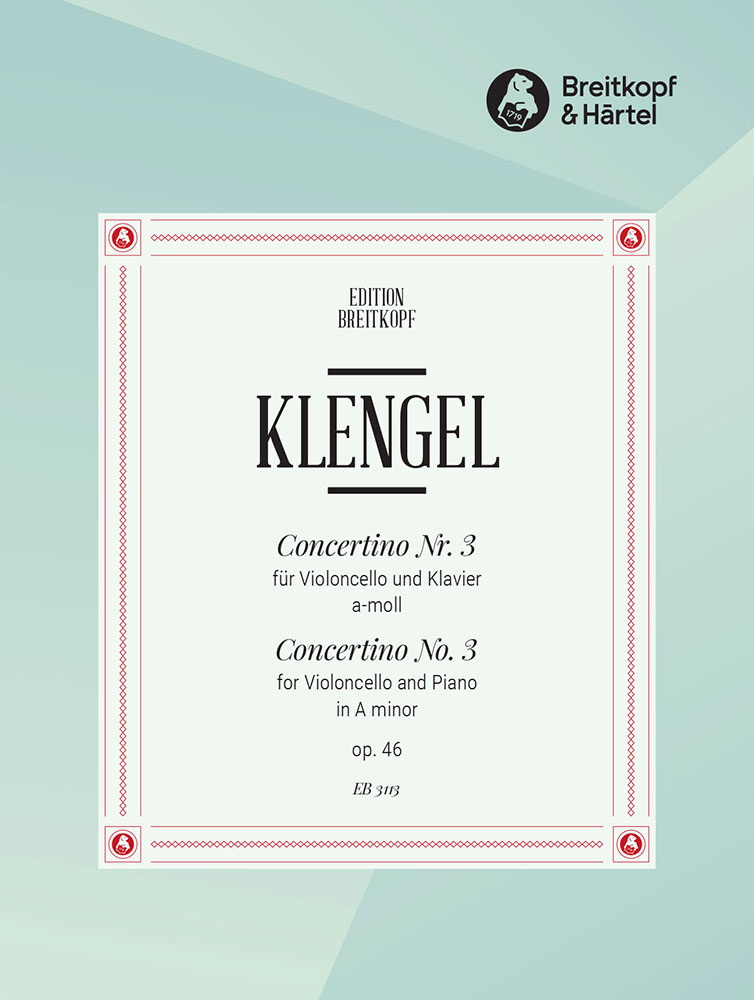
The Concertino No. 3 in A minor Op. 46 showcases Klengel’s lyrical style and technical finesse, making it a favourite among cellists seeking repertoire that…
The piece is divided into three contrasting movements:
I. Allegro non troppo – A moderately fast opening with a lyrical theme and expressive phrasing.
II. Andante – A slower, more introspective middle movement that highlights the cello’s singing tone.
III. Finale: Vivace – A lively and spirited conclusion that demands agility and flair from the performer.
The musical characteristics show melodic richness typical of Klengel’s writing. There is an emphasis on the cello’s vocal qualities, especially in the Andante. While not as challenging as a full concerto, the piece requires solid technique and musical maturity.
This concertino is a gem for intermediate to advanced cellists and a delightful addition to recital programs. If you’re exploring Romantic cello repertoire beyond the usual giants like Saint-Saëns or Elgar, Klengel’s Op. 46 offers a fresh and rewarding experience. Would you like help finding similar pieces or sheet music for practice?
R.R.P £18.00
Our Price: £15.00
Digital Download – PDF
Shipping costs: No shipping
Please create and forward a copy of this publication to the customer
Your basket is currently empty!
Notifications