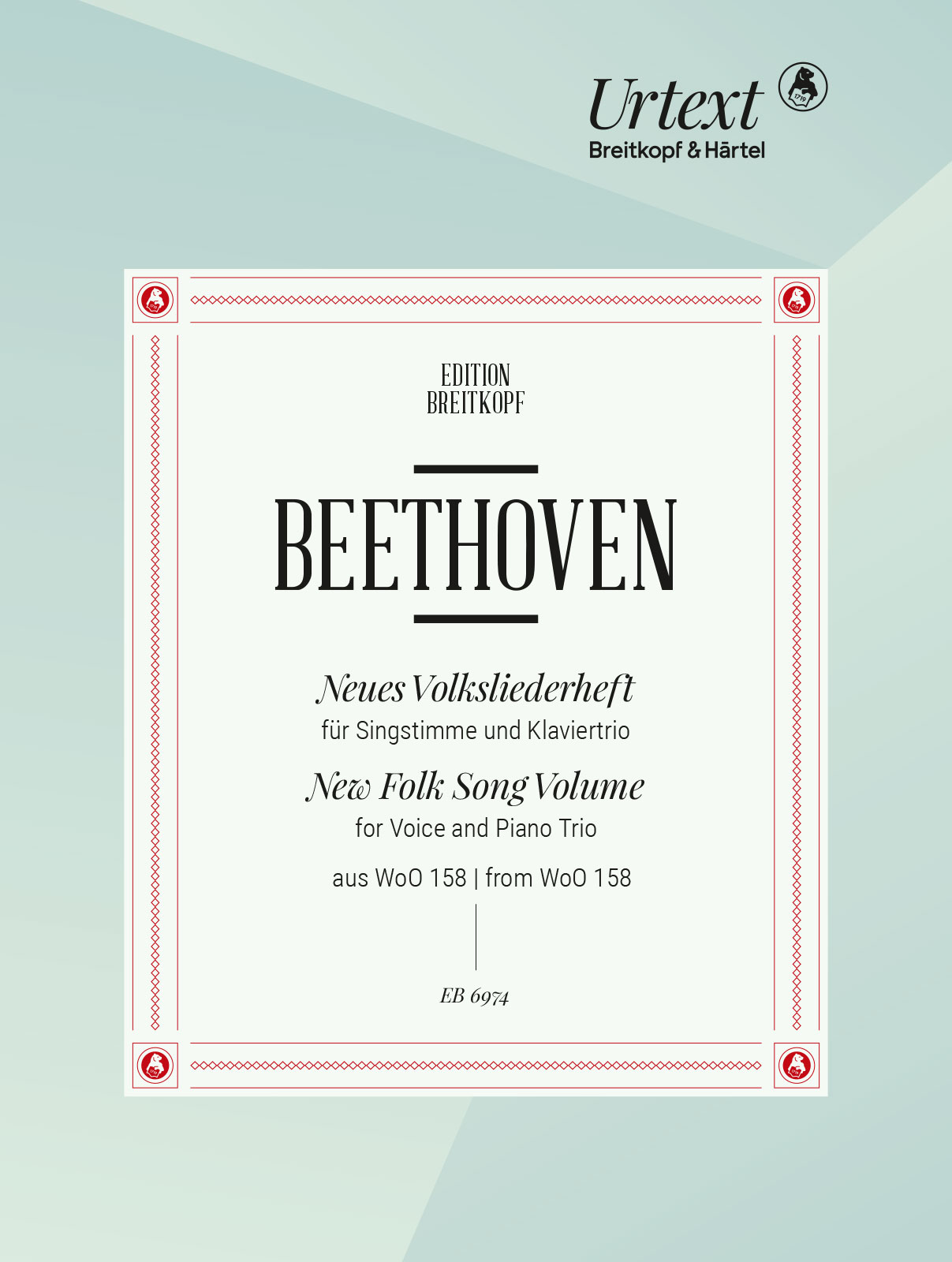
New Folk Song Volume WoO 158
“Songs of Various Nationalities”
Digital Download – PDF
R.R.P £47.00
Our Price: £39.95
Composer: Beethoven, Ludwig van
Instrumentation: Voice, Violin, Cello, Piano
Editor: Schunemann, Georg
Publisher Breitkopf and Hartel
About: Beethoven, Ludwig van
Beethoven, Ludwig van
Ludwig van Beethoven was a German composer and pianist, a pivotal figure in the transition between the Classical and Romantic eras in classical music. He was baptized on December 17, 1770, in Bonn, Germany, and died on March 26, 1827, in Vienna, Austria.
Beethoven is widely regarded as one of the greatest composers in the history of Western music. His works rank among the most performed pieces in the classical music repertoire. His career is conventionally divided into early, middle, and late periods. The early period, where he honed his craft, is typically considered to have lasted until 1802. His middle period, sometimes characterized as “heroic,” showed individual development from the styles of Joseph Haydn and Wolfgang Amadeus Mozart and lasted until around 18. During this time, Beethoven began to grow increasingly deaf. His late period, from 1812 to his death, extended his innovations in musical form and expression.
Some of his most notable works include the Symphony No. 5 in C Minor, the Symphony No. 9 in D Minor with the famous “Ode to Joy,” the “Moonlight” Sonata, the “Emperor” Concerto, and the “Archduke” Trio. His only opera, Fidelio, was first performed in 1805 and revised to its final version in 1814.
Beethoven’s personal life was marked by struggles, including his gradual hearing loss, which led to total deafness. Despite this, he continued to compose masterpieces, and his music remains a testament to his genius and the enduring power of human creativity.
Beethoven's New Folk Song Volume WoO 158 is a collection of songs composed between 1802 and 1809. These songs were written for voice and piano,…