| Product Code: | RMD1676 |
| Publishers Number: | RMD1676 |
| Published date:: | 08-Oct-25 |
| Language: | English |
| Page count: | 7 |
| Condition: | New |
David’s collaborative work gained him a prestigious award from the David Walter Charitable Trust of New York for his pioneering activities as a soloist, teacher, publisher, and commissioner of new music for double bass and he works with composers throughout the world to expand the double bass repertoire by commissioning new music and by rediscovering forgotten ones. Since 1983 more than 700 works have been written for him, music from one to twenty basses and from beginner to virtuoso, and he has premiered ten contemporary concertos with orchestra.
David began to compose in 2013 and has had music performed and recorded in 29 countries across five continents. He is a D’Addario Performing Artist and has recently commissioned a solo double bass from British master-luthier Martin Penning.
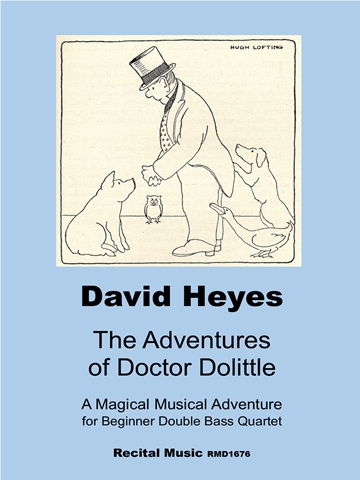
The Adventures of Doctor Dolittle is a fun, colourful and action-packed suite of seven pieces for young bassists, playable by quartet or larger forces and…
1. Puddleby-on-the-Marsh
Doctor Dolittle lives in the fictional town of Puddleby-on-the-Marsh in England’s West Country. He is a doctor but soon realises that he prefers to treat sick animals, acquiring an amazing menagerie which inhabit his house and garden and quickly horrifies and discourages his human patients. He is able to speak the language of all manner of animals and travels the world in a series of exciting adventures.
Puddleby-on-the-Marsh is a lively and bustling town and this piece depicts Market Day with the noises of stallholders advertising their wares, children running around and playing, friends gossiping and laughing, animal noises, all typical of life on an ordinary day in a very ordinary English town.
2. Polynesia
Polynesia is an African grey parrot who is both intelligent and very wise. She taught Doctor Dolittle how to speak to the animals and, although she is very old, she cannot quite remember her exact age. “I can never be quite sure of my age” she tells the Doctor, “It’s either a hundred and eighty-three or a hundred and eighty-two.” This piece has an elegant and relaxed waltz-like feel and imagines Polynesia climbing slowly but also swaying gently in time to the music.
3. Sailing to Africa
Doctor Dolittle’s fame quickly spread throughout the animal world and one day he was summoned to Africa to help cure an illness which was affecting the monkey kingdom. The sea journey took six weeks and Sailing to Africa tells of their lively and exciting adventure across the ocean before being shipwrecked on the African coast.
4. Pushmi-Pullyu
The Pushmi-Pullyu [pronounced: push me – pull you] is now extinct and has no tail but a head at each end with sharp horns on each head. It was said to be related to
the Abyssinian Gazelles and the Asiatic Chamois on its mother’s side and its father’s great-grandfather was the last of the Unicorns. Both heads could talk but it only uses one head to do so and confirms “I keep the other mouth for eating – mostly. In that way I can talk while I am eating without being rude. Our people have always been very polite.” The Pushmi-Pullyu moves slowly and gracefully and the music portrays its elegance and style, using a series of fifths to suggest the two heads working as one.
5. The Pirate Ship
On the return journey from Africa Doctor Dolittle and his menagerie are attacked by pirates but they eventually capture a pirate ship loaded with treasure. The music is exciting and dramatic, with powerful driving rhythms and great energy, using Bartok pizzicato to sound like gunfire, with eventual success as the pirates are repelled.
6. The Great Glass Sea Snail
Doctor Dolittle and his friends are transported from the mysterious floating Spider Monkey Island back to Puddleby-on-the-Marsh by the Great Glass Sea Snail which has a transparent airtight shell. The music is dignified and mysterious, using sul ponticello and harmonics to create an eerie and ethereal sound world, alongside the use of long bass notes slowly bringing the long journey to an end.
7. Doctor Dolittle’s Triumphant Return
After many adventures in Africa and also capturing a pirate ship, Doctor Dolittle returns to England. He tours with a circus, exhibiting the Pushmi-Pullyu, and makes enough money to retire to his beloved home in Puddleby-on-the-Marsh. The music is triumphal and martial, upbeat and energetic, bringing the suite to a spirited, animated and successful conclusion.
COMPOSER’S NOTE: The movements can be played in any number or order and teachers should feel free to change any bowing or dynamic to make the music more accessible to their students. Many of my beginner quartets were composed for my own students, who have always been adventurous and intrepid in their approach to new music, and much repetition is used to develop a range of musical and technical skills. Feel free to add repeats or shorten the slower pieces as feels appropriate for your students.
A brief description of each movement (above) can be used to introduce each piece, spoken by the bassists or teacher, and my aim is always to write music which is both player and audience friendly and also to introduce young bassists to the magical world of chamber music. Enjoy! [David Heyes, October 2025]
R.R.P £11.50
Our Price: £9.20
Shipping costs: No Shipping
Your basket is currently empty!
Notifications