Composer Category: 20th Century

  • Bantock, Granville

    1868-1946

    A prolific British composer, writing in most genres, alongside a successful career as a conductor and Professor of Music. He became Principal of the Birmingham and Midland Institute School of Music in 1900, succeeded Edward Elgar as Peyton Professor of Music at University of Birmingham (1908-34), and was influential in founding the City of Birmingham Orchestra (later the City of Birmingham Orchestra).

    Much of Bantock’s orchestral music has been recorded in recent years but is unjustly neglected today and certainly worthy of revival. Impressive and monumental symphonies brim with beautiful melodies and alongside magnificent orchestral textures and Granville Bantock may be the greatest unknown composer today.

  • Sibelius, Jean

    Jean Sibelius, born Johan Julius Christian Sibelius, was a Finnish composer of the late Romantic and early-modern periods. He was born on December 8, 1865, in Hämeenlinna, Grand Duchy of Finland, and passed away on September 20, 1957, in Järvenpää, Finland1. Sibelius is widely regarded as Finland’s greatest composer, and his music is often credited with having helped Finland develop a stronger national identity during its struggle against Russification in the late 19th century.

    Sibelius’s core oeuvre includes a set of seven symphonies, which, like his other major works, are regularly performed and recorded in Finland and around the world. His best-known compositions include Finlandia, the Karelia Suite, Valse triste, the Violin Concerto, the choral symphony Kullervo, and The Swan of Tuonela (from the Lemminkäinen Suite). His other works feature pieces inspired by nature, Nordic mythology, and the Finnish national epic, the Kalevala; over a hundred songs for voice and piano; incidental music for numerous plays; the one-act opera The Maiden in the Tower; chamber music, piano music, Masonic ritual music, and 21 publications of choral music.

    Sibelius composed prolifically until the mid-1920s, but after completing his Seventh Symphony (1924), the incidental music for The Tempest (1926), and the tone poem Tapiola (1926), he stopped producing major works in his last 30 years—a period commonly referred to as the “silence of Järvenpää”. Although he is reputed to have stopped composing, he attempted to continue writing, including abortive efforts on an eighth symphony. In later life, he wrote Masonic music and re-edited some earlier works, while retaining an active but not always favorable interest in new developments in music.

    The Finnish 100 mark note featured his image until 2002, when the euro was adopted. Since 2011, Finland has celebrated a flag flying day on December 8, the composer’s birthday, also known as the Day of Finnish Music. In 2015, in celebration of the 150th anniversary of Sibelius’s birth, a number of special concerts and events were held, especially in Helsinki, the Finnish capital.

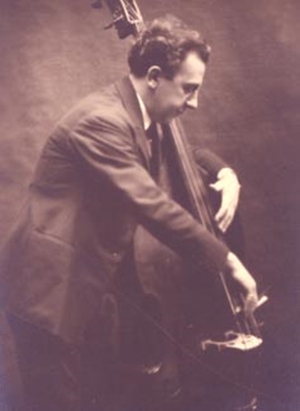
  • Nanny, Edouard

    Nanny, Edouard

    Édouard Nanny (1872-1942) was the leading French bassist of his generation, taught at the Paris Conservatoire for 20 years, and is recognised as the founder of the modern French double bass school.
    Alongside a wealth of transcriptions for double bass, Nanny also composed a series of original works which are worthy of revival in the 21st-century. His music is elegant and charming, exploiting the lyrical and technical possibilities of the double bass, and all are useful as both study and concert repertoire for the progressing bassist.
    An anniversary is a good time to reassess a composer’s work and Recital Music is planning to create new editions of a number of Nanny’s original works and transcriptions, in both tunings, this year.
    Édouard Nanny is an important figure in the development of the double bass in the first forty years of the 20th-century, particularly in France, and much of his educational music is still in print today. He made an amazing contribution to the double bass world and deserves to be celebrated and remembered.

  • Prokofiev, Serge

    Sergey Prokofiev was a 20th-century Russian (and Soviet) composer, born on April 23 (April 11, Old Style), 1891, in Sontsovka, Ukraine, then part of the Russian Empire. He passed away on March 5, 1953, in Moscow, Russia, U.S.S.R. Prokofiev was a prolific composer who wrote in a wide range of musical genres, including symphonies, concerti, film music, operas, ballets, and program pieces.

    His early life in rural Ukraine, with its peasant songs, left a lasting impression on his music. Prokofiev’s mother, a good pianist, was his first mentor in music. The Russian composer Reinhold Glière was his first teacher in theory and composition, preparing him for entrance into the St. Petersburg Conservatory.

    Prokofiev’s time at the conservatory from 1904 to 1914 was marked by rapid creative growth. His originality impressed his teachers, and upon graduation, he was awarded the Anton Rubinstein Prize in piano for a brilliant performance of his own first large-scale work—the Piano Concerto No. 1 in D-flat Major.

    He is regarded as one of the major composers of the 20th century, with works such as the March from “The Love for Three Oranges,” the suite “Lieutenant Kijé,” the ballet “Romeo and Juliet,” and “Peter and the Wolf” being widely recognized. Prokofiev’s music is known for its innovation, dissonance, and virtuosity, and he remains a significant figure in classical music history.

  • Rachmaninov, Sergei

    Sergei Vasilyevich Rachmaninov was a Russian composer, virtuoso pianist, and conductor, born on April 1, 1873, in Semyonovo, Russia, and he passed away on March 28, 1943, in Beverly Hills, California, USA. He is widely regarded as one of the finest pianists of his day and as a composer, one of the last great representatives of Romanticism in Russian classical music.

    Rachmaninov’s music is known for its song-like melodicism, expressiveness, dense contrapuntal textures, and rich orchestral colors. His compositional output prominently features the piano, and he used his skills as a performer to explore the expressive and technical possibilities of the instrument.

    His early life was marked by musical influences from his family and he began learning the piano at the age of four. He studied piano and composition at the Moscow Conservatory, graduating in 1892 with several compositions already to his name. However, the disastrous premiere of his Symphony No. 1 in 1897 led to a four-year depression during which he composed little until he completed his well-received Piano Concerto No. 2 in 1901.

    After the Russian Revolution, Rachmaninov left Russia permanently, settling in New York in 1918. He spent most of his time touring as a pianist through the US and Europe, and from 1932 onwards, he spent his summers at his villa in Switzerland. His compositional output decreased significantly after leaving Russia, completing just six works.

    Rachmaninov’s health declined by 1942, leading him to move to Beverly Hills, where he died from melanoma in 1943. Despite the challenges he faced, his legacy as a leading piano virtuoso and a major composer of the 20th century endures, with works such as the “Piano Concerto No. 2 in C Minor, Op. 18,” “Piano Concerto No. 3 in D Minor, Op. 30,” “Preludes,” “Rhapsody on a Theme of Paganini,” and “Symphonic Dances” remaining popular and frequently performed12.

The Music Realm
Privacy Overview

This website uses cookies so that we can provide you with the best user experience possible. Cookie information is stored in your browser and performs functions such as recognising you when you return to our website and helping our team to understand which sections of the website you find most interesting and useful.