Composer Category: Baroque

1600 – 1750
Known for its ornate style, counterpoint, and the development of the concerto, sonata, and opera.

  • Vivaldi, Antonio

    Antonio Vivaldi was an Italian Baroque composer, virtuoso violinist, and teacher born on March 4, 1678, in Venice1. He is best known for his contributions to the development of the concerto form and for his numerous concertos for violin and other instruments. Vivaldi’s most famous work is “The Four Seasons,” a series of violin concertos that depict scenes appropriate for each season of the year.

    Vivaldi’s early life was marked by his musical talent, which was evident from a young age. He began studying for the priesthood at the age of 15 and was ordained at 25. However, due to a health problem, he was given dispensation to no longer say public Masses.

    Throughout his career, Vivaldi composed over 500 concertos, more than 40 operas, and numerous sacred choral works. Many of his compositions were written for the all-female music ensemble of the Ospedale della Pietà, a home for abandoned children in Venice.

    Vivaldi’s influence during his lifetime was widespread across Europe, giving origin to many imitators and admirers. He pioneered developments in orchestration, violin technique, and programmatic music. Despite his success during his lifetime, Vivaldi died in poverty in Vienna on July 28, 1741.

    After almost two centuries of decline, Vivaldi’s musical reputation underwent a revival in the early 20th century. Many of his compositions, once thought lost, have been rediscovered and continue to be performed and celebrated today.
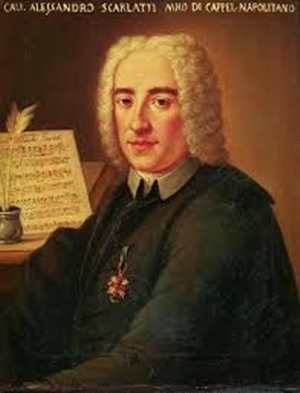
  • Scarlatti, Alessandro

    Scarlatti, Alessandro

    Alessandro Scarlatti was an Italian Baroque composer, born on May 2, 1660, in Palermo or Trapani, Sicily. He is renowned for his operas and chamber cantatas and is considered the most important representative of the Neapolitan school of opera1. Scarlatti’s career spanned both Naples and Rome, where he received his training. He is often credited with founding the Neapolitan school, although he was its most illustrious representative1.

    Scarlatti’s contributions to music were significant; he brought the Italian dramatic tradition to its peak development and designed the final form of the Da capo aria, which was imitated throughout Europe. He was also the inventor of the Italian overture in three movements and the four-part sonata, which was a precursor to the modern string quartet1.

    He was a model for musical theater during his time and influenced composers like Handel. Scarlatti’s eclectic work included genres such as sonatas, concertos, motets, masses, oratorios, and cantatas. He was also the father of two other composers, Domenico Scarlatti and Pietro Filippo Scarlatti1.

    Scarlatti passed away on October 22, 1725, in Naples1. His legacy includes more than 100 operas and a lasting influence on both Italian and European music.

  • Scarlatti, Domenico

    Giuseppe Domenico Scarlatti, also known as Domingo or Doménico Scarlatti, was an Italian composer born on October 26, 1685, in Naples. He is classified primarily as a Baroque composer, although his music was influential in the development of the Classical style. Scarlatti was the son of the renowned composer Alessandro Scarlatti and is known mainly for his 555 keyboard sonatas.

    Scarlatti spent much of his life in the service of the Portuguese and Spanish royal families. He was appointed as a composer and organist at the Chapel Royal of Naples in 1701 and briefly worked under his father, who was then the chapel’s maestro di cappella. In 1703, he revised Carlo Francesco Pollarolo’s opera “Irene” for performance at Naples.

    After moving to Rome in 1709, Scarlatti entered the service of the exiled Polish queen Marie Casimira and met Thomas Roseingrave. He was already an accomplished harpsichordist and composed several operas for Queen Casimir’s private theatre. He held the position of Maestro di Cappella at St. Peter’s from 1715 to 1719.

    Scarlatti’s later life included positions in Lisbon, Seville, and Madrid, where he became a music master to Princess Maria Barbara, who had married into the Spanish royal house. He passed away on July 23, 1757, in Madrid.

  • Purcell, Henry

    Henry Purcell was an English composer of Baroque music, born around September 10, 1659, in Westminster, London, England. He passed away on November 21, 1695, in Marsham Street, London1. Purcell’s musical style was uniquely English, though it incorporated Italian and French elements. He is generally considered one of the greatest English opera composers and is often assessed alongside John Dunstaple and William Byrd as one of England’s most important early music composers.

    Purcell’s father was a gentleman of the Chapel Royal and sang at the coronation of King Charles II of England. After his father’s death in 1664, Purcell was placed under the guardianship of his uncle Thomas, who showed him great affection and kindness. Thomas arranged for Henry to be admitted as a chorister, where he studied first under Captain Henry Cooke, Master of the Children, and afterwards under Pelham Humfrey, Cooke’s successor, who was a pupil of Lully.

    Purcell is said to have been composing at nine years old, but the earliest work that can be certainly identified as his is an ode for the King’s birthday, written in 1670. His compositions include more than 100 songs, the tragic opera Dido and Aeneas, and his incidental music to a version of Shakespeare’s A Midsummer Night’s Dream called The Fairy Queen12.

    In 1677, Purcell succeeded Matthew Locke as the composer for Charles II’s string orchestra and in 1679 was appointed organist of Westminster Abbey in succession to John Blow. A further appointment as one of the three organists of the Chapel Royal followed in 1682. He retained all his official posts through the reigns of James II and William III and Mary2.

    Purcell married in 1680 or 1681 and had at least six children, three of whom died in infancy. His son Edward was also a musician, as was Edward’s son Edward Henry (died 1765). Purcell seems to have spent all his life in Westminster. A fatal illness prevented him from finishing the music for the operatic version of John Dryden and Sir Robert Howard’s verse tragedy The Indian Queen (1664), which was completed after his death by his brother Daniel2.

    Purcell’s legacy includes a vast array of compositions that have had a lasting impact on English music and are still celebrated today for their originality and inventiveness.

The Music Realm
Privacy Overview

This website uses cookies so that we can provide you with the best user experience possible. Cookie information is stored in your browser and performs functions such as recognising you when you return to our website and helping our team to understand which sections of the website you find most interesting and useful.