Archives: Composers

  • Popper, David

    David Popper (1843-1913), a leading cello virtuoso of his day, was born in Prague, studied cello at the Prague Conservatoire with Julius Goltermann, subsequently toured throughout Europe as a soloist and became principal cellist of the Vienna Court Opera. He also performed as a chamber musician with Johannes Brahms, Jenő Hubay, Emil Sauret and Clara Schumann amongst others.

    Popper was a prolific composer of cello music and his High School of Cello Playing Op.73, comprising forty etudes have remained essential study repertoire for more than a century and Pablo Casals declared that “no other composer wrote better for the instrument”.

    Music publishers are rarely heaped with praise by composers, usually the exact opposite, so it is nice to discover a piece which commemorates the death of a publisher who was obviously also a good friend.

    Daniel Rahter (1828-1891) initially managed the A. Büttner music publishing house in St. Petersburg before setting up his own publishing company in his native Hamburg in 1879. He was a great admirer of Tchaikovsky’s music and in 1888

  • Nanny, Edouard

    Nanny, Edouard

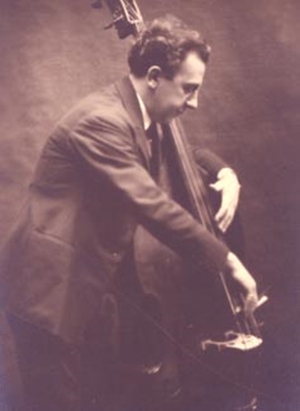
    Édouard Nanny (1872-1942) was the leading French bassist of his generation, taught at the Paris Conservatoire for 20 years, and is recognised as the founder of the modern French double bass school.
    Alongside a wealth of transcriptions for double bass, Nanny also composed a series of original works which are worthy of revival in the 21st-century. His music is elegant and charming, exploiting the lyrical and technical possibilities of the double bass, and all are useful as both study and concert repertoire for the progressing bassist.
    An anniversary is a good time to reassess a composer’s work and Recital Music is planning to create new editions of a number of Nanny’s original works and transcriptions, in both tunings, this year.
    Édouard Nanny is an important figure in the development of the double bass in the first forty years of the 20th-century, particularly in France, and much of his educational music is still in print today. He made an amazing contribution to the double bass world and deserves to be celebrated and remembered.

  • Lotter, Adolf

    Adolf Lotter was born in Prague on 4 December 1871 and studied double bass with František Černý, and composition with Antonín Dvořák, at the Prague Conservatoire.

    He lived in London from 1894, until his death in 1942, and quickly established himself as one of the leading bassists of his generation, performing with many of the famous conductors of the day including Sir Henry Wood, Richard Strauss, Weingartner, and Sir Thomas Beecham.

    Lotter was a member of the Queen’s Hall Orchestra for over thirty years (1898- 1930), becoming Principal Bass in 1911, and also played with the London Symphony Orchestra, London String Players, Guildford Symphony Orchestra, and Glyndebourne Festival Orchestra (1935-36).

  • Puccini, Giacomo

    Giacomo Puccini was an Italian composer born on December 22, 1858, in Lucca, Tuscany, Italy. He is widely regarded as one of the greatest exponents of operatic realism and is known for bringing the history of Italian opera to a close with his works. Puccini’s most famous operas include “La Bohème” (1896), “Tosca” (1900), “Madama Butterfly” (1904), and “Turandot” (1924), which was left incomplete at his death. His music is celebrated for its melodic richness and dramatic depth.

    Puccini came from a family with a long tradition of music; he was the sixth of nine children of Michele Puccini and Albina Magi. His family had been the musical directors of the Cathedral of San Martino in Lucca for two centuries. After the death of his father, the municipality of Lucca supported the family and reserved the position of cathedral organist for Giacomo until he came of age. He first studied music with his father’s former pupils and played the organ in local churches.

    A pivotal moment in Puccini’s life was witnessing a performance of Giuseppe Verdi’s “Aida” in 1876, which convinced him that his true calling was opera. He later attended the Milan Conservatory, where he studied under Antonio Bazzini and Amilcare Ponchielli. His graduation composition, “Capriccio sinfonico,” garnered attention in Milan’s musical circles.

    Puccini’s career spanned the late Romantic period into the early modern era of opera. His works are characterized by their emotional intensity, intricate vocal writing, and incorporation of verismo elements—a style focused on realism and everyday subjects.

    He passed away on November 29, 1924, in Brussels, Belgium, leaving behind a legacy that continues to resonate in opera houses around the world

  • Montgomery, Michael

    Double bassist Michael Montgomery, a student of Robert Rohe (Principal Bass, New Orleans Symphony) and Lucas Drew (Principal Bass, Miami Philharmonic), earned his Doctor of Musical Arts degree in double bass performance from the University of Miami, played full-time in the bass section of the Florida Philharmonic Orchestra for two decades.

    He now lives in the Ozark Mountains of Arkansas, where he teaches double bass at the University of Arkansas Fayetteville and privately in his home studio. Michael has composed numerous works for young double bassists (including over five dozen short bass quartets for young students) which are published by Recital Music and two American publishers.

    His articles about bass performance, literature, and teaching have been published in American Suzuki Journal, Bass World, and Pastoral Music.

  • Rae, Mary

    Mary Rae was born in Washington D.C. in 1951 and grew up in Virginia. She studied flute and voice in Boston and, at the same time, received a BA in Spanish Languages and Literature from Boston University. Mary has always been interested in composition, and devised for herself a course of self-study. Aside from writing for double bass, she particularly likes writing for voice and piano and her works have been premiered in the United States, Great Britain and elsewhere.

    Mary Rae is currently involved in the revitalisation efforts for the Cherokee language, which is severely endangered, as most indigenous languages are. She has studied the language for a number of years, and recently achieved teacher certification from the Cherokee Nation in Oklahoma, something which is rare for second language learners. Mary has been working at writing settings for Cherokee hymns with the aim of uniting two of her great interests.

  • O’Neill, Norman

    Norman O’Neill (1875-1934) was the leading British theatrical composer in the 1920s and 30s. He composed music for more than 50 plays, notably by J.M. Barrie, Shakespeare, A.A. Milne, Ibsen, Walter Scott and Ashley Dukes, showing a remarkable aptitude for devising music which enhanced a situation and reflected the stage characters. He studied with Arthur Somervell and subsequently with Iwan Knorr in Frankfurt, alongside fellow students Balfour Gardiner, Percy Grainger, Cyril Scott and Roger Quilter – subsequently nicknamed ‘the Frankfurt gang’. O’Neill was Musical Director of the Haymarket Theatre (London) from 1908-19 and returned there in 1920 for the production of J.M. Barrie’s ‘Mary Rose’ – one of his most successful scores.

  • Massenet, Jules

    Jules Massenet was a French composer of the Romantic era, celebrated for his operas, which were very popular in the late 19th and early 20th centuries.

    Born: May 12, 1842, in Montaud, near Saint-Étienne, France
    Died: August 13, 1912, in Paris, France
    Massenet was the youngest child of a prosperous ironmonger and a talented amateur musician mother who gave him his first piano lessons. His family moved to Paris when he was young, where he later entered the Paris Conservatoire at age 11. He studied under Ambroise Thomas, whom he greatly admired, and won the prestigious Prix de Rome in 1863 with his cantata “David Rizzio.”

    His operatic career began with the production of “La Grand’ Tante” in 1867, and he went on to compose more than thirty operas. The most frequently staged are “Manon” (1884) and “Werther” (1892). Massenet’s music is known for its lyricism, sensuality, and theatrical aptness.

    Massenet had a keen sense of theatre and what would succeed with the Parisian public. Despite some miscalculations, he produced a series of successes that made him the leading composer of opera in France during his time. He also became a professor at the Conservatoire, teaching composition from 1878 until 1896.

    Among his students were notable composers like Gustave Charpentier, Ernest Chausson, Reynaldo Hahn, and Gabriel Pierné. After his death, Massenet’s works were somewhat neglected but have since been reassessed and many of them have been staged and recorded. His operas are now accepted as well-crafted and intelligent products of the Belle Époque12.

    Massenet’s legacy includes a wide variety of music, including oratorios, ballets, orchestral works, incidental music, piano pieces, songs, and, of course, his operas, which continue to be performed worldwide1. His “Méditation” from “Thaïs” remains part of the standard violin repertoire

  • Monteverdi, Claudio

    Monteverdi, Claudio

    Claudio Monteverdi was an Italian composer, choirmaster, and string player, born on May 15, 1567, in Cremona1. He is considered a crucial transitional figure between the Renaissance and Baroque periods of music history1. Monteverdi’s work includes both secular and sacred music, and he is particularly noted for his contributions to the development of opera.

    Monteverdi’s early career was marked by his employment at the court of Mantua, where he developed his style and composed many of his early works. His opera “L’Orfeo” (1607) is one of the earliest operas still regularly performed today. Later in his career, he moved to Venice, where he became maestro di cappella at the basilica of San Marco and composed his final operas, including “Il ritorno d’Ulisse in patria” and “L’incoronazione di Poppea”.

    Monteverdi’s music is characterized by its expressive melodies and innovative use of harmony and orchestration. He was also a pioneer in the use of basso continuo, a technique that became a hallmark of Baroque music. His works were largely forgotten during the eighteenth and much of the nineteenth centuries but experienced a revival in the early twentieth century. Today, Monteverdi is recognized as one of the most important composers in Western music history.

  • Mahler, Gustav

    Gustav Mahler was an Austro-Bohemian Romantic composer and one of the leading conductors of his generation. He was born on July 7, 1860, in Kaliště, Bohemia, then part of the Austrian Empire, and passed away on May 18, 1911, in Vienna, Austria1. Mahler’s compositions act as a bridge between the 19th-century Austro-German tradition and the modernism of the early 20th century.

    As a composer, Mahler’s status was established beyond question only after periods of relative neglect, which included a ban on its performance during the Nazi era. His music gained wide popularity after 1945 and he became one of the most frequently performed and recorded composers, a position he has sustained into the 21st century.

    Mahler displayed his musical gifts at an early age. After graduating from the Vienna Conservatory in 1878, he held a succession of conducting posts of rising importance in the opera houses of Europe, culminating in his appointment in 1897 as director of the Vienna Court Opera (Hofoper). During his ten years in Vienna, Mahler, who had converted to Catholicism to secure the post, experienced regular opposition and hostility from the anti-Semitic press.

    His oeuvre is relatively limited; for much of his life, composing was a part-time activity while he earned his living as a conductor. His works are generally designed for large orchestral forces, symphonic choruses, and operatic soloists. These works were frequently controversial when first performed, and several were slow to receive critical and popular approval; exceptions included his Second Symphony and the triumphant premiere of his Eighth Symphony in 1910.

    Mahler’s immediate musical successors included the composers of the Second Viennese School, notably Arnold Schoenberg, Alban Berg, and Anton Webern. Later 20th-century composers who admired and were influenced by Mahler include Dmitri Shostakovich and Benjamin Britten. The International Gustav Mahler Society was established in 1955 to honor the composer’s life and achievements.

The Music Realm
Privacy Overview

This website uses cookies so that we can provide you with the best user experience possible. Cookie information is stored in your browser and performs functions such as recognising you when you return to our website and helping our team to understand which sections of the website you find most interesting and useful.