Archives: Composers

  • Garcia, Simon

    Bassist and composer Simón García was born in Mugardos (Spain) in 1977 and graduated in double bass from the Conservatorio Superior of Salamanca. He has worked as a double bassist in the Royal Orchestra of Galicia, having also performed in many orchestras throughout Spain, and is the bassist in the Symphony Wind Orchestra of A. Coruna. He has collaborated with many musicians and ensembles, particularly in the field of contemporary music, and has recorded and performed on many commercial recordings and for television and radio broadcasts.

    Simón has composed more than sixty works for double bass, ranging from one to twelve players, alongside transcriptions of these pieces for various chamber ensembles. His music has been performed in Mexico, Venezuela, Uruguay, Denmark, Spain, Japan, Italy, Austria, Germany, Canada, USA, and UK by The Bass Gang, Bass Instinct, and Il Quint-etto amongst others.

  • Gajdos, Miloslav

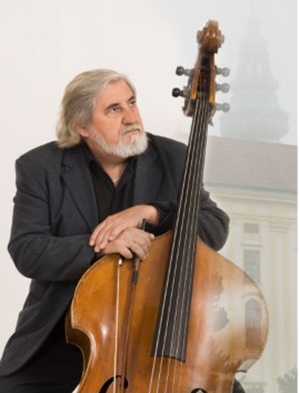
    Gajdos, Miloslav

    Miloslav Gajdoš is one of Europe’s most active and inventive bassist-composers. He was born in northern Moravia in 1948 and initially learned violin before transferring to the double bass, studying with Alois Kříž, Jirí Bortlícek and Ludwig Streicher.
    [Gajdoš is pronounced GUY-DOSH]

  • Kuchynka, Vojtech

    Vojtěch [Vojta] Kuchynka was born in the Czech town of Nové Strašecí on 7 May 1871. He studied double bass at the Prague Conservatoire with Vendelin Sládek (1851-1901) from 1885-91, and composition with Antonín Dvořák from 1891-93. In 1895 he was appointed 1st Double Bass and Soloist in the Orchestra of the Czechoslovak Folk Art Exhibition Orchestra, also conducted a number of choirs in the Czech capital and for a short time was the piano teacher of the family of Count Fürstenberg. Between 1899 and 1933 Kuchynka played in the National Theatre Orchestra in Prague and from time to time worked with the famous Czech Quartet.

    He gave solo recitals until the day of his retirement when he celebrated his 600th recital, and was known as ‘the Kubelík of the Double Bass’, after the leading Czech violinist of the day Jan Kubelík (1880-1940). He was praised for his perfect technique, impressive harmonic work, interpretation and tasteful transcriptions of classical works. Most of his recitals were in Bohemia or Moravia and one concert in Prague, reviewed in The Strad by Miss Windust, stated “Alongside the brilliant performances of František Ondříček and Karel Hoffmann it was the admirable virtuosity of Vojta Kuchynka that made the deepest impression on me.” He made the first Czech double bass recording for Parlophon, and Prague Radio broadcast recitals of his music to celebrate his 65th and 70th birthdays.

  • Hauta-aho, Teppo

    Teppo Hauta-aho (1941-2001) was the most prolific composer in the history of the double bass and composed for every ability level, from the beginner to the virtuoso. His music is evocative and atmospheric, shaped by jazz and contemporary styles, and the influence of the dramatic and bleak landscapes and vistas of his native Finland are captured throughout his engaging and accessible music.

  • Gipps, Ruth

    Ruth Gipps was born in Bexhill-on-Sea (UK) on 20 February 1921 and by the age of ten she was playing piano concertos with local orchestras and her first compositions were published in 1929. At the age of 15 she was awarded a place at the Royal College of Music, London to study composition with R.O. Morris and Ralph Vaughan Williams, oboe with Leon Goossens, and piano with Arthur Alexander and Kendall Taylor. She won a number of composition prizes at this time and her tone poem ‘Knight in Armour’ was conducted by Sir Henry Wood at the Last Night of the Proms in 1942.

    She played oboe and cor anglais with the City of Birmingham Symphony Orchestra (1944-5) and subsequently began a conducting career which was certainly an unusual step for a woman in the 1940s and 50s. Undaunted, she founded the London Repertoire Orchestra in 1955, which she ran until 1986, the London Chanticleer Orchestra in 1961, and was offered conducting work with the London Symphony Orchestra, Boyd Neel Orchestra and Pro Arte Orchestra.

    Alongside her conducting and composing commitments, Ruth Gipps spent much of her life as a Professor of composition and harmony, including appointments at Trinity College of Music (1960-66), Royal College of Music (1967-77) and from 1977 as Senior Lecturer in Music at Kingston Polytechnic (now University). In 1967 she became the second woman to chair the Composers’ Guild of Great Britain and was awarded an MBE in 1981.

    Dr. Jill Halstead, a leading academic writes: ‘Stylistically her work parallels the other British composers of her generation who were influenced by the folk song revival and the new Franco-Russian movement. Her style is easily accessible and rich in character, marked by use of highly melodic tonal/modal themes and vibrant orchestration; harmonically her work can be chromatically complex yet never fully leaves the realms of tonality.’

    Ruth Gipps died on 23 February 1999 at the age of 78.

  • Funk, Eric

    Eric Funk (b.1949) has composed 170 major works, one third of which were commissioned, including nine symphonies, four operas, nineteen concertos, six string quartets, numerous large and small choral works and chamber works.

    His music has been recorded and performed by Warsaw Philharmonic, Czech Radio Symphony Orchestra, Latvian National Symphony Orchestra, Moscow String

    Quartet, Moyzes String Quartet, Elizabeth Croy (soprano), Gregory Young (clarinet) and the Meritage String Quartet.

    In 2018 he was received an Emmy Award for Best Music Composition as part of the six Emmy Awards given for the Montana PBS/Scott Sterling documentary “The Violin Alone”, the 2018 American Prize in Composition “Best Concerto of the Year” (Variations on a Theme by Jan Hanus for Violin & String Orchestra), and the leading international 2018 Global Music Award with two gold medals for classical music and composition for his Piano Concerto No.1. Eric Funk teaches at the School of Music at Montana State University (USA).

  • Hegner, Ludvig

    Ludvig Hegner (1851-1923) studied theory and composition with Niels Gade and in 1884 became a member of the Danish Royal Theatre Orchestra, promoted two months later to the position of Principal Bass. Alongside his orchestral duties, Hegner also gave many solo performances, often playing his own works or those of his fellow bassist-composers such as Bottesini or Simandl, and after a solo performance in America, the New York Times compared Hegner to the great Dragonetti and Bottesini. Ludvig Hegner composed a number of works for double bass, which fall into the category of ‘characteristic’ or ‘salon’ music, and are typical of music being written and performed at the end of the 19th-century.

  • Hegner, Anton

    Anton Hegner (1861-1915) was a Danish cellist and composer and the brother of Ludvig Hegner (1851-1923), the Principal Bass of the Royal Danish Orchestra. Anton was appointed Principal Cello of the New York Symphony Orchestra by Walter Damrosch and alongside composing many works for cello – both study and recital works. The works included in ‘Bass for Beginners’ were adapted from his ‘Recreations for Young Cellists’.

  • Gregora, Frantisek

    Czech bassist-composer František Gregora (1819-1887) was Bottesini’s almost exact contemporary, albeit two years older and, although he was a respected soloist and composer his music has, on the whole, been largely forgotten.

    Born in Netolice, Bohemia on 9 January 1819, he showed early musical talent playing organ, piano, violin, flute and clarinet before transferring to the double bass. In 1844 he entered the Vienna Conservatoire where he studied double bass with Antonín Slama and composition with Gottfried Preyer.

    After graduation, Gregora returned to Bohemia and settled in Písek where he lived until his death on 27 January 1887. He became an important local musical figure as organist, choir-master and music teacher, and was soon nicknamed ‘the travelling bass virtuoso’, having given many recitals in the local area.

    František Gregora was a fairly prolific composer and his output includes sacred and secular choral music, chamber and orchestral works alongside a wealth of solo music for double bass.

  • Glinka, Mikhail

    Mikhail Glinka (1804-1857) is recognized as the father of the Russian national school and was a great influence on several generations of composers including Balakirev, Rimsky-Korsakov, Mussorgsky, Borodin, and Tchaikovsky.

    His first opera, A Life for the Tsar (1836), established him as the leading composer of the day, and its national character and folk influences helped to create a new Russian musical language.

The Music Realm
Privacy Overview

This website uses cookies so that we can provide you with the best user experience possible. Cookie information is stored in your browser and performs functions such as recognising you when you return to our website and helping our team to understand which sections of the website you find most interesting and useful.