Julius Klengel was more than just a famous cellist; he was an institution. He was compared to Paganini and was called the European Cellist-maker.
Young cellists from throughout Europe followed the pilgrim path to Leipzig in order to receive instruction from him. He toured Germany and Europe as a celebrated virtuoso and member of the Gewandhaus String Quartet but he always felt rested in Leipzig. He was born in Leipzig on September 24, 1859, and died there on October 17, 1933, and the city was the center of his artistic life.
Klengel embodied the spirit of Leipzig as a music city in its good points and on its less favorable side. When Klengel’s Cello Concerto No. 4 was printed in 1903, the “Allgemeine Musik-Zeitung” emphasized with praise those qualities that one could describe as “Leipzig virtues”: “It is a lively piece of music, saturated with temperament and melodiousness. Its great advantage over many other pieces of the same genre is that it is not only virtuoso music but also an extraordinarily fine piece of work in which the composer again shows that in his case virtuosity as a means to an end always has to subordinate itself to his thorough musical training.”
Of course, Klengel also wrote virtuoso music, a couple of little bravura pieces for cello. For the ensemble playing of his students he composed several works for four cellos and the “Hymn” for twelve Cellos still popular today. Among the larger genres he wrote four cello concertos, double concertos for two cellos and for violin and cello, a serenade for string orchestra, two string quartets, a sextet, and a piano trio.
(Peter Sarkar, translated by Susan Marie Praeder, from the booklet to “Klengel – Cello Concertos”, CD cpo, 2001)
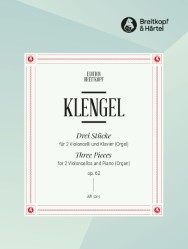
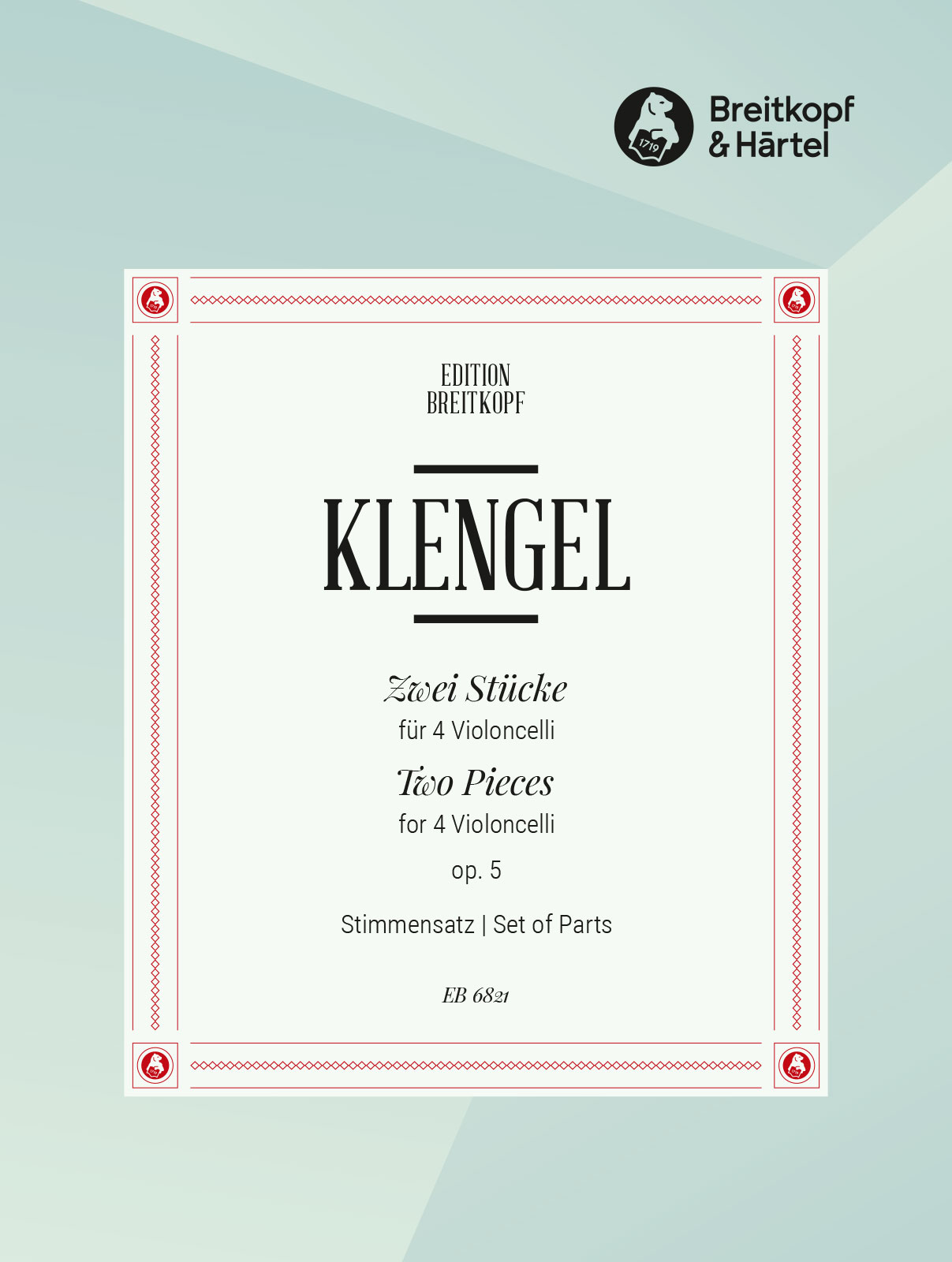
Julius Klengel’s 2 Pieces Op. 5 is a well-known work in the cello quartet repertoire. Published in 1884, it consists of two contrasting movements, the Serenade…
Julius Klengel’s 2 Pieces Op. 5 is a well-known work in the cello quartet repertoire. Published in 1884, it consists of two contrasting movements, the Serenade is a placid and melodic movement often compared to the style of Felix Mendelssohn and the Humoresque is a more spirited and technical piece, featuring a recurring single-idea motif similar to works by David Popper.
Digital Download – PDF
Shipping costs: No shipping
Please Note: This product is not fulfilled by The Music Realm Ltd. Breitkopf and Hartel have requested that all purchases are referred to them for watermarking before downloading. This usually takes 1-3 days.We regret that this means you will not be able to download your purchase immediately.
R.R.P £16.00
Our Price: £13.60
Please create and forward a copy of this publication to the customer