| Product Code: | RMD1340 |
| Publishers Number: | RMD1340 |
| Language: | English |
| Condition: | New |
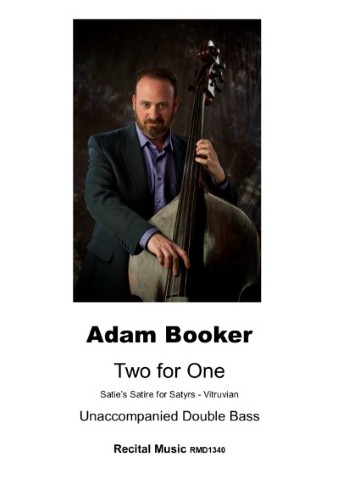
Adam Booker has presented his research in Early Jazz Double Bass Performance Techniques, and performed at the Jazz Education Network Conference in Dallas, TX, International Society of Bassists bi-annual conference in Ft. Collins, CO, and at the 2016 European Double Bass Congress in Prague, Czech Republic and the 2018 conference in Lucca, Italy.
Aside from being a sideman on numerous recordings, his first album as a leader, Unraveled Rival, was released in October of 2015 under the Shifting Paradigm Records label. His follow up record in 2018, Seven Last Worlds, is a collaboration between himself and David Heyes, juxtaposing Adam’s jazz performance and compositions with David’s masterpiece for unaccompanied double bass, Seven Last Words from the Cross. His third album, Live in Lucca, released in 2019, is a memento from a UK and Italy teaching and performing tour that occurred prior to the COVID Pandemic
Two for One brings together two impressive and inventive pieces for the intermediate double bassist. Each has a strong rhythmic momentum, exploring a wealth of…
1. Satie’s Satire for Satyrs
Written for the Syrinx Project in celebration of the centennial of Claude Debussy, Satie’s Satire for Satyrs is a nod to the special relationship between Claude Debussy and Eric Satie. The first section evokes the playful dance of Pan, with a mocking demeanour, utilising repetitive rhythmic and formal concepts from the Neo-classical movement. The middle section is played slower, with hints of Debussy’s chromaticism and the symmetrical harmonic idiom of Impressionism.
Satie’s Satire for Satyrs ends with a reprise of the first section, much as the piece, Syrinx, which inspired this project.
2. Vitruvian
Vitruvian, written for Da Vinci 500, a celebration of the great Renaissance artist, scientist, and inventor, Leonardo Da Vinci, was created by juxtaposing the circle of fifths over Da Vinci’s “Vitruvian Man.”
The resulting pitch collection yields an axis of symmetry centreed on F sharp, with a minor third in either direction, and continuing a four-note chromatic cell on either side. Essentially, C, D-flat, D Natural, E-flat—F#—A, B-flat, B natural, and C. The style, in a nod to Da Vinci’s Italian heritage, is that of a tarantella.
The piece should be performed aggressively, with a short, staccato bordering on spiccato stroke, unless otherwise specified. The challenge for the performer is allowing the notes in the lower register to speak clearly in several dynamic ranges.
[Programme notes by Adam Booker]
R.R.P £5.00
Our Price: 4
Digital Download – PDF
Shipping costs: No shipping
Your basket is currently empty!
Notifications
