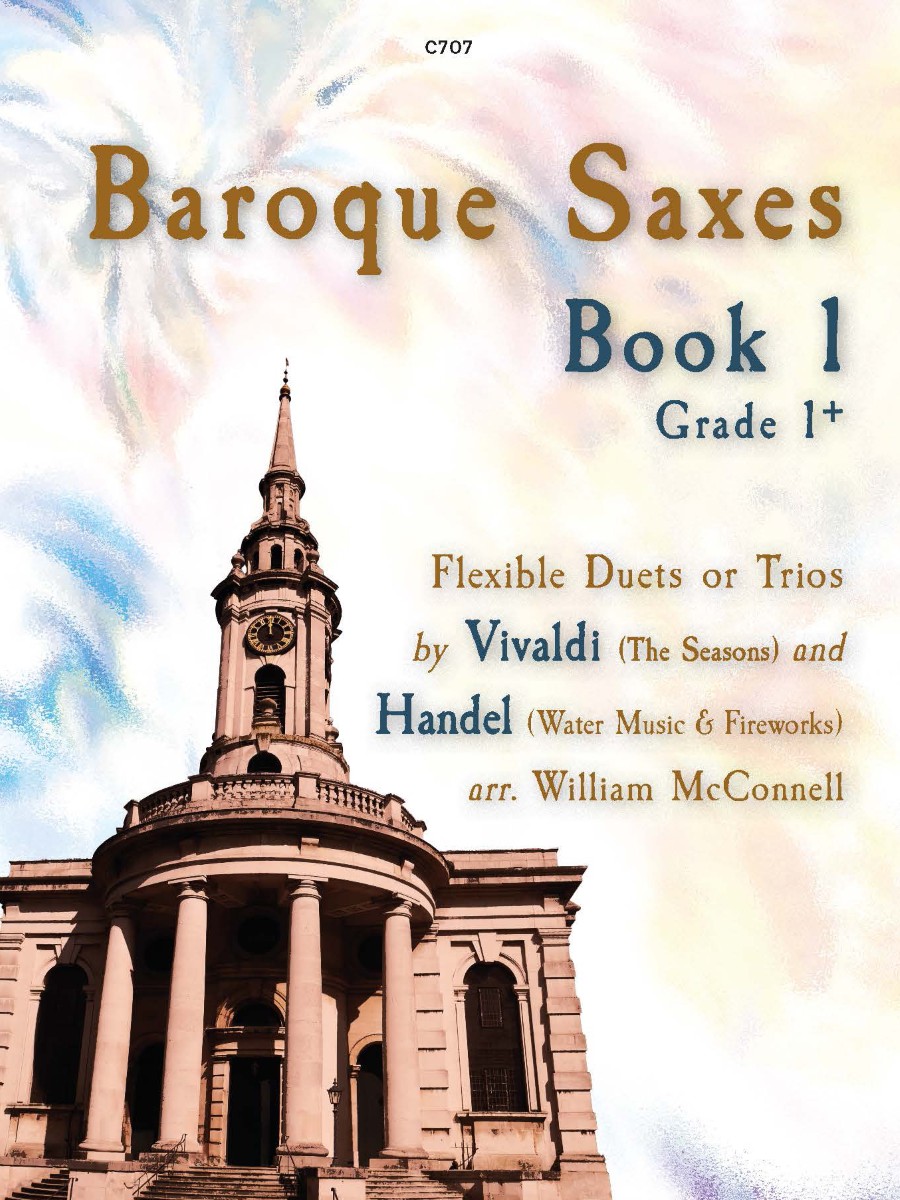
Baroque Saxes Book 1: Vivaldi and Handel
Grade 1+
Digital Download – PDF
R.R.P £11.50
Our Price: £9.78
Composer: Handel, George Frideric; Vivaldi, Antonio;
Arranger: McConnell, William
Format: Score and Parts
Publisher Clifton Edition
About the Composers
Handel, George Frideric
Georg Friedrich Händel, was a German-born English composer of the late Baroque era, celebrated for his operas, oratorios, and instrumental compositions. He was born on February 23, 1685, in Halle, Brandenburg (now Germany), and passed away on April 14, 1759, in London, England.
Handel’s music is renowned for its grandeur, dramatic qualities, and depth of expression. Notably, he composed the most famous of all oratorios, Messiah (1741), and is also known for such occasional pieces as Water Music (1717) and Music for the Royal Fireworks (1749).
His early musical education was under the composer Friedrich W. Zachow in Halle. After his father’s death, Handel enrolled as a law student at the University of Halle but quickly gravitated towards a career in music. He served as an organist at the Reformed Cathedral in Halle for a year before moving to Hamburg, where he joined the opera orchestra and presided over the premiere of his first opera, Almira.
Handel traveled in Italy from 1706 to 1710, where he met many of the greatest Italian musicians of the day, including Arcangelo Corelli and Alessandro Scarlatti. His time in Italy was prolific, resulting in two operas, numerous Italian solo cantatas, and some Latin church music.
In 1712, Handel settled in London, where he spent the bulk of his career and became a naturalized British subject in 1727. His influence was such that he started three commercial opera companies to supply the English nobility with Italian opera. After a physical breakdown in 1737, he changed direction creatively, addressing the middle class with English choral works. Following the success of Messiah in 1742, he never composed an Italian opera again.
Handel’s legacy includes more than forty operas and a wealth of other works. His music was admired by Classical-era composers, especially Mozart, Haydn, and Beethoven, and remains a cornerstone of the Western classical music canon.
Vivaldi, Antonio
Antonio Vivaldi was an Italian Baroque composer, virtuoso violinist, and teacher born on March 4, 1678, in Venice. He is best known for his contributions to the development of the concerto form and for his numerous concertos for violin and other instruments. Vivaldi’s most famous work is “The Four Seasons,” a series of violin concertos that depict scenes appropriate for each season of the year.
Vivaldi’s early life was marked by his musical talent, which was evident from a young age. He began studying for the priesthood at the age of 15 and was ordained at 25. However, due to a health problem, he was given dispensation to no longer say public Masses.
Throughout his career, Vivaldi composed over 500 concertos, more than 40 operas, and numerous sacred choral works. Many of his compositions were written for the all-female music ensemble of the Ospedale della Pietà, a home for abandoned children in Venice.
Vivaldi’s influence during his lifetime was widespread across Europe, giving origin to many imitators and admirers. He pioneered developments in orchestration, violin technique, and programmatic music. Despite his success during his lifetime, Vivaldi died in poverty in Vienna on July 28, 1741.
After almost two centuries of decline, Vivaldi’s musical reputation underwent a revival in the early 20th century. Many of his compositions, once thought lost, have been rediscovered and continue to be performed and celebrated today.
Baroque Saxes Book 1 is an arrangement for two or three saxophones by William McConnell of works by G.F. Handel and Antonio Vivaldi.
Scoring: These flexible pieces…
Page ? of ?