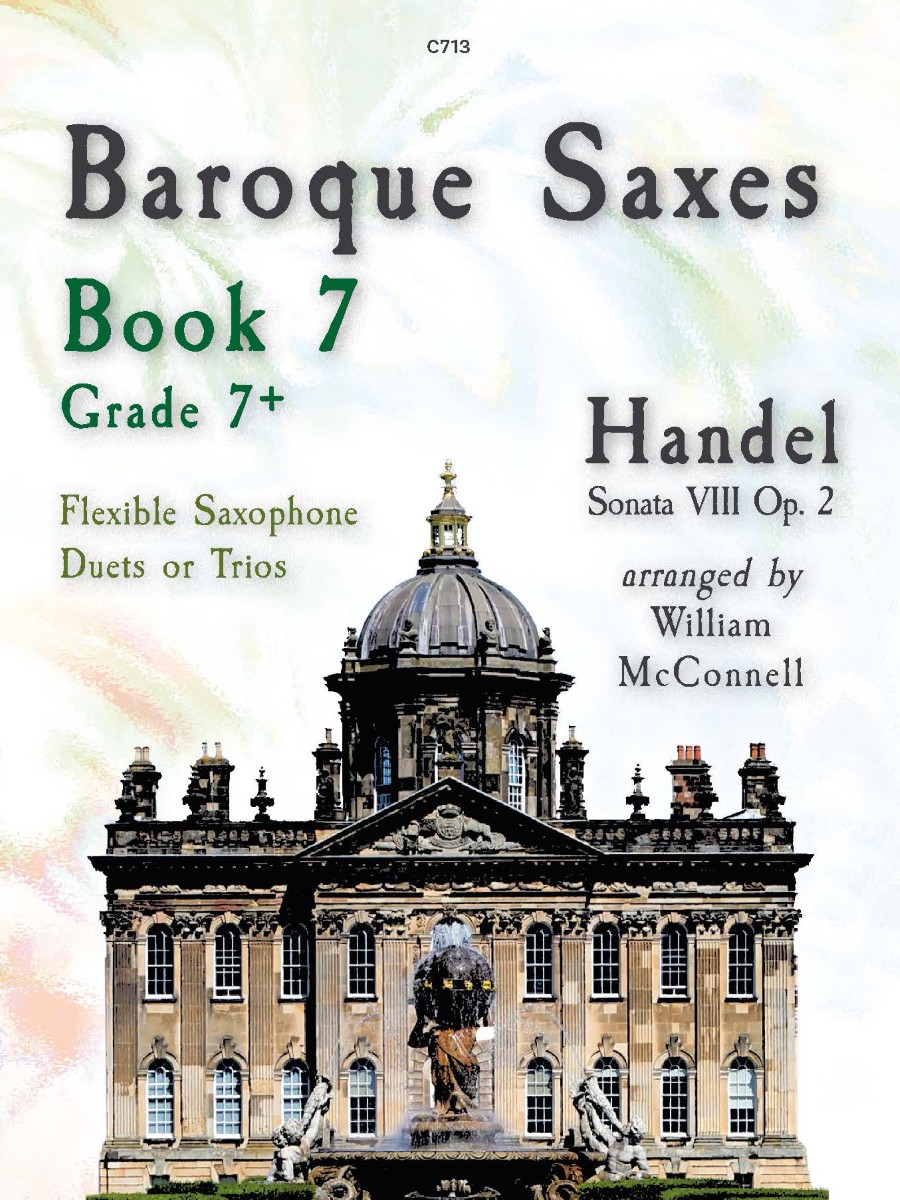
Composer: Handel, George Frideric
Arranger: McConnell, William
Arranged for: Saxophone Duet or Trio
Publisher:
| Product Code: | 979-0-570-81713-9 |
| ISMN: | 979-0-570-81713-9 |
| Publishers Number: | C713 |
| Series: | Baroque Saxes |
| Difficulty: | Grade 7+ |
| Language: | English |
| Page count: | 32 |
| Condition: | New |
Handel’s music is renowned for its grandeur, dramatic qualities, and depth of expression. Notably, he composed the most famous of all oratorios, Messiah (1741), and is also known for such occasional pieces as Water Music (1717) and Music for the Royal Fireworks (1749).
His early musical education was under the composer Friedrich W. Zachow in Halle. After his father’s death, Handel enrolled as a law student at the University of Halle but quickly gravitated towards a career in music. He served as an organist at the Reformed Cathedral in Halle for a year before moving to Hamburg, where he joined the opera orchestra and presided over the premiere of his first opera, Almira.
Handel traveled in Italy from 1706 to 1710, where he met many of the greatest Italian musicians of the day, including Arcangelo Corelli and Alessandro Scarlatti. His time in Italy was prolific, resulting in two operas, numerous Italian solo cantatas, and some Latin church music.
In 1712, Handel settled in London, where he spent the bulk of his career and became a naturalized British subject in 1727. His influence was such that he started three commercial opera companies to supply the English nobility with Italian opera. After a physical breakdown in 1737, he changed direction creatively, addressing the middle class with English choral works. Following the success of Messiah in 1742, he never composed an Italian opera again.
Handel’s legacy includes more than forty operas and a wealth of other works. His music was admired by Classical-era composers, especially Mozart, Haydn, and Beethoven, and remains a cornerstone of the Western classical music canon.
Baroque Saxes Book 7 is an arrangement for saxophones by William McConnell based on two movements from Handel’s Sonata VIII, Opus 2 originally composed for… two violins and continuo. Scoring: These flexible pieces can be played as either Duets or Trios PART 1 Bb Soprano and/or Eb Alto Saxophone PART 2 Eb Alto and/or Bb Tenor Saxophone PART 3 (optional) Eb Baritone Saxophone and/or Bassoon Previously Published by Spartan Press Former catalogue number: SP1247
R.R.P 11.5
Our Price: 9.78
Digital Download – PDF
Shipping costs: No shipping
Your basket is currently empty!
Notifications