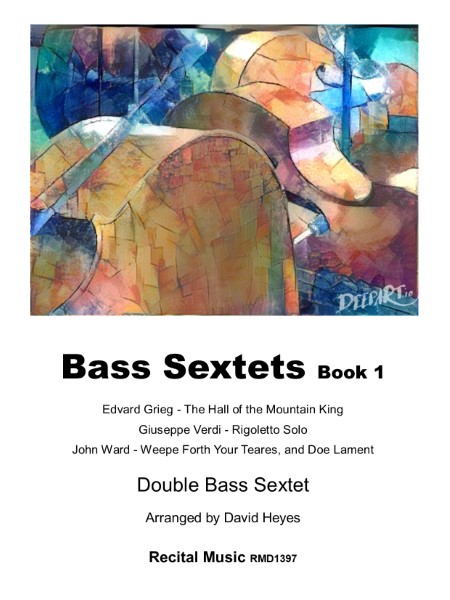
Bass Sextets Book 1
Digital Download – PDF
R.R.P £12.50
Our Price: £10.63
Composer: Grieg, Edvard; Verdi, Giuseppe; Ward, John;
Instrumentation: 4 Double Basses
Arranger: Heyes, David
Publisher Recital Music
About the Composers
Grieg, Edvard
Edvard Hagerup Grieg was a Norwegian composer and pianist born on June 15, 1843, in Bergen, Norway. He is widely considered one of the leading Romantic era composers, and his music is part of the standard classical repertoire worldwide. Grieg’s use of Norwegian folk music in his compositions brought the music of Norway to fame and helped develop a national identity, much like Jean Sibelius did in Finland and Bedřich Smetana in Bohemia.
Grieg was raised in a musical family; his mother was his first piano teacher and taught him to play when he was aged six. He studied in several schools, including Tanks Upper Secondary School. During the summer of 1858, Grieg met the eminent Norwegian violinist Ole Bull, who recognized the boy’s talent and persuaded his parents to send him to the Leipzig Conservatory.
Grieg’s later years were marked by his establishment of a home called “Troldhaugen” near Bergen, where he spent much of his time composing. He made several tours in Scandinavia, on the Continent, and in England, playing his piano concerto in London in 18882. Grieg passed away on September 4, 1907, in Bergen.
Verdi, Giuseppe
Giuseppe Fortunino Francesco Verdi was an Italian composer, one of the most influential figures in the world of opera, and a key figure in the development of the Italian Romantic movement. He was born on either October 9 or 10, 1813, in Roncole, near Busseto, in the Duchy of Parma, Italy, and passed away on January 27, 1901, in Milan, Italy.
Verdi’s early life was marked by musical education with the help of a local patron, Antonio Barezzi, and despite being rejected by the Milan Conservatory, he studied privately with Vincenzo Lavigna. His career took off after the success of his early opera Nabucco in 1842, and he became known for his sympathies with the Risorgimento movement, which sought the unification of Italy.
Throughout his career, Verdi composed many operas that remain staples of the operatic repertoire today, including Rigoletto (1851), Il trovatore (1853), La traviata (1853), Don Carlos (1867), Aida (1871), Otello (1887), and Falstaff (1893). His Requiem Mass (1874) is also a significant work in the choral repertoire.
Verdi’s later years were marked by a return to composing with three late masterpieces after the success of Aida. He became a landowner and sought a quieter life, but his music continued to be celebrated. The bicentenary of his birth in 2013 was widely commemorated, reflecting his enduring legacy in the world of classical music. His works are known for their emotional depth, memorable melodies, and dramatic character, making him a beloved composer whose music continues to be performed worldwide.
Ward, John
English composer, John Ward (1571–1638) was a contemporary of John Dowland. Born in Canterbury, he was a chorister at Canterbury Cathedral and went to London where he served Sir Henry Fanshawe both as an attorney in the Exchequer and as a musician. Ward married and had three children, moved to Essex by 1636, and died at Ilford Magna in 1638.
John Ward composed madrigals, works for viol consort, services, and anthems. His madrigals are remarkable for their fine texts, broad melodic lines and originality.
Bass Sextets Book 1 brings together three inventive and evocative works from the 17th and 19th centuries for the intermediate bass ensemble. Each pieces offers…
Page ? of ?