Ludwig van Beethoven was a German composer and pianist, a pivotal figure in the transition between the Classical and Romantic eras in classical music. He was baptized on December 17, 1770, in Bonn, Germany, and died on March 26, 1827, in Vienna, Austria.
Beethoven is widely regarded as one of the greatest composers in the history of Western music. His works rank among the most performed pieces in the classical music repertoire. His career is conventionally divided into early, middle, and late periods. The early period, where he honed his craft, is typically considered to have lasted until 1802. His middle period, sometimes characterized as “heroic,” showed individual development from the styles of Joseph Haydn and Wolfgang Amadeus Mozart and lasted until around 18. During this time, Beethoven began to grow increasingly deaf. His late period, from 1812 to his death, extended his innovations in musical form and expression.
Some of his most notable works include the Symphony No. 5 in C Minor, the Symphony No. 9 in D Minor with the famous “Ode to Joy,” the “Moonlight” Sonata, the “Emperor” Concerto, and the “Archduke” Trio. His only opera, Fidelio, was first performed in 1805 and revised to its final version in 1814.
Beethoven’s personal life was marked by struggles, including his gradual hearing loss, which led to total deafness. Despite this, he continued to compose masterpieces, and his music remains a testament to his genius and the enduring power of human creativity.
In the preface to the edition, Beethoven scholar Ernst Herttrich suggests that Beethoven composed the Violin Concerto in D major Op. 61 under immense time…
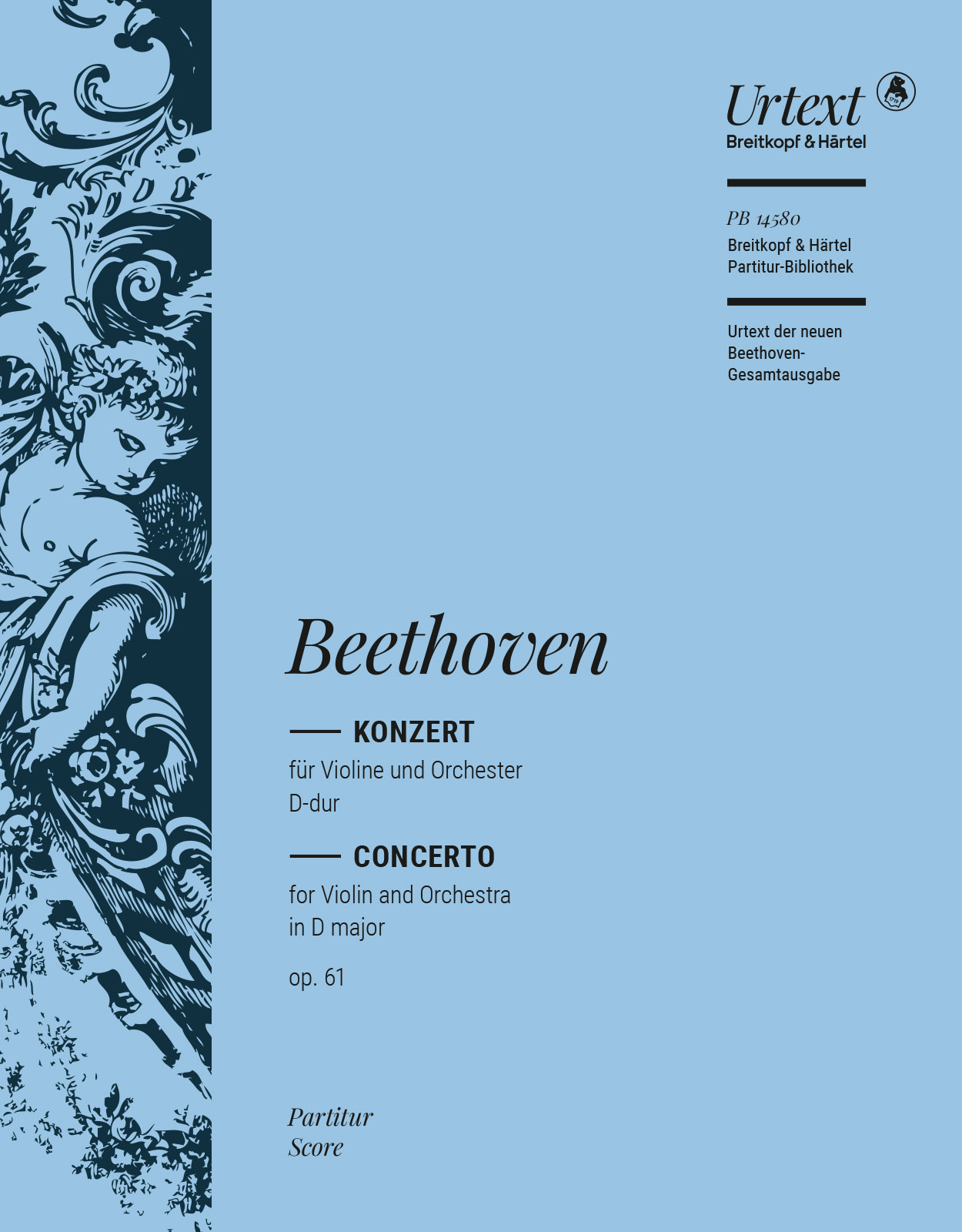
In the preface to the edition, Beethoven scholar Ernst Herttrich suggests that Beethoven composed the Violin Concerto in D major Op. 61 under immense time pressure. In the first movement of the violin concerto, the otherwise bold formal structures with artfully intertwined themes are nowhere to be found. Instead, Beethoven strings together five song-like thematic complexes almost like a potpourri.
The Violin Concerto is a testament to Beethoven’s friendship with the virtuoso Franz Clement. At a joint concert, Clement played his own violin concerto in D major. A year later, on 23 December 1806, Beethoven’s Violin Concerto in D major was premiered with Franz Clement as the soloist. According to contemporary reports, Franz Clement played the solo part at sight and without previous rehearsal. No wonder Beethoven completely reworked the solo part again after the premiere. The middle movement, a romance, is unaffected by this reworking and captivates with its delicate, aria-like character and emotional depth. A lively rondo highlights the soloist’s virtuosity with numerous figurations and provides an energetic conclusion.
Beethoven’s violin concerto was crucial for the development of the genre. Brahms’ violin concerto is unthinkable without Beethoven’s earlier example. However, Beethoven emphasizes virtuoso ornamentation in the solo part, while Brahms focuses more on the thematic permeation of the solo part.
The music text of the joint edition by Breitkopf & Härtel and G. Henle Publishers is based on the new Beethoven Complete Edition. In the preface, editor Ernst Herttrich explains the complicated history of the concerto’s origin and discusses the various versions in detail. The revised edition of this violin masterpiece also contains cadenzas by Robert D. Levin.
Urtext from the new Beethoven Complete Edition edited by Shin Augustinus Kojima.
Digital Download – PDF
Shipping costs: No shipping
Please Note: This product is not fulfilled by The Music Realm Ltd. Breitkopf and Hartel have requested that all purchases are referred to them for watermarking before downloading. This usually takes 1-3 days.We regret that this means you will not be able to download your purchase immediately.
R.R.P £57.00
Our Price: £48.45
Please create and forward a copy of this publication to the customer