Johann Sebastian Bach was a German composer and musician of the late Baroque period, born on March 31, 1685 (O.S. March 21), in Eisenach, Thuringia, Ernestine Saxon Duchies (now Germany). He passed away on July 28, 1750, in Leipzig.
Bach is now generally regarded as one of the greatest and most prolific composers of all time and is celebrated as the creator of the Brandenburg Concertos, The Well-Tempered Clavier, the Mass in B Minor, the St John and St Matthew Passions, the Christmas Oratorio and more than 300 cantatas (although only around 200 are extant. He numerous other masterpieces of church and instrumental music.
Bach’s abilities as an organist were highly respected throughout his lifetime, although he was not widely recognized as a great composer until after his death. Today, he is considered to be the master of fugue, the inventor of the solo keyboard concerto, and the greatest composer of the Baroque era.
His compositions include a wide variety of music such as orchestral music (e.g., the Brandenburg Concertos), solo instrumental works (e.g., the Cello Suites and Sonatas and Partitas for Solo Violin), keyboard works (e.g., the Goldberg Variations and The Well-Tempered Clavier), organ works (e.g., the Schübler Chorales and the Toccata and Fugue in D Minor), and choral works (e.g., the St. Matthew Passion and the Mass in B Minor).
Bach came from a highly musical family and was the last child of a city musician, Johann Ambrosius. After being orphaned at the age of 10, he lived with his eldest brother, Johann Christoph, and continued his musical education in Lüneburg. His career included working as a musician for Protestant churches in Arnstadt and Mühlhausen and at courts in Weimar and Köthen before becoming Thomaskantor (cantor at St. Thomas’s) in Leipzig.
In Leipzig, he composed music for the principal Lutheran churches of the city and for its university’s student ensemble Collegium Musicum. Despite difficult relations with his employer, Bach’s music flourished, and he enriched established German styles through his mastery of counterpoint, harmonic, and motivic organization, and his adaptation of rhythms, forms, and textures from abroad, particularly from Italy and France.
Bach’s legacy is immense, having enriched the German musical tradition and set a precedent in composition that would influence subsequent generations of composers.
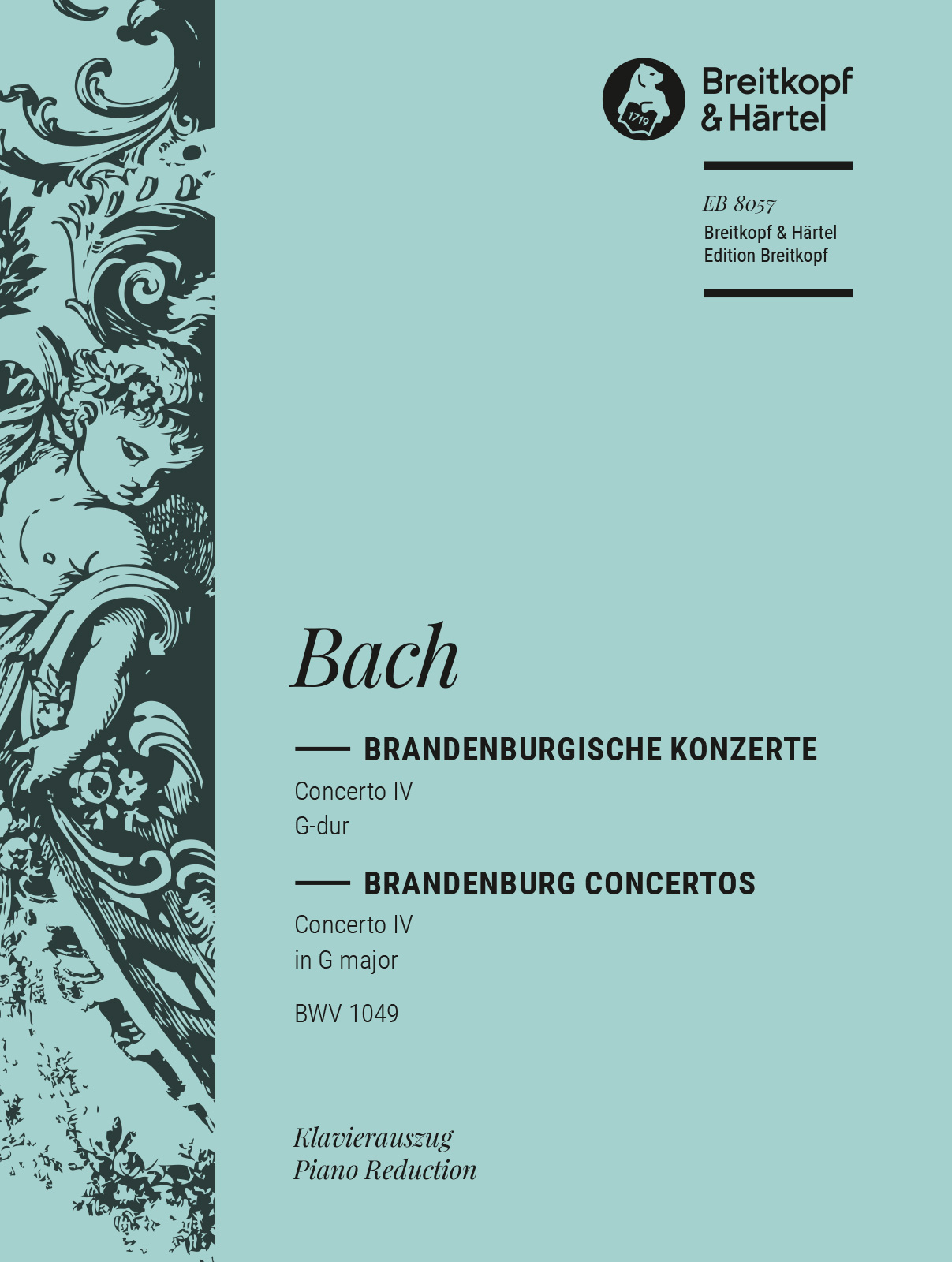
Brandenburg Concerto No. 4 in G major BWV 1049, is one of six "concertos for several instruments" dedicated by Johann Sebastian Bach to Margrave Christian…
Brandenburg Concerto No. 4 in G major BWV 1049, is one of six “concertos for several instruments” dedicated by Johann Sebastian Bach to Margrave Christian Ludwig of Brandenburg in 1721. It is widely celebrated for its bright character and unique solo instrumentation.
“The aim of this combined scholarly and practical edition of the Brandenburg Concertos is to offer a state of the art performance material of these standard works of Baroque music literature, which satisfies the practical needs of performing artists.
These new editions were based on surviving autographic source material – some of which, for the Fifth Concerto for example, has been taken into account for the first time – and the ‘Neue Bach-Ausgabe’ (NBA). Moreover, they also make use of relevant 18th-century theoretical writings for editorial additions and observations on performance practice.”
(from the joint preface to the “Six Brandenburg Concertos” by the Bach scholars Werner Felix, Winfried Hoffmann and Armin Schneiderheinze)
Digital Download – PDF
Shipping costs: No shipping
Please Note: This product is not fulfilled by The Music Realm Ltd. Breitkopf and Hartel have requested that all purchases are referred to them for watermarking before downloading. This usually takes 1-3 days.We regret that this means you will not be able to download your purchase immediately.
R.R.P £40.00
Our Price: £34.00
Please create and forward a copy of this publication to the customer