1. Larghetto (F major
2. Un poco agitato (A minor)
3. Andante espressivo (D major)
4. Scherzo (G major)
ABRSM 2025-2026 Grade 7 List A: Scherzo (G major)
ABRSM 2025-2026 Grade 8 List A: Un poco agitato
Clara Schumann (1819-1896) was a renowned German composer, pianist, and music educator of the Romantic era. She was celebrated as one of the most distinguished pianists of her time, and her influence extended to both the musical and historical landscapes, notably through her concert career, her compositions, and her dedication to promoting her husband Robert Schumann’s work and that of other composers, including Brahms.
Early Life and Musical Development:
Born Clara Josephine Wieck, she began piano lessons at the age of five with her father, Friedrich Wieck, a demanding but influential teacher. Her father meticulously shaped her into a virtuoso pianist and cultivated her musical talent. By the age of eleven, she was already embarking on concert tours, achieving success in major European cities like Paris and Vienna.
Marriage to Robert Schumann and Family Life:
Clara married composer Robert Schumann on September 12, 1840, after a protracted and difficult courtship, as her father strongly disapproved. Their relationship was deeply intertwined with music; they were both composers and performers, and they encouraged each other’s work and that of their close friend Johannes Brahms. Clara and Robert had eight children, and she continued to compose and perform throughout their marriage.
Musical Career and Contributions:
Clara Schumann was not only a celebrated performer but also a prolific composer. She wrote extensively for the piano, including sonatas, variations, and shorter pieces like Romances and Impromptus. She also composed chamber music, including a Piano Trio in G minor, and songs (lieder). Her Piano concerto ion A Minor was composed by the age of 14 and represents an incredible achievement for anyone of that age. While her compositions were admired during her lifetime, her musical output is often overshadowed by her role as a performer and her dedication to promoting Robert’s work.
Impact on Musical Culture:
Clara Schumann’s influence on musical culture was profound. As a performer, she introduced audiences to a wide range of repertoire, including works by Bach, Beethoven, and her husband Robert, as well as her own compositions. She was a pioneer in the development of the modern piano recital, emphasizing a program of diverse works and showcasing her virtuosic technique. After Robert’s death in 1856, she continued to tour extensively and further cemented her reputation as a leading pianist. She also took on a teaching position at Dr. Hoch’s Konservatorium in Frankfurt in 1878, attracting international students and becoming a highly respected educator. She also dedicated herself to editing and publishing Robert’s complete works.
Challenges and Legacy:
Clara Schumann faced challenges as a woman in a male-dominated musical world. She navigated societal expectations that discouraged women from composing and pursued her passion for music with unwavering determination. Her quote, “A woman must not desire to compose,” is often misinterpreted. It reflected the pressures she faced and the societal constraints placed upon women, rather than a belief that women should not compose. Despite these challenges, Clara Schumann’s legacy as a composer, pianist, and educator remains significant. Her music continues to be performed and studied, her influence on the piano recital is still felt, and her dedication to promoting the music of her contemporaries and her husband is widely recognized. She died in Frankfurt in 1896 and was buried beside Robert in Bonn.
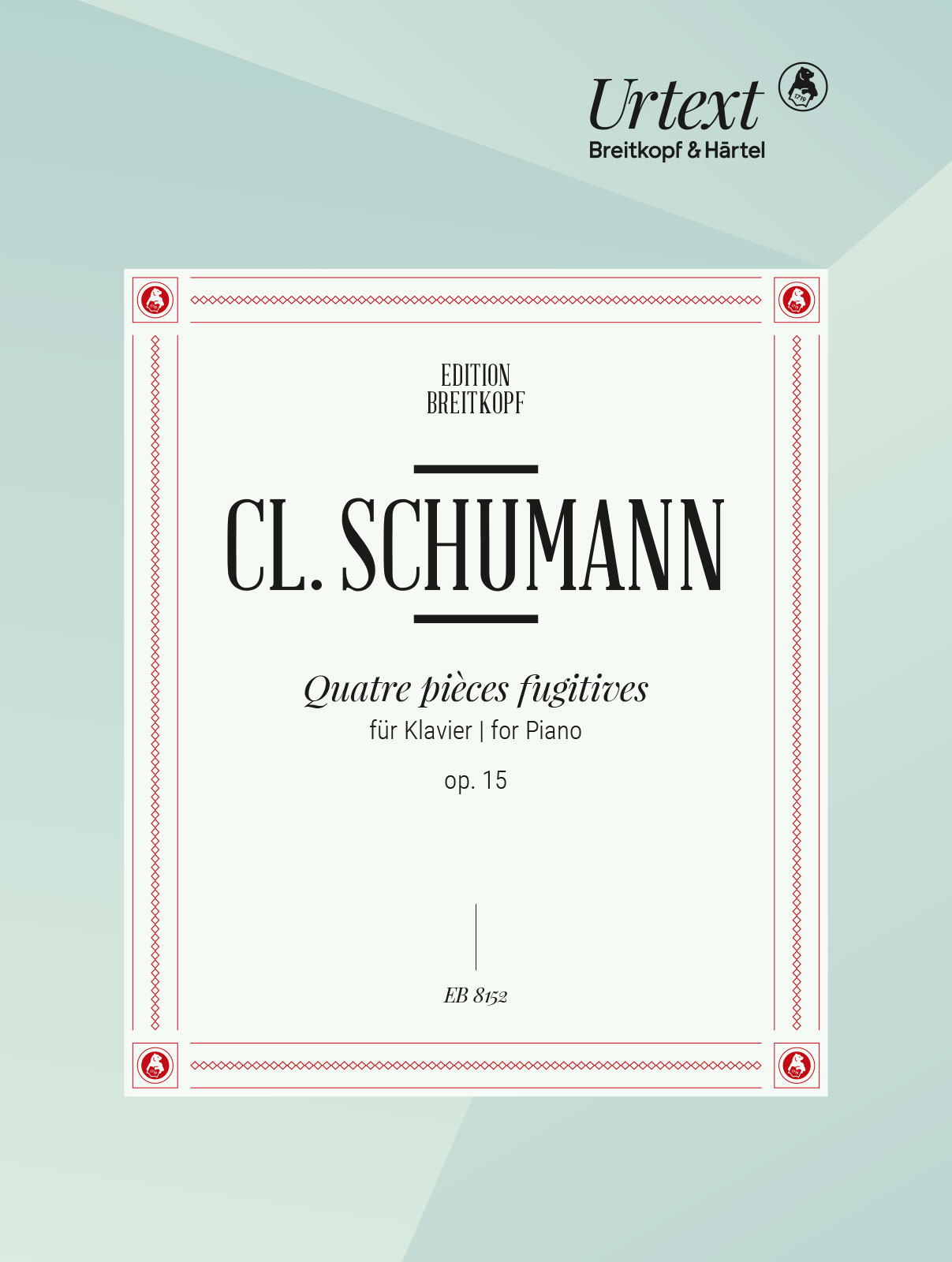
Clara Schumann's 4 Pièces Fugitives, Op. 15, (also known as 4 Flüchtige Stücke) is a collection of character pieces for solo piano published in 1845. Composed primarily…
Clara Schumann’s 4 Pièces Fugitives, Op. 15, (also known as 4 Flüchtige Stücke) is a collection of character pieces for solo piano published in 1845. Composed primarily in 1840—the same year as her marriage to Robert Schumann—these works are noted for their introspective, free-flowing nature and romantic lyricism.
Generally considered intermediate to advanced in difficulty. The No. 4 Scherzo is currently listed as an alternative exam piece for ABRSM Piano 2025–2026 Grade 7 and No. 2 Un poco agitato is on the Grade 8 syllabus.
Larghetto (F major): A wistful and gentle opening piece.
Un poco agitato (A minor): Characterised by its more turbulent and restless energy.
Andante espressivo (D major): Often praised for its “charming effects” and lyrical depth.
Scherzo (G major): A playful and “innocent” piece that has been compared to Beethoven’s shorter sonatas.
In labeling the pieces “fugitive” (or fleeting), Clara Schumann indicated a move away from rigid formal structures toward a more “unrestrained” and expressive Romantic style. While her style is original, the influence of contemporaries like Chopin, Mendelssohn, and Robert Schumann occasionally shines through in the harmonic colouring.
“Clara Schumanns writing contains a number of original traits. She is far removed from merely copying Chopin, Mendelssohn or Robert Schumann. At the most, these masters sometimes shine through the particular coloring characteristic of all of Clara Schumanns pieces. The Quatre pièces fugitives all differ jn character and style. Especially the Andante (No. 3) contains some charming effects. No. 4, Scherzo, a simple and innocent piece, recalls Beethovens shorter sonatas.” (from the review printed in the “Allgemeine Musikalische Zeitung” of 1 October 1845)
R.R.P 13
Our Price: 11
Digital Download – PDF
Shipping costs: No shipping
Please create and forward a copy of this publication to the customer