Odes, Birthday Songs, Welcome Songs and Other Occasional Works:
Ode: Hail Bright Cecilia (1692)
Birhtday Songs:
for King James II:
Sound the Trumpet, Beat the Drum (1687)
for Queen Mary:
Arise My Muse (1690)
Welcome Glorious Morn (1691)
Celebrate this Festival (1693)
Come ye Sons of Art Away (1694)
for The Duke of Gloucester:
Who can from joy refrain? (1695)
The Yorkshire Feast Song (1689)
Sacred Choral Works:
Te Deum Laudamus and Jubilate Deo (1694)
Anthem: Thou knowest Lord (1695)
Incidental Music:
The Libertine or The Libertine Destroyed (1692)
The Comical History of Don Quixote Part II (1694)
Bonduca or The British Heroine (1695)
Opera, Semi-Opera and Masque:
The History of Dioclesian or The Prophetess
King Arthur or The British Worthy (1691)
The Fairy Queen (1691)
Timon of Athens, The Man-Hater (1694)
The Indian Queen (1695)
Instrumental Music:
Sonata in D (1694?)
March and Canzone for the Funeral of Queen Mary (1695)
Henry Purcell was an English composer of Baroque music, born around September 10, 1659, in Westminster, London, England. He passed away on November 21, 1695, in Marsham Street, London. Purcell’s musical style was uniquely English, though it incorporated Italian and French elements. He is generally considered one of the greatest English opera composers and is often assessed alongside John Dunstaple and William Byrd as one of England’s most important early music composers.
Purcell’s father was a gentleman of the Chapel Royal and sang at the coronation of King Charles II of England. After his father’s death in 1664, Purcell was placed under the guardianship of his uncle Thomas, who showed him great affection and kindness. Thomas arranged for Henry to be admitted as a chorister, where he studied first under Captain Henry Cooke, Master of the Children, and afterwards under Pelham Humfrey, Cooke’s successor, who was a pupil of Lully.
Purcell is said to have been composing at nine years old, but the earliest work that can be certainly identified as his is an ode for the King’s birthday, written in 1670. His compositions include more than 100 songs, the tragic opera Dido and Aeneas, and his incidental music to a version of Shakespeare’s A Midsummer Night’s Dream called The Fairy Queen.
In 1677, Purcell succeeded Matthew Locke as the composer for Charles II’s string orchestra and in 1679 was appointed organist of Westminster Abbey in succession to John Blow. A further appointment as one of the three organists of the Chapel Royal followed in 1682. He retained all his official posts through the reigns of James II and William III and Mary.
Purcell married in 1680 or 1681 and had at least six children, three of whom died in infancy. His son Edward was also a musician, as was Edward’s son Edward Henry (died 1765). Purcell seems to have spent all his life in Westminster. A fatal illness prevented him from finishing the music for the operatic version of John Dryden and Sir Robert Howard’s verse tragedy The Indian Queen (1664), which was completed after his death by his brother Daniel.
Purcell’s legacy includes a vast array of compositions that have had a lasting impact on English music and are still celebrated today for their originality and inventiveness.
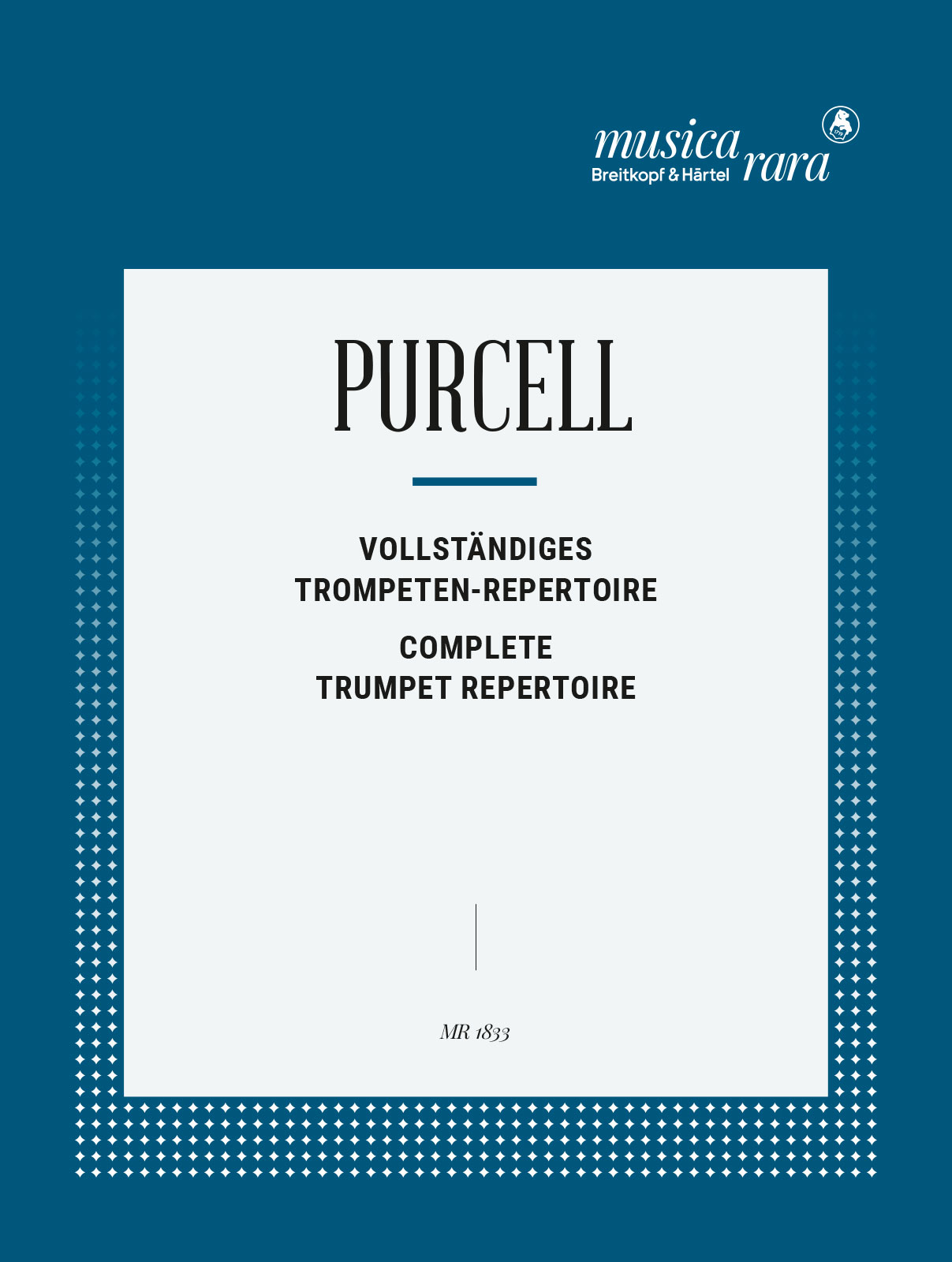
Complete Trumpet Repertoire by Henry Purcell is a fantastic collection of the trumpet parts from some of the composers most famous works.
Digital Download – PDF
Shipping costs: No shipping
Please Note: This product is not fulfilled by The Music Realm Ltd. Breitkopf and Hartel have requested that all purchases are referred to them for watermarking before downloading. This usually takes 1-3 days.We regret that this means you will not be able to download your purchase immediately.
R.R.P £40.00
Our Price: £34.00
Please create and forward a copy of this publication to the customer