Robert Schumann was a German composer, pianist, and influential music critic of the Romantic era, born on June 8, 1810, in Zwickau, Saxony, Germany. He passed away on July 29, 1856, in Endenich, near Bonn, Prussia, Germany. Schumann is renowned particularly for his piano music, songs (lieder), and orchestral music. Many of his best-known piano pieces were written for his wife, the pianist Clara Schumann.
Schumann’s early years were marked by his father’s influence, who was a bookseller and publisher. He began his musical education at the age of six, studying the piano. In 1827, he came under the musical influence of Austrian composer Franz Schubert and the literary influence of German poet Jean Paul Richter. In the same year, he composed some songs.
Despite initially studying law at the University of Leipzig, Schumann’s passion for music prevailed. He studied the piano seriously with Friedrich Wieck, Clara’s father, and eventually married Clara despite Wieck’s opposition2. Schumann’s early works were mainly piano pieces, including the large-scale “Carnaval” (1834–1835). He co-founded the “Neue Zeitschrift für Musik” (New Musical Journal) in 1834 and edited it for ten years, contributing significantly to music criticism.
His compositions include the “Piano Concerto in A Minor, Op. 54,” “Symphony No. 1 in B-flat Major,” and song cycles such as “Frauenliebe und -leben” and “Dichterliebe.” Schumann turned to orchestral music in 1841, chamber music and choral works in the following years, and his wife Clara premiered many of his works, including the Piano Concerto.
Schumann’s life was troubled by mental health issues, which led to his attempted suicide in 1854 and subsequent confinement in a sanatorium, where he died two years later. His legacy remains significant, as he was one of the most important Romantic composers and a highly regarded music critic, whose deeply personal music reflects the nature of Romanticism.
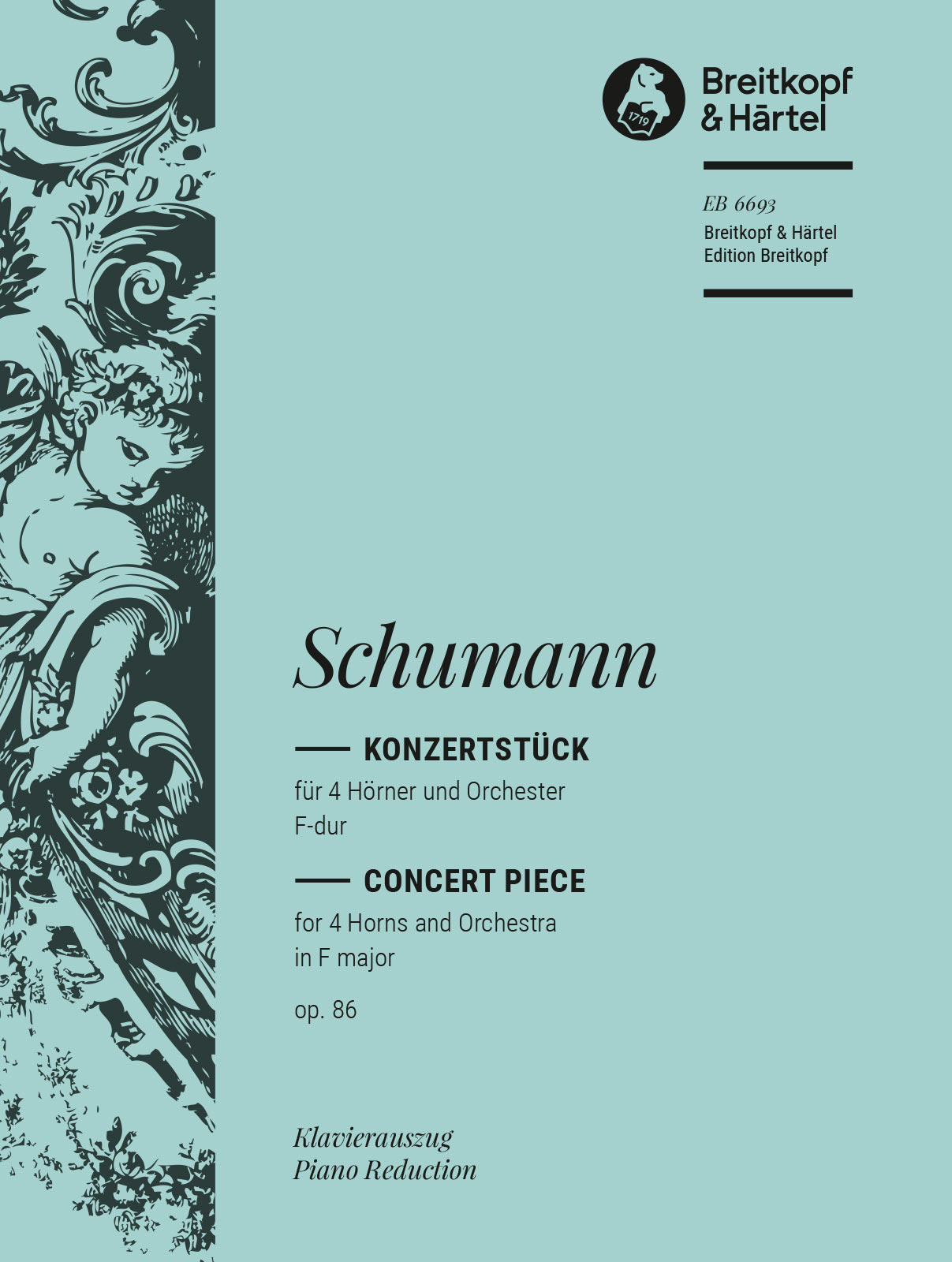
Robert Schumann's Konzertstück (Concert Piece) in F major for 4 Horns and Orchestra, op. 86, was composed in 1849 and is considered one of the…
Robert Schumann’s Konzertstück (Concert Piece) in F major for 4 Horns and Orchestra, op. 86, was composed in 1849 and is considered one of the milestones of Romantic horn literature. Enthused by the new possibilities offered by the recently invented valve horn, Schumann exploited the instrument’s potential to the full in his opus 86. In a single-movement, three-part form, he interweaves fanfare-like brilliance, lyrical cantilenas and dance-like lightness. The work is highly demanding in terms of technique and ensemble playing: Four soloists engage in a closely interwoven dialogue with the orchestra – a striking example of Schumann’s search for new means of expression.
Digital Download – PDF
Shipping costs: No shipping
Please Note: This product is not fulfilled by The Music Realm Ltd. Breitkopf and Hartel have requested that all purchases are referred to them for watermarking before downloading. This usually takes 1-3 days.We regret that this means you will not be able to download your purchase immediately.
R.R.P £31.00
Our Price: £26.35
Please create and forward a copy of this publication to the customer