Antonio Vivaldi was an Italian Baroque composer, virtuoso violinist, and teacher born on March 4, 1678, in Venice. He is best known for his contributions to the development of the concerto form and for his numerous concertos for violin and other instruments. Vivaldi’s most famous work is “The Four Seasons,” a series of violin concertos that depict scenes appropriate for each season of the year.
Vivaldi’s early life was marked by his musical talent, which was evident from a young age. He began studying for the priesthood at the age of 15 and was ordained at 25. However, due to a health problem, he was given dispensation to no longer say public Masses.
Throughout his career, Vivaldi composed over 500 concertos, more than 40 operas, and numerous sacred choral works. Many of his compositions were written for the all-female music ensemble of the Ospedale della Pietà, a home for abandoned children in Venice.
Vivaldi’s influence during his lifetime was widespread across Europe, giving origin to many imitators and admirers. He pioneered developments in orchestration, violin technique, and programmatic music. Despite his success during his lifetime, Vivaldi died in poverty in Vienna on July 28, 1741.
After almost two centuries of decline, Vivaldi’s musical reputation underwent a revival in the early 20th century. Many of his compositions, once thought lost, have been rediscovered and continue to be performed and celebrated today.
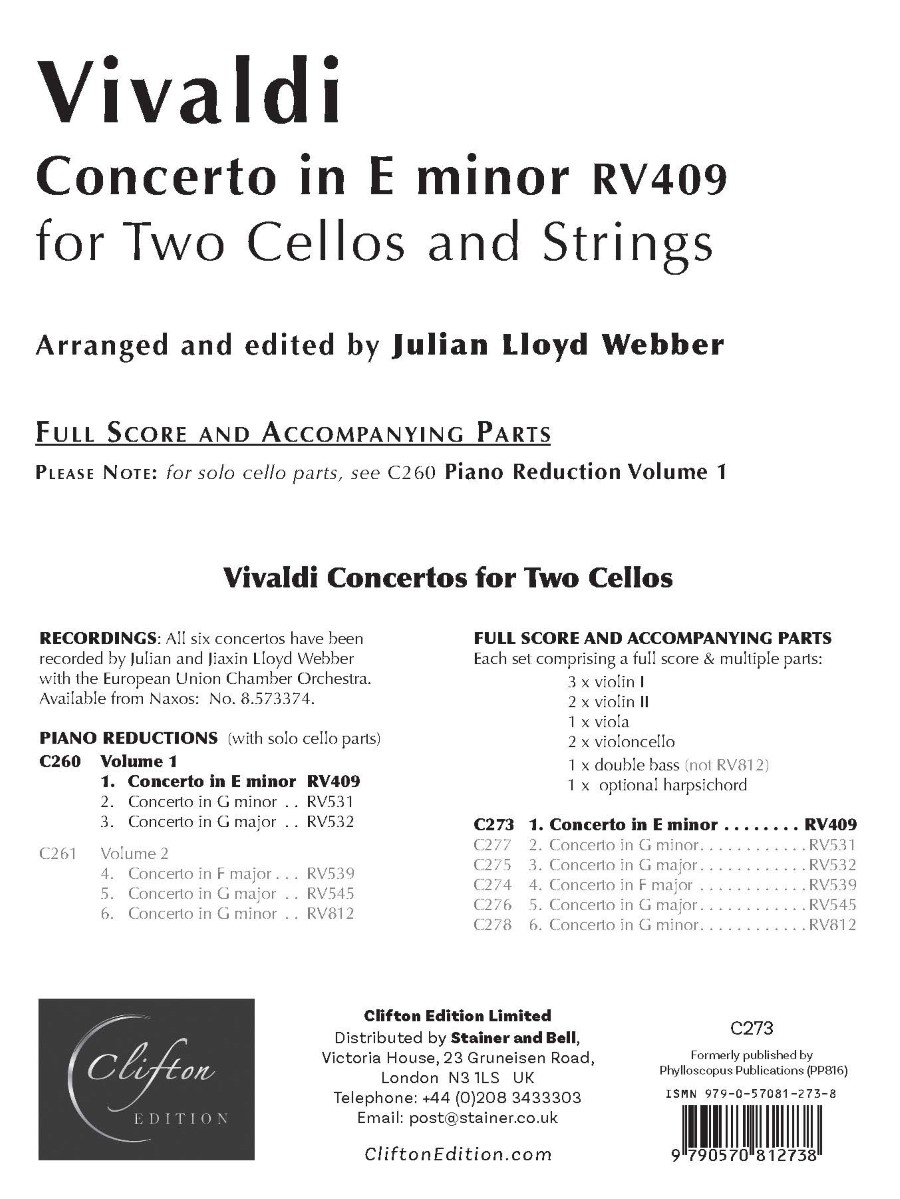
The Concerto for Two Cellos RV409 was originally composed for Bassoon, Cello, Strings and continuo, and has been arranged for two Cellos by Julian Lloyd…
The Concerto for Two Cellos RV409 was originally composed for Bassoon, Cello, Strings and continuo, and has been arranged for two Cellos by Julian Lloyd Webber
It is a fascinating and somewhat unconventional work in his cello concerto repertoire and showcases Vivaldi’s flair for dramatic contrasts and inventive textures.
The concerto follows the typical three-movement Baroque format:
Movement 1: Adagio – Allegro molto: Begins with a solemn Adagio, quickly shifting into a vigorous Allegro.
Movement 2: Allegro – Adagio: Reverses the pattern: energetic solo passages marked Allegro, interrupted by brief Adagio ritornellos. This inversion creates a playful tension between soloist and ensemble.
Movement 3: Allegro: A lively finale in ritornello form, with recurring orchestral themes framing virtuosic cello episodes.
Vivaldi rarely ventures above fourth position on the cello, keeping the technical demands accessible but expressive.
Previous Publisher: Phylloscopus Publications
Former catalogue number: PP816
A recording, featuring Julian Lloyd Webber, is available: CD cat. No. 8573374. Arranged and edited from the original concerto for cello, bassoon and strings.