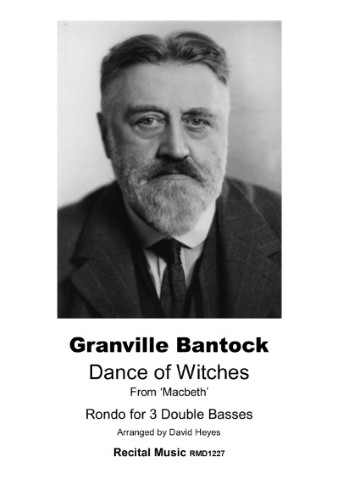
Composer: Bantock, Granville
Arranger: David Heyes
Instrumentation: 3 Double Basses
Publisher:
| Product Code: | RMD1227 |
| Publishers Number: | RMD1227 |
| Language: | English |
| Condition: | New |
Born in London on August 7, 1868, Granville Ransome Bantock was originally destined for a career in the civil service, following his father’s wishes. However, after studying at the Royal Academy of Music under Frederick Corder, Bantock committed fully to a life in music. His early career was marked by a variety of positions, including conducting musical theatre and light opera, which exposed him to a range of styles and helped develop his talent for dramatic and evocative orchestration.
Granville Bantock’s musical language was heavily influenced by Romanticism, particularly the works of Richard Wagner and Richard Strauss. He often gravitated towards programmatic music—compositions that told stories or painted pictures, often based on literary or philosophical themes. His interest in Eastern and Celtic culture also played a significant role in shaping his unique style, often incorporating modal scales and exotic orchestral colors.
One of Bantock’s most ambitious and well-known works is Omar Khayyám, a massive choral-orchestral trilogy based on Edward FitzGerald’s translation of the Persian poet’s Rubáiyát. The work is notable for its scale, lush harmonies, and sensual evocation of Eastern mysticism. It was enthusiastically received in its time and drew praise from leading composers and critics, including Jean Sibelius and Havergal Brian.
Another key work is Celtic Symphony (1940), scored for strings and six harps, reflecting his fascination with Celtic folklore and mythology. Bantock also composed several tone poems, such as The Witch of Atlas and Dante and Beatrice, which demonstrate his interest in literary and philosophical themes, particularly those of Shelley and Dante.
Bantock’s admiration for other cultures was not merely aesthetic; it was often grounded in genuine philosophical and spiritual engagement. His interest in Theosophy and other forms of mystical and esoteric thought shaped his artistic outlook, leading to works that sought to transcend mere musical entertainment and instead probe the deeper questions of existence and the divine.
In addition to composing, Bantock was an influential educator and conductor. He served as principal of the Birmingham and Midland Institute School of Music and later as Professor of Music at the University of Birmingham. In these roles, he championed contemporary British composers and helped cultivate a renewed sense of national identity in music. He was also a staunch supporter of Sibelius and played a critical role in introducing the Finnish composer’s works to British audiences.
Despite his early popularity, Bantock’s music fell into relative obscurity after his death in 1946, partly due to the shifting musical tastes of the mid-20th century. The rise of modernist styles and the decline of Romantic aesthetics contributed to the neglect of his works. However, there has been a modest revival of interest in his music in recent decades, with recordings and performances bringing renewed attention to his contributions.
In sum, Granville Bantock was a complex and visionary composer whose works deserve a more prominent place in the classical music repertoire. His blend of rich orchestration, literary depth, and cross-cultural curiosity make him a unique voice in British music. While he may never achieve the widespread fame of some of his peers, his artistic integrity and adventurous spirit continue to inspire listeners and musicians alike.
Dance of Witches was composed in 1926, originally as incidental music for a play, and rearranged for bassoon or cello trio the following year by…
“I first came across the music of Granville Bantock (1868-1946) when I was about 18 years old. If memory serves me well, The South Bank Show broadcast a television programme about the City of Hull Youth Orchestra recording Bantock’s Hebridean Symphony and I was immediately taken with the wonderfully evocative and beautifully epic music.
Although his name and music have gradually fallen from the radar, he was a very successful and important musician in his day, combining his skills as a composer and conductor alongside the role of Principal of the Birmingham and Midland Institute School of Music. He was knighted in 1930, was influential in founding the City of Birmingham Orchestra (which became the City of Birmingham Symphony Orchestra) and both Jean Sibelius and Edward Elgar dedicated works to him.
One of my prized possessions is a biography of Granville Bantock, written by his daughter Myrrha, and first published in 1972, and is probably the only book written about this important and fascinating musician in British musical life. Some years ago I discovered a bassoon trio by Bantock which I thought would transcribe well for double basses but, as his music didn’t come out of copyright in Britain until 2017, I didn’t think any more about the piece until earlier this year. Bantock had composed the incidental music for performances of Shakespeare’s Macbeth in 1926, scored for 3 trumpets, 3 trombones, 3 bassoons, drums and 2 pipes, and the following year rewrote or adapted his ‘Dance of Witches: Rondo for 3 bassoons or cellos’. He must have thought well of the music because he also composed a Macbeth Overture for orchestra in 1940, also based on the incidental music from the play.
‘Dance of Witches’ is in one extended movement, with three clearly defined sections, which are inventive, dramatic and colourful. The piece gradually gains in speed and momentum with something of interest for each player, and effective musical contrasts between shorter fast notes and more lyrical phrases. It reaches a climax with all three bassoons playing the highest note of the piece followed by a two octave descending chromatic scale played in canon, marked fortissimo, falling into the lowest register with a diminished chord which dies away. This is followed by snatches of a short rhythmic motif, passed from player to player, ending quietly and simply. The original key of C major/A minor was good for bassoons or cellos but too low for Double Bass, Trio and maybe an octave higher was not the best choice either. My original compromise was G major/E minor – a 5th higher than the original version, which seemed like a good choice.
A few weeks ago I typeset the score and parts, ready for publication, added a few judicious pizzicato notes and passages to create tonal variety but, as I was writing this blog, I realised that F major/D minor were better keys and, having transposed the computer score, I knew this was the best choice. A few short passages and notes have been changed enharmonically, otherwise it’s the same as the original but now in a new key. The piece uses
a three octave range of the Double Bass, Trio and hopefully makes a useful and accessible addition to the transcription repertoire.
If you like the piece listen to some of Bantock’s orchestral works – he was amazingly good but slightly forgotten today. I’m sure he would have thought the bassoon trio was nothing but a ‘trifle’ or completely insignificant when compared to the grandeur of much of his orchestral music, but the signs of a master composer and craftsman are ever present in the trio and this might be a good introduction to a fascinating composer who knew the leading composers and musicians of his day.” [David Heyes / 13 December 2019]
R.R.P £8.50
Our Price: 6.8
Digital Download – PDF
Shipping costs: No shipping
Your basket is currently empty!
Notifications