François Devienne's Quartet in F Major Op. 73 No. 2 is a prominent work in late 18th-century chamber music for bassoon and strings. Composed by…
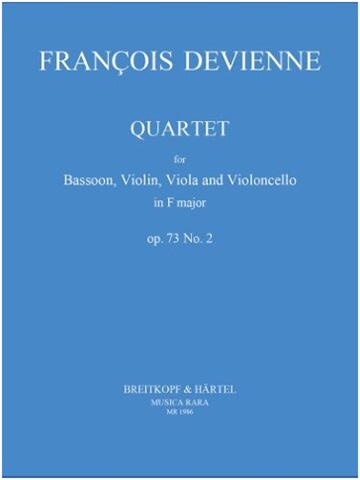
François Devienne’s Quartet in F Major Op. 73 No. 2 is a prominent work in late 18th-century chamber music for bassoon and strings. Composed by the French musician often called the “French Mozart,” it is the second of three quartets in the Op. 73 set.
The quartet is written for bassoon, violin, viola, and cello and is divided into three movements:
Allegro: A lively opening movement in F major.
Adagio: A slower, expressive middle movement.
Grazioso con variazioni: A concluding theme and variations that highlights the technical agility of the bassoon.
The “Trois Quatuors Pour Basson, Violon, Alto et Basse, op. 73”, (published by Erard (Paris) in 1798, were dedicated to Devienne’s friend, Garnier of Lyon. This may have been François Joseph Garnier (1755-1825), a noted French oboist and flautist, also a composer of solo and wind chamber music and a widely-used method for oboe.
These quartets are somewhat superior to most of those contemporaneous works written for a wind instrument and strings. Although the bassoon part is a brilliant one, each of the string voices enjoys a high degree of independence.