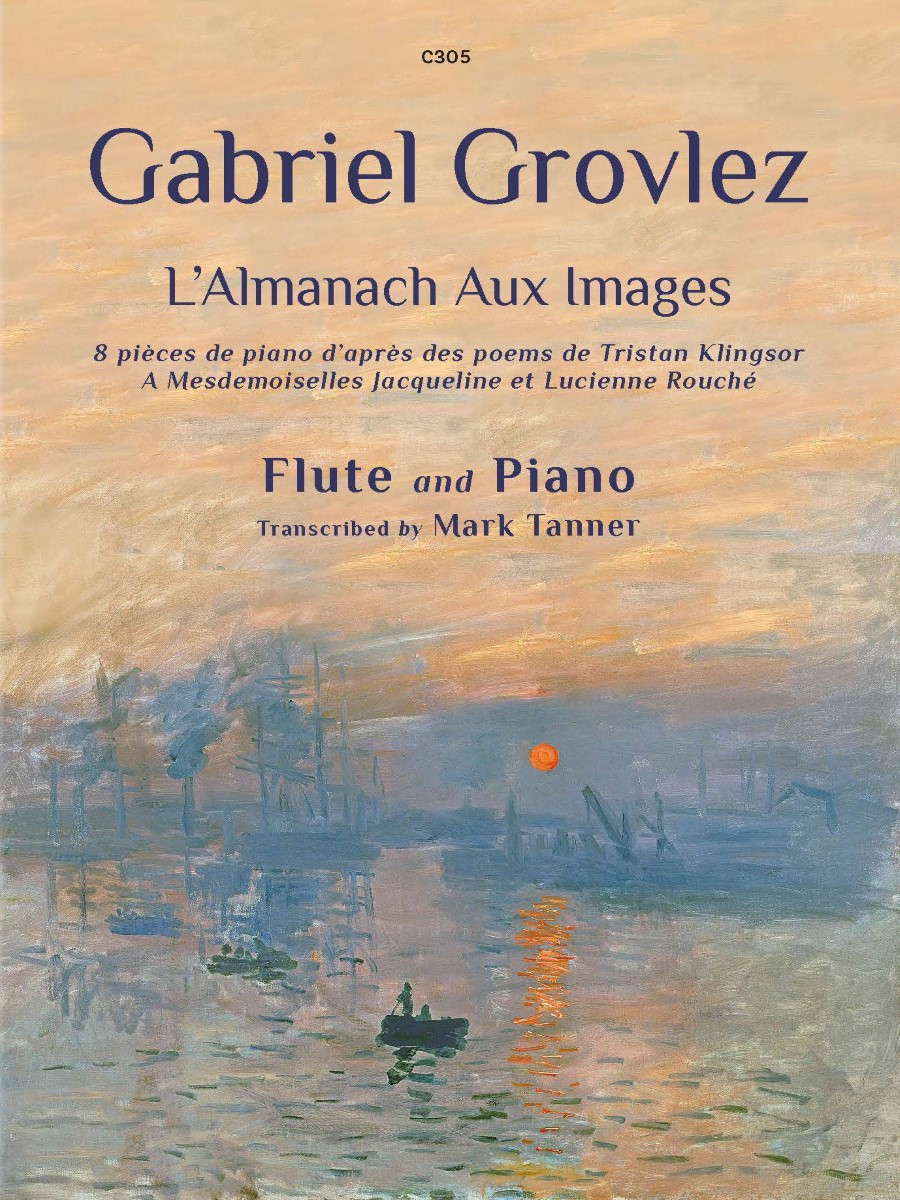
Composer: Grovlez, Gabriel
Arranger: Mark Tanner
Arranged for: Flute and Piano
Publisher:
| Product Code: | 979-0-570-81305-6 |
| ISMN: | 979-0-570-81305-6 |
| Publishers Number: | C305D |
| Language: | English |
| Page count: | 44 |
| Condition: | New |
Grovlez was quite a cosmopolitan character; besides making a notable mark in his native country (he was, latterly, a professor of chamber music at the Paris Conservatoire), he travelled to the United States and Africa, as well as across Europe. Although we tend to remember Grovlez today for his influence primarily as a composer in the mould of Fauré or Debussy, bringing a quirky quality to some of his writing more than occasionally reminiscent of Poulenc, it was as a conductor that Grovlez initially made an impact. Moreover, we should not overlook the fact that he gave the inaugural performances of some highly treasured works by the likes of Ravel (Ma Mère l’Oye) and Fauré (Dolly Suite), a piano duet which has earned an especially important place in the hearts of countless amateur pianists, young and old. Nor should we neglect his sizeable impact in resurrecting music by, for example, Monteverdi, Rameau, Gluck and Lully. His charming, delightfully compact and eclectic resourcefulness also became channelled into stage works such as operas and ballets, as well as symphonic poems, vocal and choral pieces, memorable for their warmth of personality and, at times, startlingly farsighted stylistic direction.
To counter those who feel that Grovlez was, not unlike Erik Satie, disinclined to write music of complexity in favour of irony and understatement, pianists might wish to get their hands on a copy of Grovlez’s Deux études de difficulté transcendante (1919), which contrasts superbly with his first published work for the instrument in 1907: Au jardin de l’enfance (In the Garden of Childhood). There remains a risk that composers such as Grovlez become recognised only in light of their various stylistic borrowings, in this case placing him somewhat in the shadow of Debussy and Fauré, rather than as a musician of the highest ranking in his own right, and I believe that by bringing works such as the marvellous L’Almanach aux images to a wider audience by means of sensitive arrangements can only help matters. Doubtless, now that Grovlez’s music has emerged from copyright, we can expect to see a growing number of such enterprises.
L'Almanach Aux Images is a collection of eight beautiful pieces were originally written for piano in 1911, transcribed here for flute and piano by Mark…
Previously published by Spartan Press
Former catalogue number: SP1249
A marionette is a string-operated puppet. Popular from as far back as Ancient Greece, and increasingly the focus of entertainment during the Middle Ages and Renaissance period, it has been proposed that the art of puppetry was the logical precursor to the appearance of live actors in the theatre. Stravinsky’s ground-breaking ballet Petrushka, which was completed in 1911 (the same year as Grovlez’s L’Almanach, incidentally), undoubtedly remains the best-known evocation of a puppet.
‘Lullaby for a doll’, though a seemingly improbable starting point for a musical work, functions beautifully next to the marionettes in Grovlez’s magical, image-rich world, though I detect something faintly subversive bubbling under the surface of this sublime melody.
The ‘Sarabande’ is a stately dance in triple-time with a characteristic gentle emphasis on the second beat and was, apparently, first referenced in print in Central America during the 16th century (zarabanda). It rapidly grew in popularity over successive centuries, especially within the Spanish colonies – and of course in Spain itself – where its reputation as having being ‘invented in hell’ (according to Cervantes) assured it a place in dance suites from Bach’s time onwards.
‘Hunter’s Song’ is a rollicking, rum-tee-tum piece of great insouciance and swagger. The 6/8 rhythms and horn-like proclamations ride delightfully roughshod throughout the music.
‘The Donkeys’. I presume Eee-orrr has the same connotation in French! – moreover, the comical spirit of the music is not so far removed from Ibert’s famous Le Petit Âne Blanc (Avec une tranquille bonne humeur) from Histoires, a set of ten Debussy-inspired pieces composed in 1922.
‘The Shepherd’ remains an intriguing source of musical inspiration – composers such as Bach, Mendelssohn, Cyril Scott and countless others were clearly enchanted by the biblical symbolism and innocence of which the shepherd seems perennially suggestive.
What an appropriate title ‘Swing Song’ is for this sunny, lilting tune in the style of a Viennese Waltz. Grovlez entirely captured the carefree mood and, judging from his many markings, wished the music to be highly flexible in tempo.
Though the final item in L’Almanach, for me this remains the gem of the set. Tristan Klingsor’s poem fits the syntax of the rapt melody down to the last syllable, as I discovered some years ago when contemplating making a choral arrangement of the piece.
R.R.P £12.95
Our Price: £11.01
Digital Download – PDF
Shipping costs: No shipping
Your basket is currently empty!
Notifications