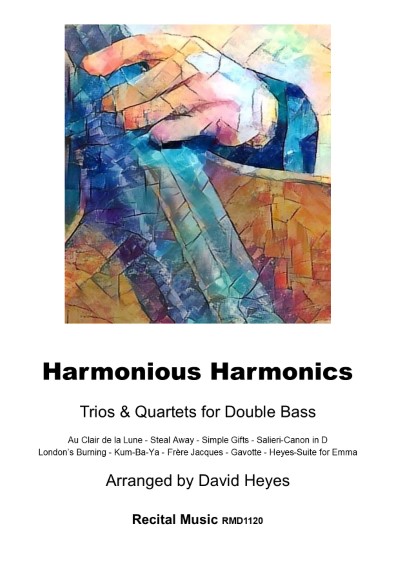
Harmonious Harmonics
Trios & Quartets for Double Basses
Digital Download – PDF
R.R.P £10.00
Our Price: £8.50
Composer: Heyes, David; Salieri, Antonio;
Instrumentation: 3 and 4 Double Basses
Arranger: Heyes, David;
Publisher Recital Music
About the Composers
Heyes, David
David Heyes (b.1960) studied double bass with Laurence Gray and Bronwen Naish, later at the Royal College of Music in London, and completed his post-graduate studies in Prague with František Pošta (Principal Bass, Czech Philharmonic Orchestra). He has given recitals and masterclasses in 20 countries over the past few years and has been a juror at a number of international competitions, three times as chairman.
David’s collaborative work gained him a prestigious award from the David Walter Charitable Trust of New York for his pioneering activities as a soloist, teacher, publisher, and commissioner of new music for double bass and he works with composers throughout the world to expand the double bass repertoire by commissioning new music and by rediscovering forgotten ones. Since 1983 more than 700 works have been written for him, music from one to twenty basses and from beginner to virtuoso, and he has premiered ten contemporary concertos with orchestra.
David began to compose in 2013 and has had music performed and recorded in 29 countries across five continents. He is a D’Addario Performing Artist and has recently commissioned a solo double bass from British master-luthier Martin Penning.
Salieri, Antonio
Antonio Salieri was an Italian composer and teacher of the classical period, born on August 18, 1750, in Legnago, south of Verona, in the Republic of Venice. He is known for his significant contributions to the development of late 18th-century opera and was a pivotal figure in the Viennese classical music scene.
Salieri’s career was marked by his role as a teacher and mentor to many prominent composers, including Franz Liszt, Franz Schubert, Ludwig van Beethoven, Anton Eberl, Johann Nepomuk Hummel, and Franz Xaver Wolfgang Mozart. He was appointed the director of the Italian opera by the Habsburg court in 1774 and held this position until 1792. During his tenure, he dominated Italian-language opera in Vienna and also wrote works for opera houses in Paris, Rome, and Venice.
His best-known work is the French opera “Tarare” (1787), which was later translated into Italian as “Axur, re d’Ormus.” This opera was preferred by the Viennese public over Mozart’s “Don Giovanni”2. Salieri’s last opera was performed in 1804, after which he devoted himself to composing sacred music.
Salieri’s relationship with Wolfgang Amadeus Mozart has been a subject of much speculation. Despite rumors that they were bitter rivals and that Salieri had poisoned Mozart—a claim that has been proven untrue—historical evidence suggests that they were at least mutually respectful peers.
Antonio Salieri passed away on May 7, 1825, in Vienna. His legacy includes a vast body of work that continues to be studied and performed today.
HARMONIOUS HARMONICS consists of five quartets, one canon, two rounds, and a three movement Suite for Emma composed by David Heyes. They are all designed…
Page ? of ?