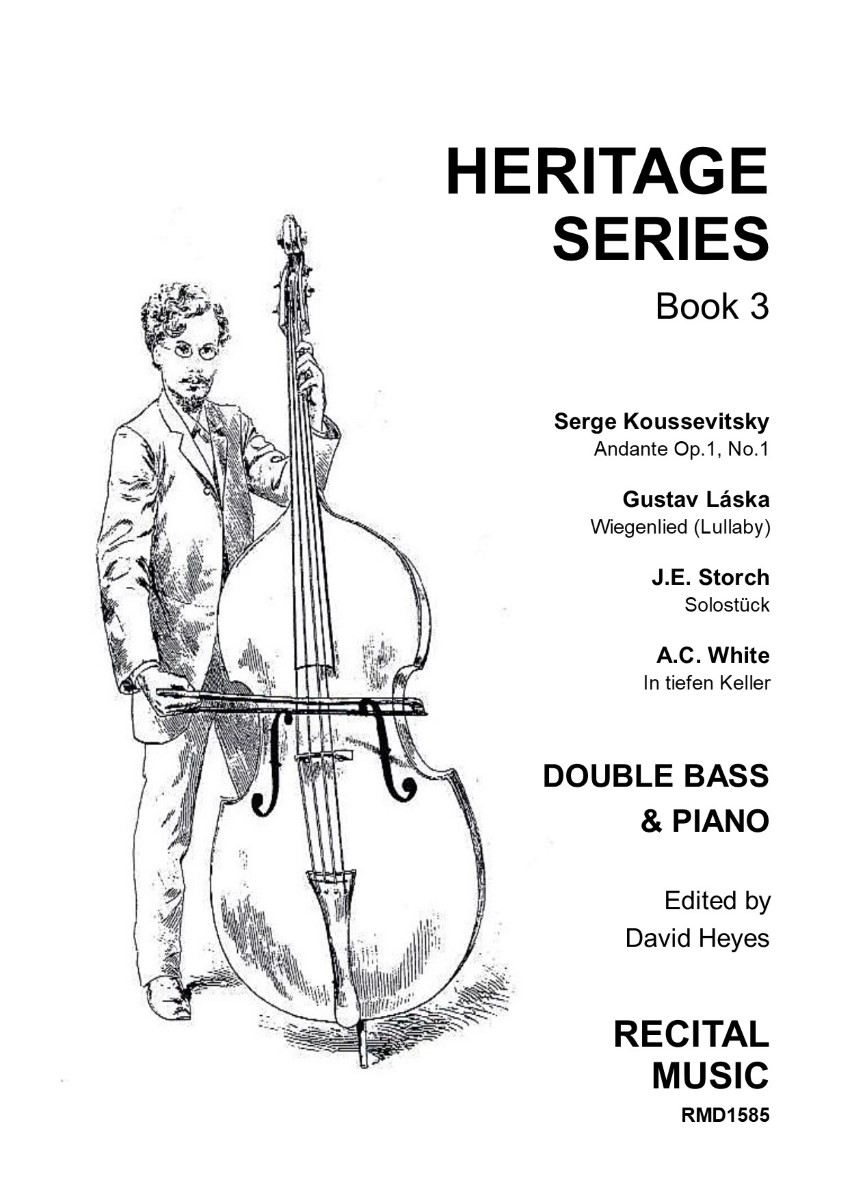
Heritage Series Book 3
Digital Download – PDF
R.R.P £11.50
Our Price: £9.78
Composer: Koussevitsky, Serge; Laska, Gustav; Storch, Josef Emanuel; White, Adolphus Charles;
Instrumentation: Double Bass & Piano
Editor: Heyes, David
Publisher Recital Music
About the Composers
Koussevitsky, Serge
Serge Koussevitsky was born in Russia in 1871 and was a virtuoso double bassist before becoming the revered conductor of the Boston Symphony Orchestra. He studied double bass with Josef Rambousek, joined the Bolshoi Theatre Orchestra at the age of 20 and succeeded his teacher as Principal Bass in 1901.He studied conducting in Berlin with Arthur Nikisch, subsequently founding his own orchestra in Moscow and a publishing company to promote and perform the music of many fellow Russian composers. In 1924 Koussevitsky succeeded Pierre Monteux as conductor of the Boston Symphony Orchestra, retiring in 1949. He was one of the most important champions of new music during his tenure in Boston, commissioning music from Aaron Copland, Serge Prokofiev, Paul Hindemith, Igor Stravinsky, Albert Roussel, Bohuslav Martinů, Béla Bartók and many more, and in 1922 he commissioned Maurice Ravel to create an orchestration of Mussorgsky’s Pictures at an Exhibition. Serge Koussevitsky died in Boston in 1951.
Laska, Gustav
Gustav Láska was born in Prague on 23 August 1847 and died in Schwerin (Germany) on 16 October 1928, aged 81 and after a long and successful career. He studied at the Prague Conservatoire from 1861-7 with Josef Hrabě (double bass), Jan B. Kittl (music theory) and Josef Krejci (composition) and after graduation gave solo performances in Austria and subsequently became a member of the orchestra in Kassel, Germany. He travelled extensively in Europe and America, both as a soloist and orchestral player, and was Principal Double Bass at the Bayreuth Festival for many years.
Throughout his life Láska also taught, conducted and composed, alongside his solo and orchestral performances, and Franz Tischer-Zeitz who edited the Dittersdorf Concerto in the 1930s, was one of his students. In 1904 his Method for Double Bass Op.50 was published in Leipzig but is practically forgotten today – the fate of many similar double bass tutors. From 1878 until his death in 1928 he was a member of the Court Opera Orchestra of Mecklenburg-Schwerin and was also choirmaster of the Schwerin Singakademie and church choir.
Gustav Láska was a prolific composer, writing in many genres, including three operas (Der Kaisersoldat, Sunde and Abu Seid), two orchestral overtures, two symphonies, sacred choral works, piano music, and many of works for double bass. His music for double bass is well written for the instrument, featuring many technical challenges alongside lyrical and cantabile melodies, but much of it has fallen from the repertoire since his death almost 90 years ago.
The smaller works are probably best described as salon or characteristic music, but of a high quality, and many are still worthy of performance today. His music often fuses the technical skills of the Czech School with the lyricism and virtuosity of Bottesini, although still with one foot very firmly in the Czech camp. The salon style is a little out of step with today’s music making and sensibilities but fashions do change and there is a wealth of great music awaiting rediscovery by the curious and adventurous bassists.
Storch, Josef Emanuel
Josef Emanuel Storch was born in Semily (Czech Republic) in 1841 and between 1855-61 studied double bass at Prague Conservatoire with Josef Hřabe. After graduation he moved to Leipzig where he became a member of the Leipzig Gewandhaus Orchestra and taught at the Music Conservatoire. The Storch-Hřabe studies for double bass, which are still in use today, were probably a collaboration between teacher and pupil, and Storch also composed a number of original works for double bass which have been sadly forgotten and are now mostly out of print. Josef Emanuel Storch died in 1877.
The Heritage Series features a wealth of exciting and innovative music from the 19th century by some of the leading bassist-composers of the day. Each…
Page ? of ?