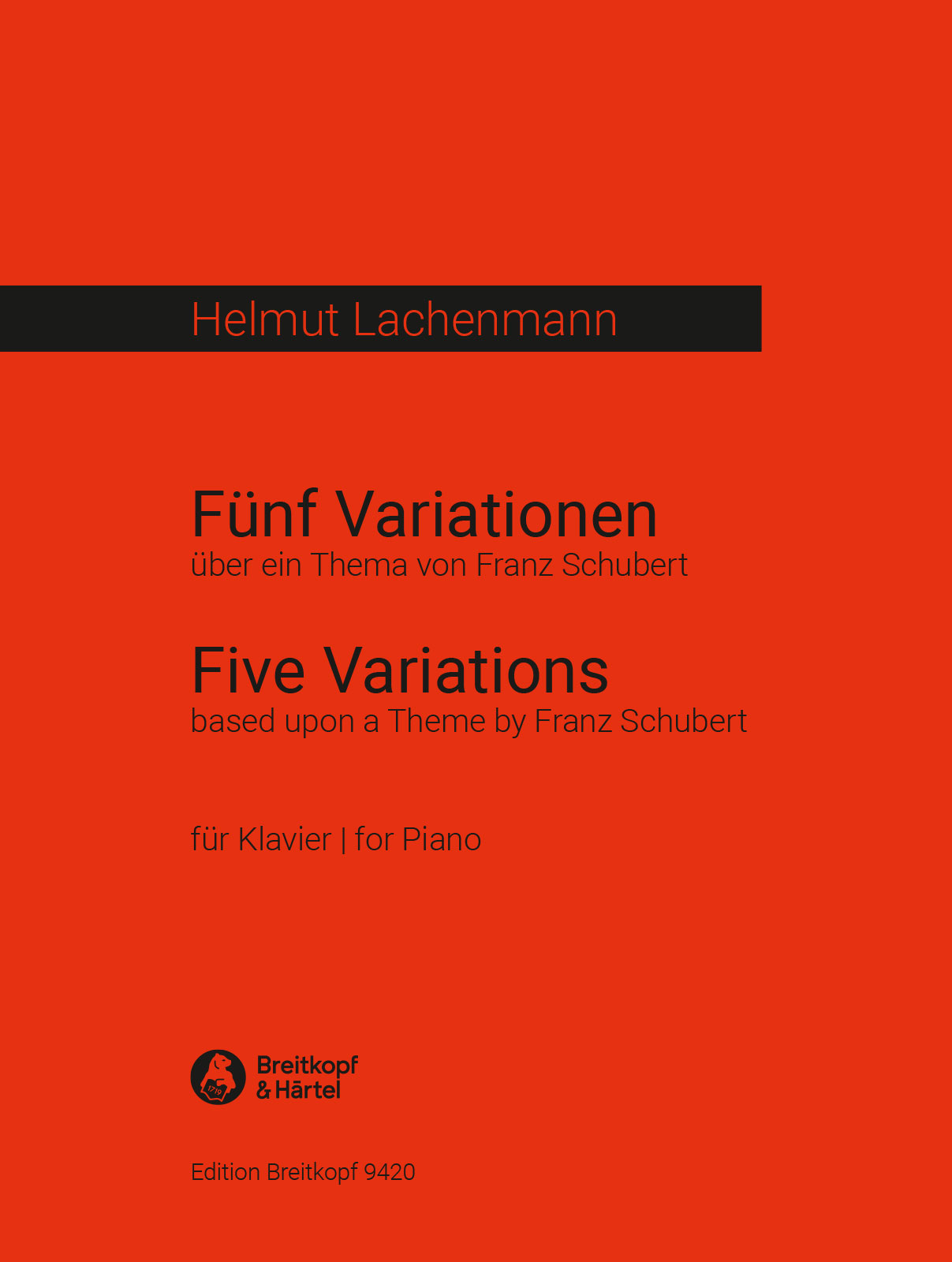
Helmut Lachenmann's 5 Variations on a Theme by Schubert (5 Variationen über ein Thema von Franz Schubert) is an early piano composition written in 1956.
Helmut Lachenmann’s 5 Variations on a Theme by Schubert (5 Variationen über ein Thema von Franz Schubert) is an early piano composition written in 1956.
Although the variations are shaped predominantly by rational compositional means, drawing on the serial techniques of Schoenberg and the late Stravinsky, the playful, musicianly element and the dance‑like character—though continually refracted in different ways—have remained intact.
(Helmut Lachenmann, 1985)
Bourgeois thought is marked by a highly developed system of mechanisms of repression, intended to gloss over the individual’s isolation, alienation, fear, and speechlessness. Our cultural establishment is an essential part of this system of repression. In this sense, it has appropriated tradition: it preserves the illusion of a shared basis of understanding—one that in reality has long since been lost—through the conservation and fetishisation of historical aesthetic categories and the value systems attached to them. As a synonym for tabooed convention, tradition today forms a revealing part of our present reality.
The Five Variations on a Theme by Franz Schubert were written in 1956, that is, before my studies with Nono. In them, the socially and culturally critical stance outlined above is scarcely recognisable, at most latent. I am fond of the piece in the way one might be fond of souvenirs from one’s youth. It is shaped predominantly by rational principles, drawing on the motivic techniques of Schoenberg and the late Stravinsky, and yet the musicianly element and the dance‑like character—though always differently refracted—have remained intact. What is not yet developed here is the resistance to tradition, insofar as its categories, as prevailing conventions, are subject to those bourgeois mechanisms of repression mentioned earlier.
Helmut Lachenmann
(from the programme booklet for Tage der Neuen Musik, Würzburg 1989)