Miloslav Gajdoš is one of Europe’s most active and inventive bassist-composers. He was born in northern Moravia in 1948 and initially learned violin before transferring to the double bass, studying with Alois Kříž, Jirí Bortlícek and Ludwig Streicher.
[Gajdoš is pronounced GUY-DOSH]
Sextdeciment was composed for 16 bassists from 12 countries and was premiered on 20 March 1997 at Kloster Michaelstein International Workshop in Germany, with a…
Sextdeciment was composed for 16 bassists from 12 countries and was premiered on 20 March 1997 at Kloster Michaelstein International Workshop in Germany, with a second performance the following day.
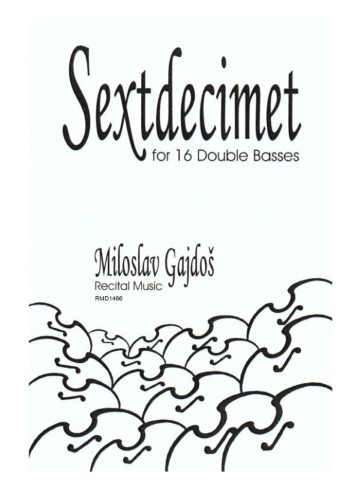
Sextdecimet is a monumental and impressive work which features a solo for each bass alongside tutti passages which explore and exploit the entire range of the double bass. The music is primarily in four or eight parts and in a tonal and traditional style, with each stand/desk of two bassists playing the same part.
Sextdecimet is perfect for any massed double bass festival or workshop, playable with or without a conductor, and would be a spectacular finale to any concert.
The bassists at the premiere were:
Desk 1 – Miloslav Gajdoš & Klaus Trumpf Desk 2 – Ovidiu Badila & Radoslav Šašina Desk 3 – Rudolf Senn & Hans Roelofsen Desk 4 – Petia Bagovska & Alexander Michno Desk 5 – Miloslav Jelínek & Markus Rex Desk 6 – Paul Erhard & Antal Szentirmai Desk 7 – David Heyes & Mette Hanskov
Desk 8 – Lev Rakov & Karoly Saru
With a few small changes Sextdecimet can be performed by bass octet. Each bassist should play both solos for their desk but Solo 6 (Desk 3) should be played by Bass 1 (Desk 1), from bar 309 to the first beat of bar 333, when Bass 1 continues with Desk 1 music.