| Product Code: | RMD1691 |
| Publishers Number: | RMD1691 |
| Published date:: | 18-Dec-25 |
| Language: | English |
| Condition: | New |
He now lives in the Ozark Mountains of Arkansas, where he teaches double bass at the University of Arkansas Fayetteville and privately in his home studio. Michael has composed numerous works for young double bassists (including over five dozen short bass quartets for young students) which are published by Recital Music and two American publishers.
His articles about bass performance, literature, and teaching have been published in American Suzuki Journal, Bass World, and Pastoral Music.
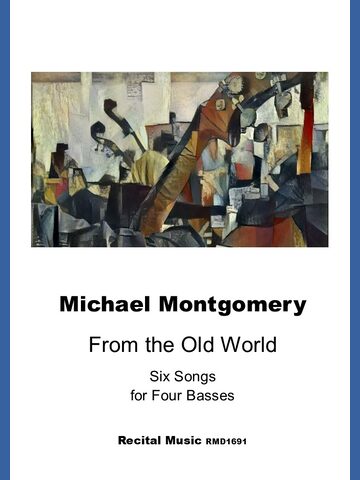
From the Old World is a collection of six European folk songs which have been arranged for double bass quartet with great skill and ingenuity…
The edition includes a score and parts and there are few technical challenges but many opportunities to play popular folk songs in straightforward settings alongside numerous performance possibilities.
The six pieces are short and succinct and the repeat of each can easily be used to create length, variety and contrast. Pizzicato, sul ponticello, tremolando and col legno can be introduced to produce new textures and sound worlds alongside playing the accompaniment without the melody on one repeat.
The parts can be shared between the players as needed and the performance possibilities are endless. The double bass quartets of this collection are short and simple arrangements of six European Folk Songs from the 18th and 19th-centuries. In each Bass 4 plays mainly in First Position and the range of Bass 3 extends from 1st to 6th positions.
The upper two parts offer a non-threatening introduction to the upper register of the instrument: Bass 2 plays the melody of each song in thumb position, while Bass 1 embellishes the accompaniments using only nine harmonics found at the end of the fingerboard.
1. Au Clair de la Lune (French, 1808) Although it is well established that Au Claire de la Lune has had a significant place in popular French culture for many generations, we do not know exactly when it came to be or the identity of an original composer – but most sources agree its printed version first appeared with the 1808 Louis Emmanuel Félicité Charles’ opera Les voitures versées.
2. Auld Lang Syne (Scottish, 1788) In 1788 Scottish poet Robert Burns wrote a text which he set to the music of “an old song, of the olden times, and which has never been in print”. To this day that song, Auld Lang Syne , is traditionally sung with a toast at midnight on New Year’s Eve the world over to welcome in the New Year.
3. Baa! Baa! Black Sheep (English, 1744) It is thought the text of this song, first printed in 1744, might have originally been written long ago in reaction to the heavy tax placed by King Edward on wool in the 13th-century, as he looked for a way to pay for the crusades. The melody was lifted from a 1761 French folk tune, one on which Mozart based his famous Twelve Variations on Ah vous dirai-je, maman (K.265/300e). This melody is also used with Twinkle, Twinkle and the Alphabet Song.
4. Cockles and Mussels (Irish, 1876) A number of earlier versions of this song are known to exist, but the first published one is thought to be from a collection of College Songs in 1876 (J.B. Geoghegan is credited with this). A later version was also published by James Yorkston in 1884. Cockles and Mussels, considered the unofficial anthem of Dublin, is often referred to as Molly Malone in that it tells the poignant story of a fishmonger of this name who died young in the streets of Dublin.
5. Home Sweet Home (American/English, 1822) The song Home Sweet Home was included in the English opera Claribel or The Maid of Milan (lyrics by American John Howard Payne and music by English composer Sir Henry Bishop), which was premiered on 8 May 1823. The lyrics, which Payne wrote the year before, are said to have been inspired by a peasant woman he heard singing in the streets of Italy. The song became one of the most popular in the English-speaking world in the 19th-century, and it was particularly beloved during the American Civil War, when it was often sung by both Union and Confederate soldiers lamenting their long months away from home.
6. The Mulberry Bush (English, 1728) First recorded as a children’s game by James Orchard Halliwell in the 1840s, this song originated as a popular mid-18th-century dance tune made famous by English actor and dancer Nancy Dawson who danced to it during the intermission of The Beggar’s Opera, which premiered on 29 January 1728 at Lincoln’s Inn Fields Theatre in London. [Programme note by Michael Montgomery]
R.R.P £8.00
Our Price: £6.40
Digital Download – PDF
Shipping costs: No shipping
Your basket is currently empty!
Notifications