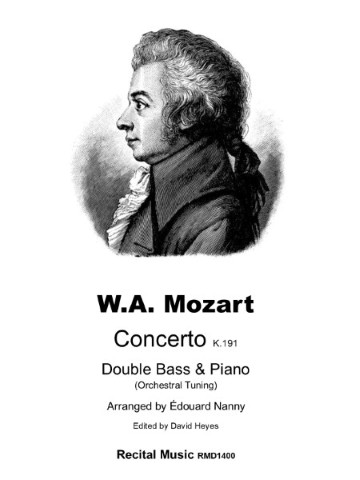
Composer: Mozart, Wolfgang Amadeus
Arranger: Nanny, Edouard
Editor: Heyes, David
Instrumentation: Double Bass and Piano
Publisher:
| Product Code: | RMD1400 |
| Publishers Number: | RMD1400 |
| Language: | English |
| Condition: | New |
In his adolescent years, Mozart’s creative output and technical command of music rapidly evolved, setting new standards for the art form. His early works, composed under the bright lights of European audiences, combined technical brilliance with an intimate emotional depth. Whether drafting lively sonatas or elaborate symphonies, Mozart’s compositions sparkled with a refined elegance that was both accessible and sophisticated. His ability to blend innovation with classical form revolutionized the musical world. In the vibrant salons and opera houses of his time, audiences were treated to works that pushed the boundaries of traditional composition, introducing new dynamics, intricate counterpoints, and a playful use of melody that still resonates today. This period of experimentation not only solidified his reputation as a prodigious talent but also laid the groundwork for the many masterpieces that would emerge in his later life.
While Mozart’s early works laid a strong foundation, it is his mature compositions that truly define his legacy. In operas such as “The Marriage of Figaro,” “Don Giovanni,” and “The Magic Flute,” Mozart showcased his ability to blend humour, drama, and human emotion into a tapestry of sound that captured the complexities of human nature. Each opera is a masterful amalgamation of libretto, orchestration, and vocal prowess, revealing a deep understanding of the human condition that is both timeless and universally appealing. Mozart’s symphonies and concertos further extend his genius, featuring layers of tonal beauty and structural innovation that challenge and inspire musicians and audiences alike. His music, characterized by its clarity, balance, and emotional depth, continues to evoke powerful responses, transcending the confines of time and geography to touch listeners worldwide.
Beyond his technical brilliance, what truly sets Mozart apart is the sheer emotional range and expressive power embedded in his works. His compositions often move effortlessly between moments of joyful exuberance and profound melancholy, reflecting the duality of life itself. Despite living a relatively short life—Mozart passed away at the young age of 35—his musical output was incredibly prolific, leaving behind a legacy of over 600 works that span every genre of his era. The enduring popularity of these works is a testament to their universal appeal. Whether performed in grand concert halls or intimate chamber settings, Mozart’s music continues to inspire both seasoned musicians and new audiences. His ability to convey complex human emotions through the language of music creates a bridge between cultures and eras, making his art as relevant today as it was centuries ago.
Mozart’s profound influence on the evolution of Western music is undeniable. His innovative approach to composition redefined the possibilities of musical structure and storytelling, paving the way for future generations of composers. Many of Mozart’s contemporaries and successors, including Ludwig van Beethoven and Franz Schubert, were deeply inspired by his work, incorporating aspects of his style into their own compositions. Moreover, Mozart’s deft handling of form and structure has been studied by music scholars and educators for generations, with his works serving as quintessential examples of balance, clarity, and ingenuity. Today, his music is not only a staple of the classical repertoire but also a living document of the creative spirit that propelled the Classical era into modern consciousness.
In reflection, Mozart’s life and music embody the pinnacle of artistic expression, where technical mastery meets emotional sincerity in a celebration of life’s intricacies. His journey from a precocious child prodigy to a mature, innovative composer is a narrative filled with both brilliance and poignant struggle, providing insight into the nature of genius itself. Even though Mozart’s life was tragically brief, his relentless pursuit of excellence in every musical endeavor left behind an oeuvre that continues to evoke admiration and introspection. As listeners and performers alike delve into the intricate techniques and heartfelt emotion woven throughout his compositions, they not only experience the beauty of the music but are also reminded of the timeless connection between art and human experience. Mozart’s story is a continuous call to embrace creativity and passion, inspiring generations to push beyond conventional boundaries in their own artistic pursuits.
Mozart’s enduring genius forever continues to inspire music lovers worldwide.
Mozart's Bassoon Concerto K.191 in B flat major was completed in Salzburg on 4 June 1774, when the composer was only 18 years old. He…
The Mozart family had recently returned from one of their many visits to Italy and were newly settled at the Hannibal-Platz in Salzburg in 1772 and two years before, Prince-Archbishop Colleredo confirmed Mozart’s position as Konzertmeister.
For many years the Bassoon Concerto was believed to have been composed for the amateur bassoonist and wealthy patron Baron Thaddäus von Dürnitz but it was more likely to have been composed for Heinrich Schulz or Melchior Sandmayr, bassoonists at the Salzburg court.
Scored for solo bassoon, 2 oboes, 2 horns and strings, the concerto is in three movements, and is one of the most popular and performed works in the bassoon repertoire. The contrasting movements demonstrate the many possibilities of the bassoon and Mozart composed an early masterpiece which demonstrates a thorough understanding of the instrument, even though he didn’t play the instrument.
The first movement (Allegro) is the longest of the three and exploits the full range of the bassoon, as well as its ability to play wide leaps with ease and fast scale passages followed by a more expansive and lyrical slow movement (Andante ma adagio) which emphasises the bassoon’s cantabile and singing qualities above an accompaniment of muted strings. The finale (Rondo: Tempo di menuetto), the shortest of the three, is lively and ebullient and full of great character and classical spirit.
Mozart’s Bassoon Concerto exists in a number of versions for double bass, the main ones being by Édouard Nanny (1872-1942) and Stuart Sankey (1927-2000). Nanny’s transcription dates from 1928 (Alphonse Leduc et Cie, Paris) and is transposed into A major, with the double bass part in G major for solo tuning. The solo part is written a 6th higher than the original bassoon part, but in reality sounding a semitone below the original key.
Nanny makes a good case for the change of key and register and after 95 years it is still in print. He adds fingering and bowing suggestions and writes a very evocative and beautifully written cadenza in the slow movement, but nothing for the others.
Nanny removes eight bars before the end of the first movement, which included
space for a cadenza, and also amends the end of the last movement, but otherwise remains fairly true to the original.
Stuart Sankey’s edition (IMC, 1964) is in B flat major and for double bass in orchestral tuning, presumably to make use of the existing piano accompaniment and with no added typesetting or printing costs for the publisher, apart from amending the title page and producing a solo double bass part. Sankey also adds fingerings and bowings and changes a few notes which are too low to play on a four stringed double bass. He suggests some passages can be played in a higher register and also includes cadenzas in each movement which are effective and well written, although the one in the last movement is only two bars long.
Both editions are by respected bassists and each offer something different to the performer – the Nanny version is more virtuosic and is in solo tuning, using the solo register predominantly, whereas the Sankey edition generally uses more of the orchestral register, although the cadenza does take the player to the higher end of the fingerboard. Both are well conceived for the double bass – the Nanny will be too high for some bassists and the Sankey too low for others. The choice is yours…
[David Heyes / 10 July 2018]
R.R.P £7.50
Our Price: 6
Digital Download – PDF
Shipping costs: No shipping
Your basket is currently empty!
Notifications