Johannes Brahms was a German composer, pianist, and conductor of the mid-Romantic period, born on May 7, 1833, in Hamburg, Germany. He passed away on April 3, 1897, in Vienna, Austria-Hungary (now Austria). Brahms is often grouped with Johann Sebastian Bach and Ludwig van Beethoven as one of the “Three Bs” of music, a comment originally made by the nineteenth-century conductor Hans von Bülow.
Brahms’s music includes symphonies, concerti, chamber music, piano works, choral compositions, and over 200 songs. His style is deeply rooted in the structures and compositional techniques of the Classical masters, yet his music also embodies deeply Romantic motifs. While some contemporaries found his music to be overly academic, his craftsmanship was admired by later figures as diverse as Arnold Schoenberg and Edward Elgar.<
His life began in a Lutheran family, and his father, Johann Jakob Brahms, was a musician who found work as a jobbing musician and a string and wind player in Hamburg. Johannes showed early promise as a pianist and first studied music with his father. At age seven, he was sent for piano lessons to F.W. Cossel, who three years later passed him to his own teacher, Eduard Marxsen.
Between ages 14 and 16, Brahms helped support his family by playing in inns in the dock area of Hamburg, while also composing and sometimes giving recitals. In 1850, he met Eduard Reményi, a Jewish Hungarian violinist, with whom he gave concerts and from whom he learned something of Roma music—an influence that remained with him always.
The turning point in his career came in 1853 when he met the violin virtuoso Joseph Joachim, who instantly recognized Brahms’s talent. Joachim introduced him to composer Robert Schumann, and this connection led to Brahms’s music being published and gaining recognition
Brahms was a virtuoso pianist who premiered many of his own works. He worked with leading performers of his time, including the pianist Clara Schumann and the violinist Joseph Joachim, the latter being a close friend. His works have become staples of the modern concert repertoire, and his influence on music has been profound, with his detailed construction of works serving as a starting point and inspiration for a generation of composers.
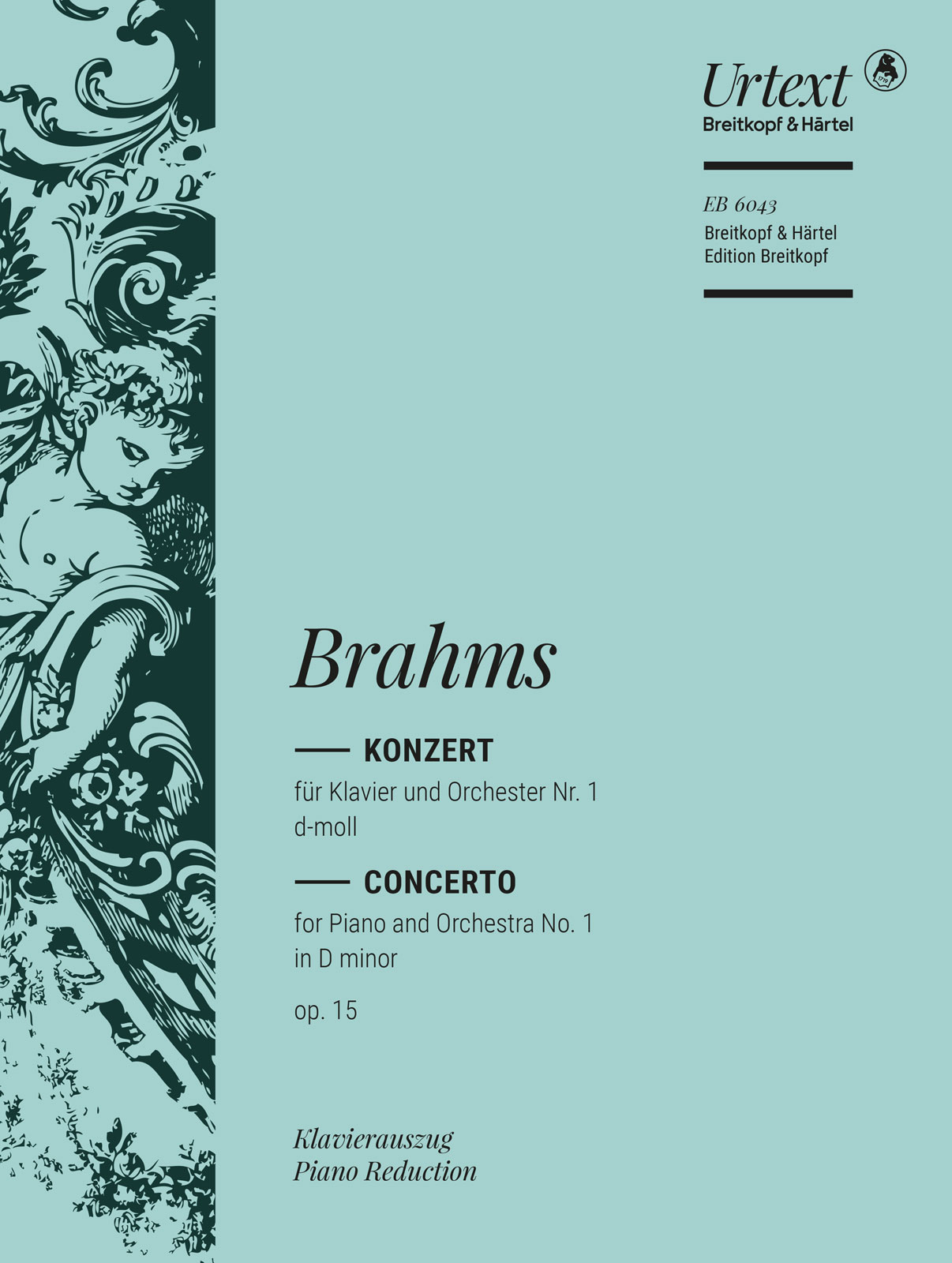
Johannes Brahms‘ first Piano Concerto was the fruit of a complex, protracted, and extremely trying creative process. Its origin goes back to a sonata in…
Johannes Brahms‘ first Piano Concerto was the fruit of a complex, protracted, and extremely trying creative process. Its origin goes back to a sonata in D minor for two pianos conceived in spring 1854. The impulse for the creation of the main subject was however a shocking event: According to Joseqph Joachim, the theme originated “after hearing about Schumanns suicide attempt.” A few months earlier, Schumann had revealed Brahms to the musical world in his essay “New Paths”. In this article, Brahms is extolled as the musician who “is called to give expression to the feeling of his times in an ideal fashion.” The unusually rapid genesis of the D-minor sonata and its prevailingly dark, monumental mood can be interpreted as an impassioned compositional response to Schumann’s suicide attempt. However, the year-long struggle to arrive at the final form of the work should perhaps also be seen in the context of the resounding praise of Schumann’s prophetic article. Brahms undoubtly felt a growing inner pressure to live up to the expectations aroused therein.
Together with Clara Schumann, Brahms played the three so far existing movements of the sonata, but he was very self-critical. He felt that he had not been able to realize the monumentality he had envisioned, and which Clara Schumann felt, by merely doubling the piano sound. He soon decided to transform the sonata into a symphony (his first orchestral project). However, this idea did not seem to fit his vision either. Only in spring 1855 did he strike upon the definitive solution: a piano concerto. With Brahms as soloist, this concerto premiered in 1859, though he initially had little success. He wrote to Joachim about one of the first performances that the concerto was a “brilliant and unmistakable – failure.” This hardly surprised Brahms, for he was undoubtedly aware of the newness of the work, which surpassed the expectations of the audience. The work’s complex structure and symphonic dimensions, the solo part’s rejection of showy, elegant brilliance, and the uniquely Brahmsian orchestral density it maintains throughout; all of these qualities inevitably exasperated audiences at first – until they raised this work to the ranks of the most celebrated concertos of all time.
R.R.P 24
Our Price: 20
Digital Download – PDF
Please create and forward a copy of this publication to the customer