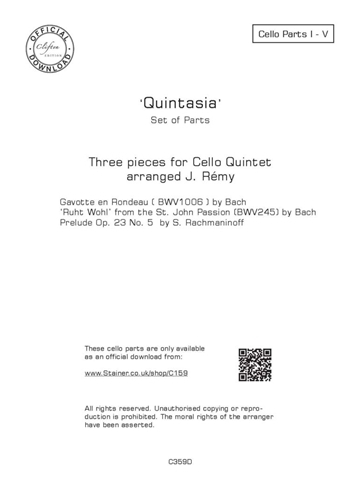
Quintasia – 3 Pieces for Cello Quintet
Digital Download – PDF
R.R.P £9.95
Our Price: £8.46
Composer: Bach, Johann Sebastian; Rachmaninov, Sergei
Arranged for: 5 Cellos
Arranger: Remy, J.;
Format: Parts
Publisher Clifton Edition
About the Composers
Bach, Johann Sebastian
Johann Sebastian Bach was a German composer and musician of the late Baroque period, born on March 31, 1685 (O.S. March 21), in Eisenach, Thuringia, Ernestine Saxon Duchies (now Germany). He passed away on July 28, 1750, in Leipzig.
Bach is now generally regarded as one of the greatest and most prolific composers of all time and is celebrated as the creator of the Brandenburg Concertos, The Well-Tempered Clavier, the Mass in B Minor, the St John and St Matthew Passions, the Christmas Oratorio and more than 300 cantatas (although only around 200 are extant. He numerous other masterpieces of church and instrumental music.
Bach’s abilities as an organist were highly respected throughout his lifetime, although he was not widely recognized as a great composer until after his death. Today, he is considered to be the master of fugue, the inventor of the solo keyboard concerto, and the greatest composer of the Baroque era.
His compositions include a wide variety of music such as orchestral music (e.g., the Brandenburg Concertos), solo instrumental works (e.g., the Cello Suites and Sonatas and Partitas for Solo Violin), keyboard works (e.g., the Goldberg Variations and The Well-Tempered Clavier), organ works (e.g., the Schübler Chorales and the Toccata and Fugue in D Minor), and choral works (e.g., the St. Matthew Passion and the Mass in B Minor).
Bach came from a highly musical family and was the last child of a city musician, Johann Ambrosius. After being orphaned at the age of 10, he lived with his eldest brother, Johann Christoph, and continued his musical education in Lüneburg. His career included working as a musician for Protestant churches in Arnstadt and Mühlhausen and at courts in Weimar and Köthen before becoming Thomaskantor (cantor at St. Thomas’s) in Leipzig.
In Leipzig, he composed music for the principal Lutheran churches of the city and for its university’s student ensemble Collegium Musicum. Despite difficult relations with his employer, Bach’s music flourished, and he enriched established German styles through his mastery of counterpoint, harmonic, and motivic organization, and his adaptation of rhythms, forms, and textures from abroad, particularly from Italy and France.
Bach’s legacy is immense, having enriched the German musical tradition and set a precedent in composition that would influence subsequent generations of composers.
Rachmaninov, Sergei
Sergei Vasilyevich Rachmaninov was a Russian composer, virtuoso pianist, and conductor, born on April 1, 1873, in Semyonovo, Russia, and he passed away on March 28, 1943, in Beverly Hills, California, USA. He is widely regarded as one of the finest pianists of his day and as a composer, one of the last great representatives of Romanticism in Russian classical music.
Rachmaninov’s music is known for its song-like melodicism, expressiveness, dense contrapuntal textures, and rich orchestral colors. His compositional output prominently features the piano, and he used his skills as a performer to explore the expressive and technical possibilities of the instrument.
His early life was marked by musical influences from his family and he began learning the piano at the age of four. He studied piano and composition at the Moscow Conservatory, graduating in 1892 with several compositions already to his name. However, the disastrous premiere of his Symphony No. 1 in 1897 led to a four-year depression during which he composed little until he completed his well-received Piano Concerto No. 2 in 1901.
After the Russian Revolution, Rachmaninov left Russia permanently, settling in New York in 1918. He spent most of his time touring as a pianist through the US and Europe, and from 1932 onwards, he spent his summers at his villa in Switzerland. His compositional output decreased significantly after leaving Russia, completing just six works.
Rachmaninov’s health declined by 1942, leading him to move to Beverly Hills, where he died from melanoma in 1943. Despite the challenges he faced, his legacy as a leading piano virtuoso and a major composer of the 20th century endures, with works such as the “Piano Concerto No. 2 in C Minor, Op. 18,” “Piano Concerto No. 3 in D Minor, Op. 30,” “Preludes,” “Rhapsody on a Theme of Paganini,” and “Symphonic Dances” remaining popular and frequently performed.
Clifton Editions' publication "Quintasia" is a collection of three pieces for five cellos, two of which are by J.S. Bach and one by Sergei Rachmaninoff.
J.S….
Page ? of ?