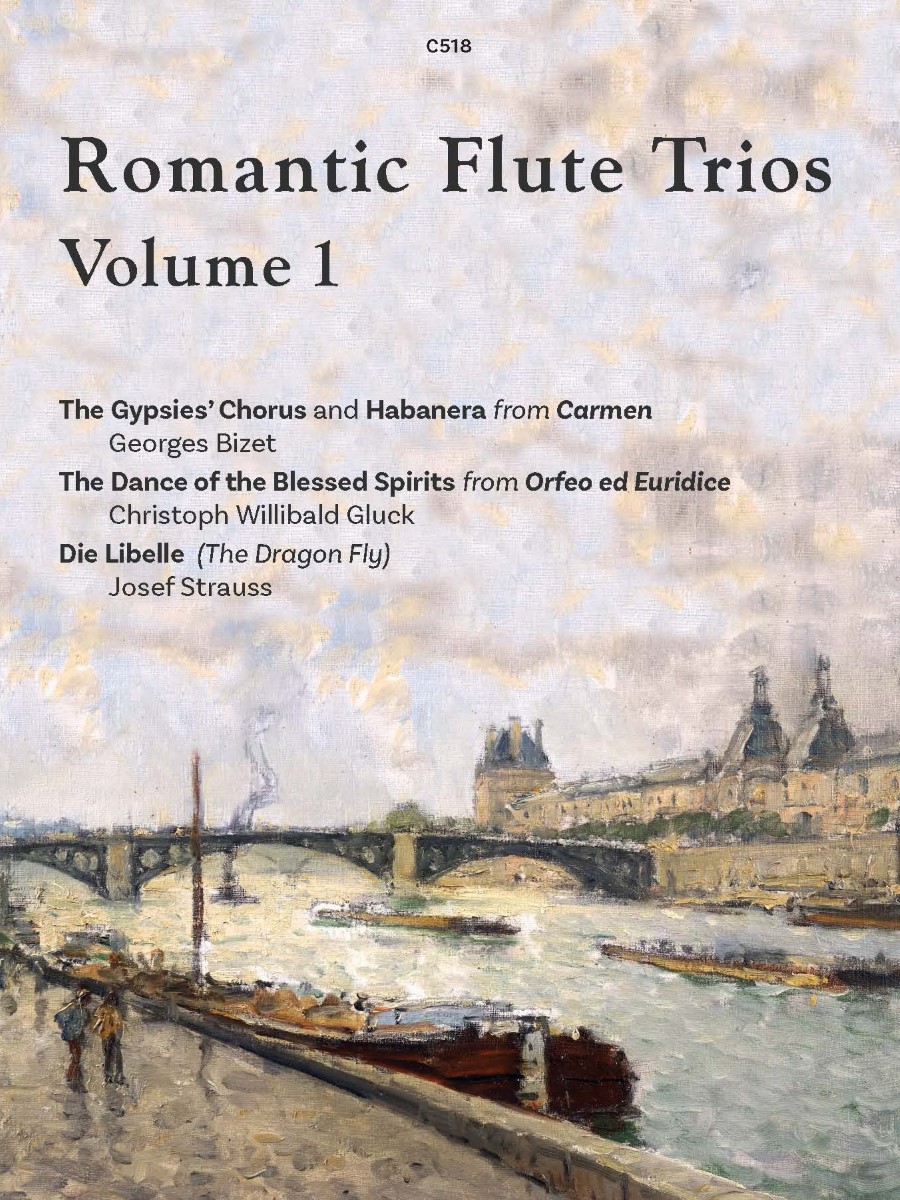
Romantic Flute Trios Volume 1
Score and Parts
Digital Download – PDF
R.R.P £15.95
Our Price: £13.56
Composer: Bizet, Georges; Gluck, Christoph Willibald; Christoph Willibald von; Strauss, Josef;
Instrumentation: 3 Flutes
Arranger: Dods, Marcus; Malcolm, Peter;
Publisher Clifton Edition
About the Composers
Bizet, Georges
Georges Bizet, originally named Alexandre César Léopold Bizet, was a French composer of the Romantic era born on October 25, 1838, in Paris, France. He is best known for his operas, particularly Carmen, which has become one of the most popular and frequently performed works in the entire opera repertoire.
Bizet was a prodigy at the Conservatoire de Paris, winning many prizes, including the prestigious Prix de Rome in 1857. Despite being recognized as an outstanding pianist, he chose not to perform publicly often. After spending almost three years in Italy, he returned to Paris to find that the main opera theatres preferred established classical repertoires over newcomers’ works.
His career faced challenges as his keyboard and orchestral compositions were largely ignored, leading him to earn a living by arranging and transcribing the music of others. He began many theatrical projects in the 1860s, but most were abandoned, and neither of his two operas that reached the stage during this time—Les pêcheurs de perles and La jolie fille de Perth—were immediately successful.
After serving in the National Guard during the Franco-Prussian War of 1870–1871, he had little success with his one-act opera Djamileh. However, an orchestral suite derived from his incidental music to Alphonse Daudet’s play L’Arlésienne was instantly popular. The production of Carmen was delayed due to concerns that its themes of betrayal and murder would offend audiences. After its premiere on March 3, 1875, Bizet was convinced that the work was a failure. Tragically, he died of a heart attack three months later, on June 3, 1875, in Bougival, near Paris, unaware that Carmen would prove to be a spectacular and enduring success.
Bizet’s marriage to Geneviève Halévy was intermittently happy and produced one son. After his death, apart from Carmen, his work was generally neglected. Manuscripts were given away or lost, and published versions of his works were frequently revised and adapted by others. He founded no school and had no obvious disciples or successors. Despite years of neglect, his works began to be performed more frequently in the 20th century, and commentators have acclaimed him as a composer of brilliance and originality whose premature death was a significant loss to French musical theatre.
Strauss, Josef
Josef Strauss was an Austrian composer, born on August 20, 1827, in Mariahilf (now part of Vienna), Austria. He was the son of Johann Strauss I and Maria Anna Streim, and the brother of Johann Strauss II and Eduard Strauss.
Initially, Josef pursued a career in engineering and worked for the city of Vienna as an engineer and designer. He even designed a horse-drawn revolving brush street-sweeping vehicle and published two textbooks on mathematical subjects.
Despite his father’s wishes for him to have a career in the Austrian Habsburg military, Josef’s talents in music were undeniable. He studied music with Franz Dolleschal and learned to play the violin with Franz Anton Ries. He had a wide array of talents, including being an artist, painter, poet, dramatist, singer, composer, and inventor.
Josef joined the family orchestra in the 1850s, alongside his brothers. His first published work was “Die Ersten und Letzten” (The First and the Last). When Johann became seriously ill in 1853, Josef led the orchestra for a while. His compositions were well-received, and he decided to continue in the family tradition of composing dance music. Johann once remarked, “Pepi is the more gifted of us two; I am merely the more popular…”.
Josef married Caroline Pruckmayer at the church of St. Johann Nepomuk in Vienna on June 8, 1857, and they had one daughter, Karolina Anna, born on March 27, 1858. As a composer, Josef wrote 283 opus numbers, including many waltzes like “Sphären-Klänge” (Music of the Spheres), “Delirien” (Deliriums), “Transaktionen” (Transactions), “Mein Lebenslauf ist Lieb’ und Lust” (My Character is Love and Joy), and “Dorfschwalben aus Österreich” (Village Swallows from Austria), as well as polkas, most famously the “Pizzicato Polka” co-written with his brother Johann.
Unfortunately, Josef’s later life was plagued by illness. He suffered from fainting spells and intense headaches. During a tour in 1870, he fell unconscious from the conductor’s podium in Warsaw while conducting his ‘Musical Potpourri’, striking his head. He was brought back home to Vienna by his wife, where he died on July 22, 1870. The exact cause of death was not determined as his widow forbade any autopsy.
Originally buried in the St. Marx Cemetery, Josef was later exhumed and reburied in the Vienna Central Cemetery, alongside his mother Anna.
A brand new edition of Romantic Flute Trios Volume 1 contains effective arrangements of Bizet, Gluck and Strauss. This collection, originally published by Pan Educational…
Page ? of ?