Jean Sibelius, born Johan Julius Christian Sibelius, was a Finnish composer of the late Romantic and early-modern periods. He was born on December 8, 1865, in Hämeenlinna, Grand Duchy of Finland, and passed away on September 20, 1957, in Järvenpää, Finland. Sibelius is widely regarded as Finland’s greatest composer, and his music is often credited with having helped Finland develop a stronger national identity during its struggle against Russification in the late 19th century.
Sibelius’s core oeuvre includes a set of seven symphonies, which, like his other major works, are regularly performed and recorded in Finland and around the world. His best-known compositions include Finlandia, the Karelia Suite, Valse triste, the Violin Concerto, the choral symphony Kullervo, and The Swan of Tuonela (from the Lemminkäinen Suite). His other works feature pieces inspired by nature, Nordic mythology, and the Finnish national epic, the Kalevala; over a hundred songs for voice and piano; incidental music for numerous plays; the one-act opera The Maiden in the Tower; chamber music, piano music, Masonic ritual music, and 21 publications of choral music.
Sibelius composed prolifically until the mid-1920s, but after completing his Seventh Symphony (1924), the incidental music for The Tempest (1926), and the tone poem Tapiola (1926), he stopped producing major works in his last 30 years—a period commonly referred to as the “silence of Järvenpää”.
Although he is reputed to have stopped composing, he attempted to continue writing, including abortive efforts on an eighth symphony. In later life, he wrote Masonic music and re-edited some earlier works, while retaining an active but not always favorable interest in new developments in music.
The Finnish 100 mark note featured his image until 2002, when the euro was adopted. Since 2011, Finland has celebrated a flag flying day on December 8, the composer’s birthday, also known as the Day of Finnish Music. In 2015, in celebration of the 150th anniversary of Sibelius’s birth, a number of special concerts and events were held, especially in Helsinki, the Finnish capital.
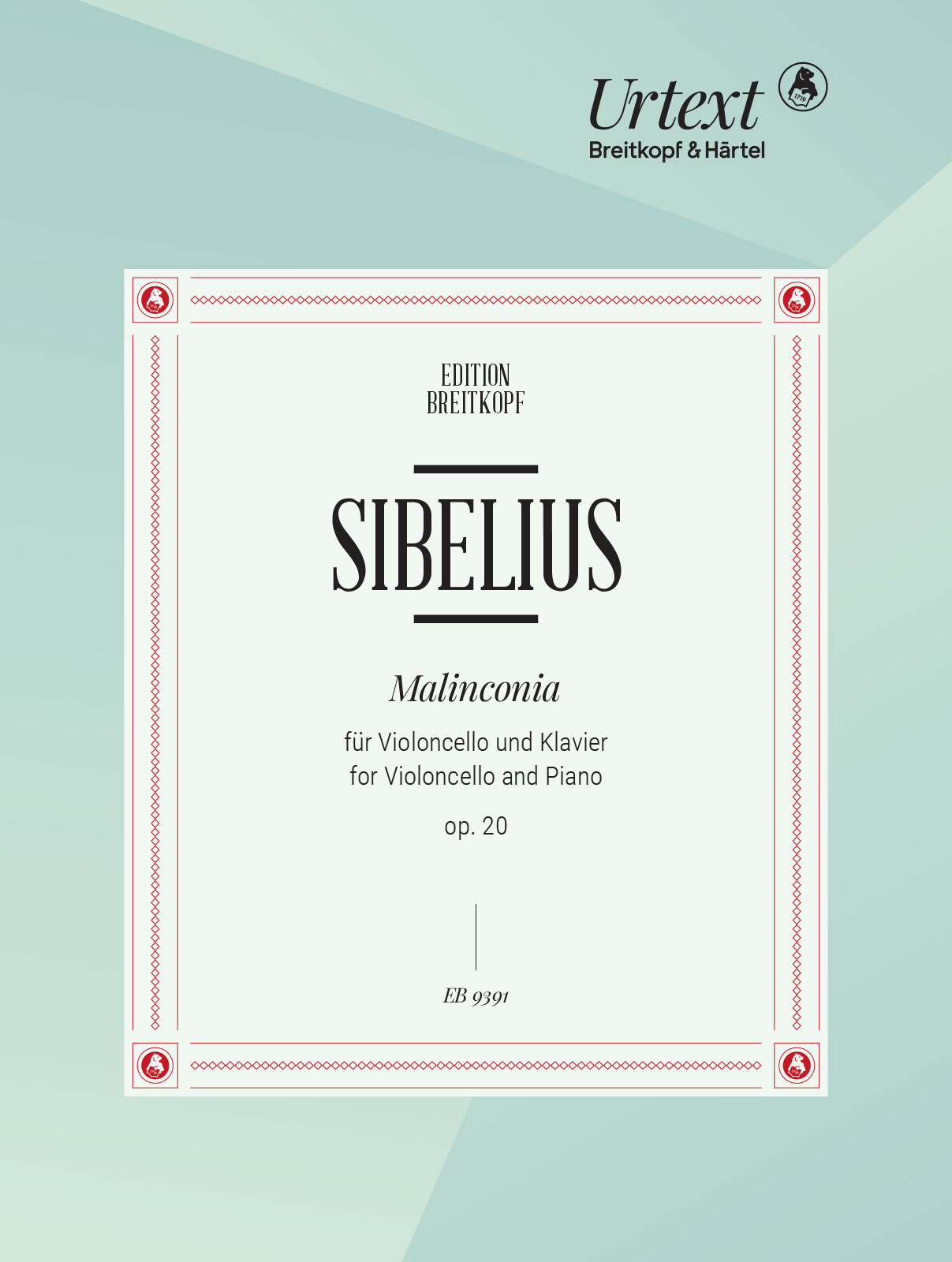
Jean Sibelius composed far less music for the cello than for the violin. Malinconia (op. 20) – published in 1911 but composed in 1900 under the title Fantasia –…
Jean Sibelius composed far less music for the cello than for the violin. Malinconia (op. 20) – published in 1911 but composed in 1900 under the title Fantasia – remained his only opus-numbered work exclusively for cello and piano.
The Fantasia for cello and piano, an early stage of Malinconia, was premiered at a soirée in the Solemnity Hall of the University of Helsinki on 12 March 1900 and was given positive press reviews:
“The work, which mainly drew attention with its logical and clear structure, begins with a powerful and substantial cello solo, to which the piano responds with a glimmering series of arpeggiated chords. At the end where the instruments unite in a harmonious, deeply emotional song, the harmonic impression they create is very bright and lovely.”
The autograph manuscript of Fantasia shows that Sibelius omitted a larger passage of music between the present bars 24 and 25 and that he made further revisions to the work, either before the publishing process or in the proofs he read in April 1911 for Breitkopf.
Digital Download – PDF
Shipping costs: No shipping
Please Note: This product is not fulfilled by The Music Realm Ltd. Breitkopf and Hartel have requested that all purchases are referred to them for watermarking before downloading. This usually takes 1-3 days.We regret that this means you will not be able to download your purchase immediately.
R.R.P £23.00
Our Price: £19.55
Please create and forward a copy of this publication to the customer