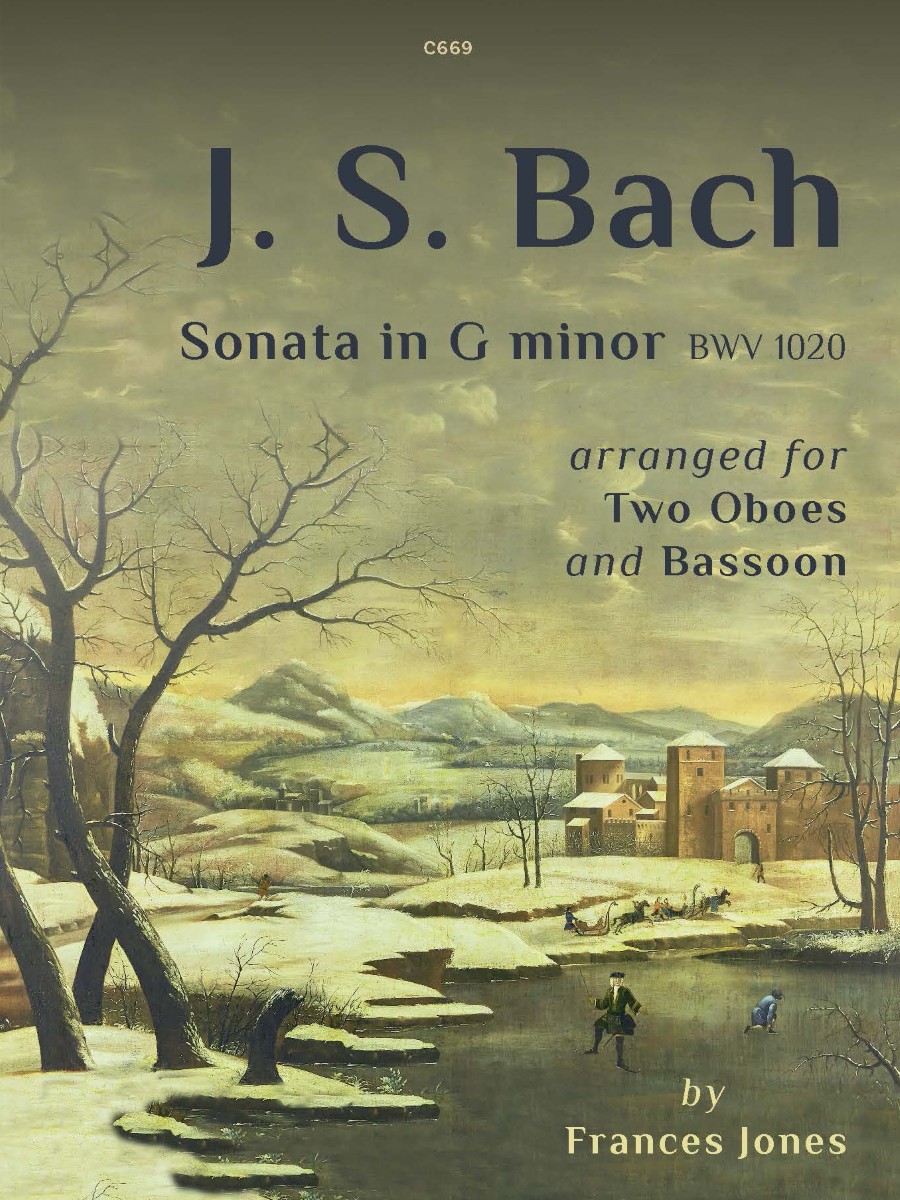
Composer: Bach, Johann Sebastian
Arranger: Jones, Frances
Arranged for: 2 Oboes and Bassoon
Publisher:
| Product Code: | 979-0-570-81669-9 |
| ISMN: | 979-0-570-81669-9 |
| Publishers Number: | C669 |
| Language: | English |
| Page count: | 36 |
| Condition: | New |
Bach is now generally regarded as one of the greatest and most prolific composers of all time and is celebrated as the creator of the Brandenburg Concertos, The Well-Tempered Clavier, the Mass in B Minor, the St John and St Matthew Passions, the Christmas Oratorio and more than 300 cantatas (although only around 200 are extant. He numerous other masterpieces of church and instrumental music.
Bach’s abilities as an organist were highly respected throughout his lifetime, although he was not widely recognized as a great composer until after his death. Today, he is considered to be the master of fugue, the inventor of the solo keyboard concerto, and the greatest composer of the Baroque era.
His compositions include a wide variety of music such as orchestral music (e.g., the Brandenburg Concertos), solo instrumental works (e.g., the Cello Suites and Sonatas and Partitas for Solo Violin), keyboard works (e.g., the Goldberg Variations and The Well-Tempered Clavier), organ works (e.g., the Schübler Chorales and the Toccata and Fugue in D Minor), and choral works (e.g., the St. Matthew Passion and the Mass in B Minor).
Bach came from a highly musical family and was the last child of a city musician, Johann Ambrosius. After being orphaned at the age of 10, he lived with his eldest brother, Johann Christoph, and continued his musical education in Lüneburg. His career included working as a musician for Protestant churches in Arnstadt and Mühlhausen and at courts in Weimar and Köthen before becoming Thomaskantor (cantor at St. Thomas’s) in Leipzig.
In Leipzig, he composed music for the principal Lutheran churches of the city and for its university’s student ensemble Collegium Musicum. Despite difficult relations with his employer, Bach’s music flourished, and he enriched established German styles through his mastery of counterpoint, harmonic, and motivic organization, and his adaptation of rhythms, forms, and textures from abroad, particularly from Italy and France.
Bach’s legacy is immense, having enriched the German musical tradition and set a precedent in composition that would influence subsequent generations of composers.
Little is known about this work Bach’s Sonata in G minor BWV 1020, and no original autograph copy exists. The version upon which modern editions… are based is a manuscript held in the Westdeutsche Bibliothek, Marburg/Lahn (Mus. ms. Bach 1059), stating Sonata del Sign. Bach in an unknown hand. There is much discussion about whether it was composed by Johann Sebastian or by one of his sons. Neither is the date of composition nor the original instrumentation known. The above manuscript specifies a sonata for violin and cembalo, but musicologists doubt the authenticity of this; the solo line does not go below a D, thus does not use the G string at all, nor does it contain any of the string crossing figurations common in baroque violin writing. The flute is much quoted as the preferred melody instrument, and the work was first published by Nagels Musik-Archiv as a sonata for flute and cembalo obbligato in 1931. The writing is not particularly well suited to the flute either as it contains much low detail which does not articulate or project easily on the flute, and does not use the top register of the flute at all. The work has been adopted by oboists in recent years, the tessitura, range and breathing requirements being ideally suited to performance on the oboe. What is in no doubt, though, is the quality of wonderful music therein. It is for this reason that Frances Jones took the liberty of making this present arrangement of the work for two oboes and bassoon, as the writing seems particularly suitable for this. In the outer movements the keyboard part is entirely written as just two voices, the upper being very much an equal contrapuntal line to the ?solo? part. It only once ventures below the middle B flat, thus this second voice is all, with the exception of this one note, within the range of a second oboe player on a modern instrument. The bass voice sits comfortably within the range and style of a bassoon. In the central movement the writing occasionally splits to create a fourth voice, but the music loses very little in using only three for this arrangement. While the editor is not suggesting that this new version is a reconstruction of an original instrumentation of this sonata, nevertheless it suits the music well to play it on the instruments chosen here. In making this arrangement, the editor has exchanged some of the music between the original upper two voices to highlight the echo writing in the original work and to balance the technical interest between the two oboists. Seventeen bars of figured bass (movement 1, bars 13-15, 18-20, 58-60, 63-65 & 93-98) have been elaborated into an appropriate second part. Dynamic marks are few and mostly editorial, offering suggestions for performance and a starting point for the players? own interpretation. Similarly, the articulation marks are suggestions for the double reed sound and can be altered according to taste. Previously Published by Phylloscopus Publications Former catalogue number: PP431
R.R.P 11.5
Our Price: 9.78
Digital Download – PDF
Shipping costs: No shipping
Your basket is currently empty!
Notifications