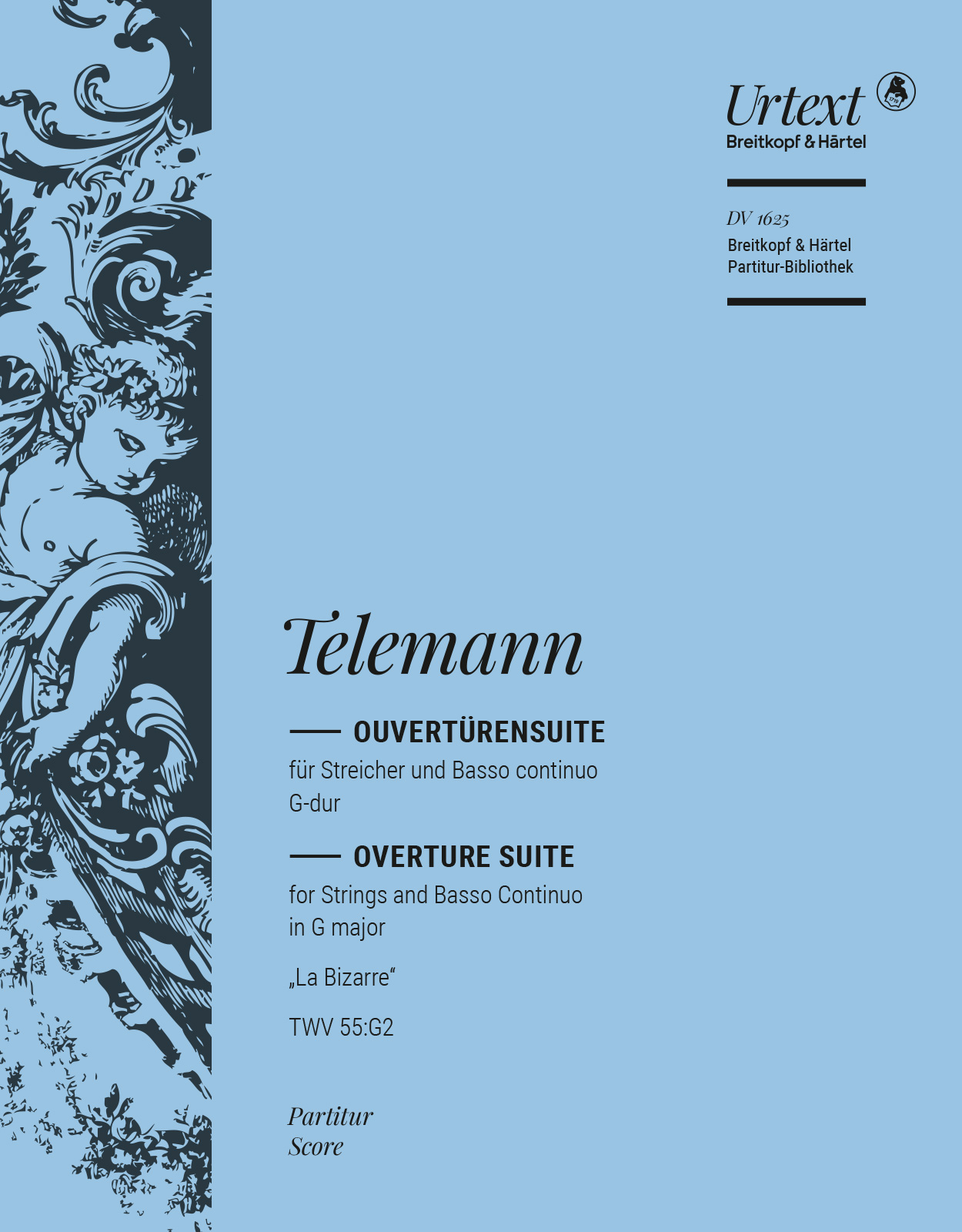
Composer: Telemann, Georg Philipp
Arranger: Bernstein, W.H. (Cont.)
Editor: Hobohm, Wolf
Instrumentation: String Orchestra
Publisher:
| Product Code: | 979-0-200-41499-8 |
| ISMN: | 979-0-200-41499-8 |
| Publishers Number: | DV 1625D |
| Page count: | 30 |
| Condition: | New |
Telemann was considered by his contemporaries to be one of the leading German composers of the time and was compared favorably both to his friend Johann Sebastian Bach, who made Telemann the godfather and namesake of his son Carl Philipp Emanuel, and to George Frideric Handel, whom Telemann also knew personally. Despite opposition from his family, who forbade any musical activities, Telemann pursued his passion for music and became a composer against his family’s wishes.
After studying in Magdeburg, Zellerfeld, and Hildesheim, Telemann entered the University of Leipzig to study law, but he eventually settled on a career in music. He held important positions in Leipzig, Sorau (now Żary, Poland), Eisenach, and Frankfurt before settling in Hamburg in 1721, where he
Telemann’s personal life was often troubled; his first wife died less than two years after their marriage, and his second wife had extramarital affairs and accumulated a large gambling debt before leaving him. As part of his duties, he wrote a considerable amount of music for educating organists under his direction, including 48 chorale preludes and 20 small fugues to accompany his chorale harmonizations for 500 hymns.
His music incorporates French, Italian, and German national styles, and he was at times even influenced by Polish popular music. He remained at the forefront of all new musical tendencies, and his music stands as an important link between the late Baroque and early Classical styles. The Telemann Museum in Hamburg is dedicated to his life and work.
The Overture Suite in G major TWV 55:G2 "La Bizarre" is an orchestral suite for strings and basso continuo by G. P. Telemann consisting of…
I. Ouverture: A French-style overture featuring a slow, dotted-rhythm introduction and a fast fugal section. It is notable for its “bizarre” rhythmic irregularities, particularly a second violin part that operates independently of the main fugal material.
II. Courante: A triple-meter dance featuring subtle uses of ritardando.
III. Gavotte en rondeau: A lively dance in a recurring “rondeau” form.
IV. Branle: A movement based on a 15th-century dance. It is unique for featuring four different time signatures simultaneously: allabreve, 6/4, 2/4, and 6/8.
V. Sarabande: A slow, stately dance.
VI. Fantaisie: A free-form movement.
VII. Menuet I & II: A pair of contrasting minuets.
VIII. Rossignol (Nightingale): A character piece that concludes the suite, often imitating birdsong through violin effects.
R.R.P £16.00
Our Price: £14.00
Digital Download – PDF
Shipping costs: No shipping
Please create and forward a copy of this publication to the customer
Your basket is currently empty!
Notifications