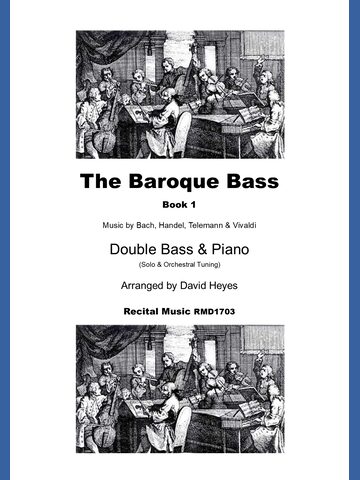
The Baroque Bass Book 1
Solo and Orchestral Tuning
Digital Download – PDF
R.R.P £11.50
Our Price: £9.20
Composer: Bach, Johann Sebastian; Handel, George Frideric; Telemann, Georg Philipp; Vivaldi, Antonio;
Arranger: Heyes, David
Editor: Heyes, David
Publisher Recital Music
About the Composers
Bach, Johann Sebastian
Johann Sebastian Bach was a German composer and musician of the late Baroque period, born on March 31, 1685 (O.S. March 21), in Eisenach, Thuringia, Ernestine Saxon Duchies (now Germany). He passed away on July 28, 1750, in Leipzig.
Bach is now generally regarded as one of the greatest and most prolific composers of all time and is celebrated as the creator of the Brandenburg Concertos, The Well-Tempered Clavier, the Mass in B Minor, the St John and St Matthew Passions, the Christmas Oratorio and more than 300 cantatas (although only around 200 are extant. He numerous other masterpieces of church and instrumental music.
Bach’s abilities as an organist were highly respected throughout his lifetime, although he was not widely recognized as a great composer until after his death. Today, he is considered to be the master of fugue, the inventor of the solo keyboard concerto, and the greatest composer of the Baroque era.
His compositions include a wide variety of music such as orchestral music (e.g., the Brandenburg Concertos), solo instrumental works (e.g., the Cello Suites and Sonatas and Partitas for Solo Violin), keyboard works (e.g., the Goldberg Variations and The Well-Tempered Clavier), organ works (e.g., the Schübler Chorales and the Toccata and Fugue in D Minor), and choral works (e.g., the St. Matthew Passion and the Mass in B Minor).
Bach came from a highly musical family and was the last child of a city musician, Johann Ambrosius. After being orphaned at the age of 10, he lived with his eldest brother, Johann Christoph, and continued his musical education in Lüneburg. His career included working as a musician for Protestant churches in Arnstadt and Mühlhausen and at courts in Weimar and Köthen before becoming Thomaskantor (cantor at St. Thomas’s) in Leipzig.
In Leipzig, he composed music for the principal Lutheran churches of the city and for its university’s student ensemble Collegium Musicum. Despite difficult relations with his employer, Bach’s music flourished, and he enriched established German styles through his mastery of counterpoint, harmonic, and motivic organization, and his adaptation of rhythms, forms, and textures from abroad, particularly from Italy and France.
Bach’s legacy is immense, having enriched the German musical tradition and set a precedent in composition that would influence subsequent generations of composers.
Handel, George Frideric
Georg Friedrich Händel, was a German-born English composer of the late Baroque era, celebrated for his operas, oratorios, and instrumental compositions. He was born on February 23, 1685, in Halle, Brandenburg (now Germany), and passed away on April 14, 1759, in London, England.
Handel’s music is renowned for its grandeur, dramatic qualities, and depth of expression. Notably, he composed the most famous of all oratorios, Messiah (1741), and is also known for such occasional pieces as Water Music (1717) and Music for the Royal Fireworks (1749).
His early musical education was under the composer Friedrich W. Zachow in Halle. After his father’s death, Handel enrolled as a law student at the University of Halle but quickly gravitated towards a career in music. He served as an organist at the Reformed Cathedral in Halle for a year before moving to Hamburg, where he joined the opera orchestra and presided over the premiere of his first opera, Almira.
Handel traveled in Italy from 1706 to 1710, where he met many of the greatest Italian musicians of the day, including Arcangelo Corelli and Alessandro Scarlatti. His time in Italy was prolific, resulting in two operas, numerous Italian solo cantatas, and some Latin church music.
In 1712, Handel settled in London, where he spent the bulk of his career and became a naturalized British subject in 1727. His influence was such that he started three commercial opera companies to supply the English nobility with Italian opera. After a physical breakdown in 1737, he changed direction creatively, addressing the middle class with English choral works. Following the success of Messiah in 1742, he never composed an Italian opera again.
Handel’s legacy includes more than forty operas and a wealth of other works. His music was admired by Classical-era composers, especially Mozart, Haydn, and Beethoven, and remains a cornerstone of the Western classical music canon.
Telemann, Georg Philipp
Georg Philipp Telemann was a German Baroque composer and multi-instrumentalist, born on March 14, 1681, in Magdeburg, Brandenburg, Germany. He passed away on June 25, 1767, in Hamburg. Telemann is one of the most prolific composers in history, with a surviving oeuvre that is among the largest of any composer.
Telemann was considered by his contemporaries to be one of the leading German composers of the time and was compared favorably both to his friend Johann Sebastian Bach, who made Telemann the godfather and namesake of his son Carl Philipp Emanuel, and to George Frideric Handel, whom Telemann also knew personally. Despite opposition from his family, who forbade any musical activities, Telemann pursued his passion for music and became a composer against his family’s wishes.
After studying in Magdeburg, Zellerfeld, and Hildesheim, Telemann entered the University of Leipzig to study law, but he eventually settled on a career in music. He held important positions in Leipzig, Sorau (now Żary, Poland), Eisenach, and Frankfurt before settling in Hamburg in 1721, where he
Telemann’s personal life was often troubled; his first wife died less than two years after their marriage, and his second wife had extramarital affairs and accumulated a large gambling debt before leaving him. As part of his duties, he wrote a considerable amount of music for educating organists under his direction, including 48 chorale preludes and 20 small fugues to accompany his chorale harmonizations for 500 hymns.
His music incorporates French, Italian, and German national styles, and he was at times even influenced by Polish popular music. He remained at the forefront of all new musical tendencies, and his music stands as an important link between the late Baroque and early Classical styles. The Telemann Museum in Hamburg is dedicated to his life and work.
Vivaldi, Antonio
Antonio Vivaldi was an Italian Baroque composer, virtuoso violinist, and teacher born on March 4, 1678, in Venice. He is best known for his contributions to the development of the concerto form and for his numerous concertos for violin and other instruments. Vivaldi’s most famous work is “The Four Seasons,” a series of violin concertos that depict scenes appropriate for each season of the year.
Vivaldi’s early life was marked by his musical talent, which was evident from a young age. He began studying for the priesthood at the age of 15 and was ordained at 25. However, due to a health problem, he was given dispensation to no longer say public Masses.
Throughout his career, Vivaldi composed over 500 concertos, more than 40 operas, and numerous sacred choral works. Many of his compositions were written for the all-female music ensemble of the Ospedale della Pietà, a home for abandoned children in Venice.
Vivaldi’s influence during his lifetime was widespread across Europe, giving origin to many imitators and admirers. He pioneered developments in orchestration, violin technique, and programmatic music. Despite his success during his lifetime, Vivaldi died in poverty in Vienna on July 28, 1741.
After almost two centuries of decline, Vivaldi’s musical reputation underwent a revival in the early 20th century. Many of his compositions, once thought lost, have been rediscovered and continue to be performed and celebrated today.
The Baroque Bass Book 1 brings together eight pieces by four of the most important composers of the Baroque era. Aimed at the intermediate bassist,…
Page ? of ?