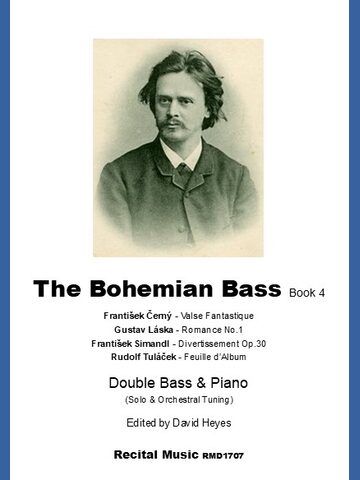
The Bohemian Bass Book 4
Solo and Orchestral Tuning
Digital Download – PDF
R.R.P £11.50
Our Price: £9.20
Composer: Cerny, Frantisek; Laska, Gustav; Simandl, Frantisek; Tulacek, Rudolf;
Instrumentation: Double Bass & Piano
Editor: Heyes, David
Publisher Recital Music
About the Composers
Cerny, Frantisek
František Černý was a Czech bassist, teacher and composer. He was born on 23 January 1860 in Pardubice and studied at the Prague Conservatoire (1876-82) and in Paris, where he later became a member of the Orchestre Colonne-Lamoureux from 1884-1890. He returned to Czechoslovakia in 1890, when he was appointed Principal Bass of the National Theatre Orchestra in Prague (1890-1900), and it was at this time that he discovered the wonderful Grancino double bass of 1693, later owned by Oldrichs Sorejs and František Pošta.
Černý was an outstanding teacher and taught at the Prague Conservatoire for 31 years (1900-31) and many of the leading Czech bassists at the beginning of the 20th-century were taught by him. He was not a prolific composer and most of his works were written for the double bass, including a Method (1906), 30 Etudes-Caprices (1923), Technical Studies in Thumb Position (1927), 4 Concertos and ten salon pieces for double bass and piano.
Černý studied composition with Antonín Dvořák and much of his music reflects the salon style of the late 19th-century. All his works are melodic and appealing, combining the late-Romantic idiom of Dvořák and Brahms, with Czech lyricism and influences, and he makes full use of the solo capabilities of the double bass.
František Černý died in Prague on 3 September 1940.
Laska, Gustav
Gustav Láska was born in Prague on 23 August 1847 and died in Schwerin (Germany) on 16 October 1928, aged 81 and after a long and successful career. He studied at the Prague Conservatoire from 1861-7 with Josef Hrabě (double bass), Jan B. Kittl (music theory) and Josef Krejci (composition) and after graduation gave solo performances in Austria and subsequently became a member of the orchestra in Kassel, Germany. He travelled extensively in Europe and America, both as a soloist and orchestral player, and was Principal Double Bass at the Bayreuth Festival for many years.
Throughout his life Láska also taught, conducted and composed, alongside his solo and orchestral performances, and Franz Tischer-Zeitz who edited the Dittersdorf Concerto in the 1930s, was one of his students. In 1904 his Method for Double Bass Op.50 was published in Leipzig but is practically forgotten today – the fate of many similar double bass tutors. From 1878 until his death in 1928 he was a member of the Court Opera Orchestra of Mecklenburg-Schwerin and was also choirmaster of the Schwerin Singakademie and church choir.
Gustav Láska was a prolific composer, writing in many genres, including three operas (Der Kaisersoldat, Sunde and Abu Seid), two orchestral overtures, two symphonies, sacred choral works, piano music, and many of works for double bass. His music for double bass is well written for the instrument, featuring many technical challenges alongside lyrical and cantabile melodies, but much of it has fallen from the repertoire since his death almost 90 years ago.
The smaller works are probably best described as salon or characteristic music, but of a high quality, and many are still worthy of performance today. His music often fuses the technical skills of the Czech School with the lyricism and virtuosity of Bottesini, although still with one foot very firmly in the Czech camp. The salon style is a little out of step with today’s music making and sensibilities but fashions do change and there is a wealth of great music awaiting rediscovery by the curious and adventurous bassists.
Simandl, Frantisek
František [Franz] Simandl (1840-1912) was one of the leading bassists and teachers of his generation and studied double bass at the Prague Conservatoire with Josef Hrabě. He became a member of the Vienna Philharmonic and taught at the Vienna Conservatoire, teaching many bassists who exported the Czech double bass school to every corner of the world. Although Simandl’s music has fallen from favour in recent times, he was a pioneer of his day and his New Method for Double Bass helped succeeding generations to build and develop the standard of double bass playing today.
Tulacek, Rudolf
Czech bassist-composer, Rudolf Tuláček (1885-1954) studied at Prague Conservatoire with František Černý, was solo double bass of Zagreb Philharmonic Orchestra for many years and in 1937 moved to Brno (Czech Republic) where he was appointed Professor of double bass at the Academy of Music. Tuláček wrote a number of lyrical and characteristic works for double bass at the beginning of the 20th-century and wrote in a tonal and late-romantic style, reminiscent of much salon music of the time.
The Bohemian Bass Book 4 is a collection of four impressive, inventive and mostly forgotten pieces for double bass and piano by leading members of…
Page ? of ?