Composer: Bach, Johann Sebastian
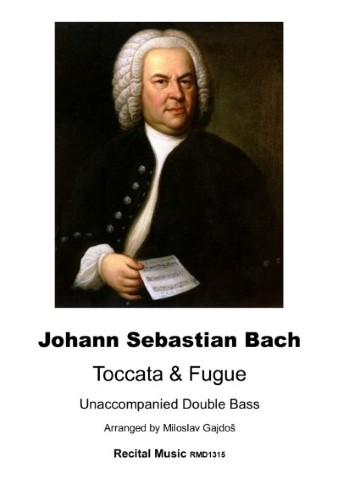
Arranger: Miloslav Gajdos
Arranged for: Double Bass Solo
Publisher:
| Product Code: | RMD1315 |
| Publishers Number: | RMD1315 |
| Language: | English |
| Condition: | New |
Bach is now generally regarded as one of the greatest and most prolific composers of all time and is celebrated as the creator of the Brandenburg Concertos, The Well-Tempered Clavier, the Mass in B Minor, the St John and St Matthew Passions, the Christmas Oratorio and more than 300 cantatas (although only around 200 are extant. He numerous other masterpieces of church and instrumental music.
Bach’s abilities as an organist were highly respected throughout his lifetime, although he was not widely recognized as a great composer until after his death. Today, he is considered to be the master of fugue, the inventor of the solo keyboard concerto, and the greatest composer of the Baroque era.
His compositions include a wide variety of music such as orchestral music (e.g., the Brandenburg Concertos), solo instrumental works (e.g., the Cello Suites and Sonatas and Partitas for Solo Violin), keyboard works (e.g., the Goldberg Variations and The Well-Tempered Clavier), organ works (e.g., the Schübler Chorales and the Toccata and Fugue in D Minor), and choral works (e.g., the St. Matthew Passion and the Mass in B Minor).
Bach came from a highly musical family and was the last child of a city musician, Johann Ambrosius. After being orphaned at the age of 10, he lived with his eldest brother, Johann Christoph, and continued his musical education in Lüneburg. His career included working as a musician for Protestant churches in Arnstadt and Mühlhausen and at courts in Weimar and Köthen before becoming Thomaskantor (cantor at St. Thomas’s) in Leipzig.
In Leipzig, he composed music for the principal Lutheran churches of the city and for its university’s student ensemble Collegium Musicum. Despite difficult relations with his employer, Bach’s music flourished, and he enriched established German styles through his mastery of counterpoint, harmonic, and motivic organization, and his adaptation of rhythms, forms, and textures from abroad, particularly from Italy and France.
Bach’s legacy is immense, having enriched the German musical tradition and set a precedent in composition that would influence subsequent generations of composers.
Bach’s Toccata & Fugue in D minor is a cornerstone of the organ repertoire and is one of the most recognisable works to classical music…
The magnificent arrangement for unaccompanied double bass by Miloslav Gajdoš offers musical and technical challenges throughout and is a monumental and outstanding to the transcription, Repertoire. It sounds in C minor when played in orchestral tuning and in D minor, its original key, when played in solo tuning.
“From the time I seriously started studying the double bass, I realised there was no solo piece for instrument by J. S. Bach. The double bass orchestral parts in his 3rd Brandenburg Concerto or in the Violin Concerto in E major and Double Concerto in D minor for two violins are not enough, even though they are beautiful.
Sometime in 1966, whilst studying at the conservatoire, I was enthralled by hearing the Menuets from the third Cello Suite and together with the Sarabande and Gigue, I decided to rework them for double bass. I chose to use tenor clef instead of bass to achieve the sound, which would not to be too high nor too low. This proved to work even in other cello suites which I later used as study material for my students.
At the beginning of 1990’s I concentrated on three violin partitas and strangely they are more suitable for double bass than the cello suites. I also used tenor clef, instead of treble clef, because the key of the solo double bass remains the same as violin.
It was a monumental task to work on the Chaconne, which was also perfect for playing on double bass. This piece only needed a few minimal changes and I performed it in Berlin 1988 with great success.
Frederick Charlton posted a video performing Bach’s Toccata and Fugue in 2010 in which he preserved the original D minor key for orchestra tuning. After seeing this video, I decided to rewrite this piece for unaccompanied double bass, where the originally dominant note of A would be played on the highest open string.
The premiere of my transcription was in Brno (Czech Republic) in 2011, with very positive feedback. Because the Toccata & Fugue is originally written for organ, it gives the double bass the opportunity to use and show beautiful tone in middle, higher and lower pedal positions. Thanks to very interesting melodic and harmonic sequences we can say the double bass interpretation has been enriched by, so far unknown, resources which build extraordinary place for new, Repertoire.”
[Programme note by Miloslav Gajdoš / Kroměříž 15 January 2023]
R.R.P £8.50
Our Price: 6.8
Digital Download – PDF
Shipping costs: No shipping
Your basket is currently empty!
Notifications