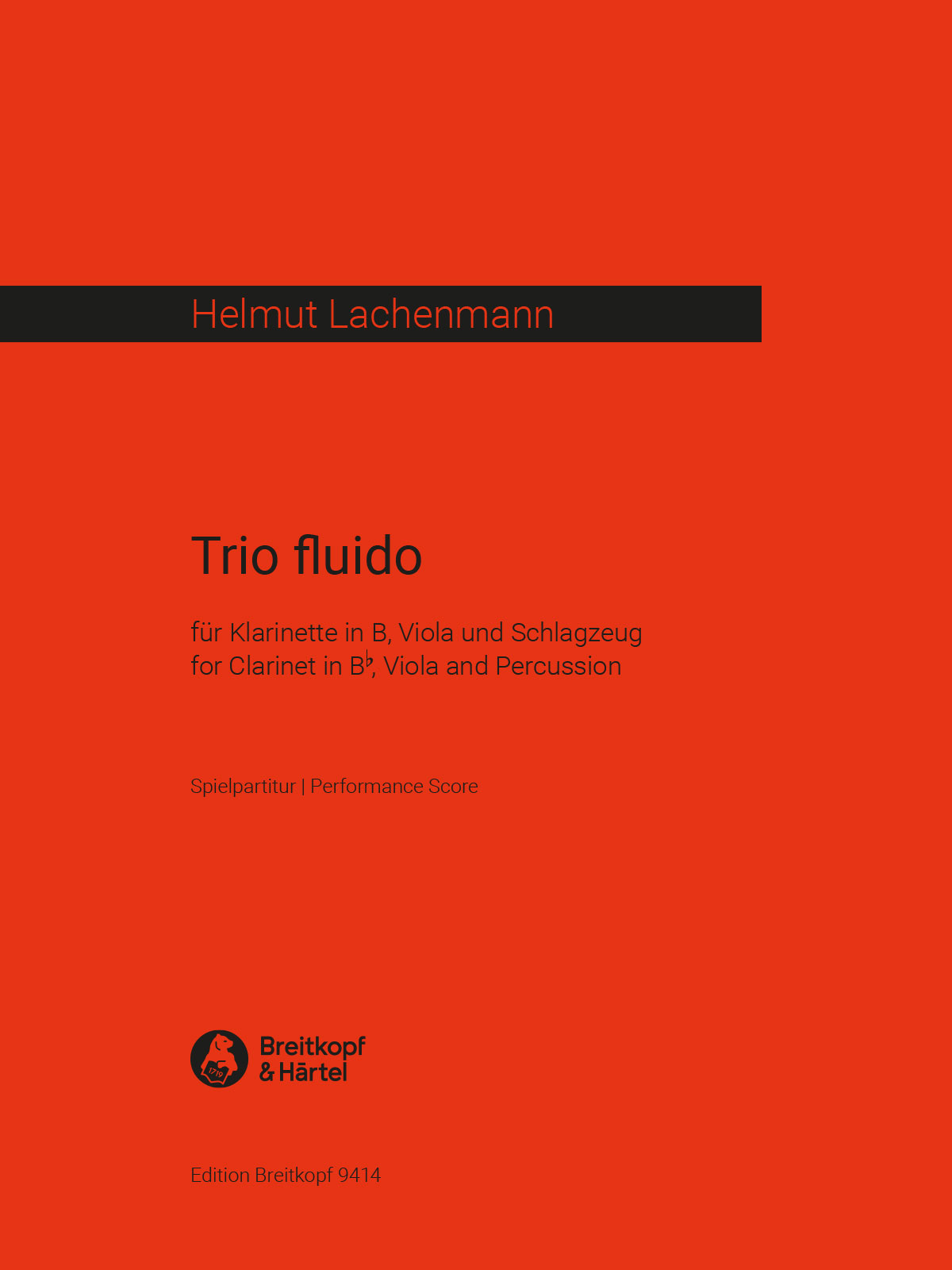
Composer: Lachenmann, Helmut
Instrumentation: B-flat Clarinet, Viola and Percussion
Publisher:
| Product Code: | 979-0-004-81517-5 |
| ISMN: | 979-0-004-81517-5 |
| Publishers Number: | EB 9414D |
| Page count: | 26 |
| Condition: | New |
Trio fluido is a chamber music work composed by Helmut Lachenmann between 1966 and 1967. It is a foundational example of his "musique concrète instrumentale,"…

From the composer:
“For me, the piece represents one of various attempts to break away from a strictly selective musical thinking with which I had identified since my studies with Luigi Nono and to which I was determined to remain faithful in my own way, especially at that time when the so-called avant-garde seemed to be increasingly making surrealist compromises with bourgeois comfort.
The line-up – clarinet, viola and drums (marimba with alpine bells, cymbals, timpani and bongos) – ensured a homogeneous starting point for the instrumental means, from which on the one hand a kind of sound gesture – that is, narrower or more branched tonal figurations – could be developed, while on the other hand the sound differentiation could be pushed further inward, right into the conscious anatomy of the resulting (blown, beaten, rubbed, bowed, plucked, dabbed, etc.) sound. This music moves between these two opposites – the liquefaction of the selective thought here and its petrification or inner rupture, opening there – opposites that I took further to radical extremes in later works, while here the whole thing still has a more abstract, playful overall character remains committed.”
(Helmut Lachenmann, 1989)
Trio fluido , composed even before the solo percussion piece Intérieur I, my “Opus 1,” belongs to a creative period still strongly shaped by structuralism, in which compositional decisions were guided exclusively by relationships and developments derived from the acoustic material itself. Whatever playful elements on the one hand, or alienation and sound‑deconstruction on the other, may be found in this piece “resulted” from the application of such immanently oriented principles and was therefore never the product of expressive speculation.
Formally, the piece presents a curve that is repeatedly broken yet overall both rising and falling: against the backdrop of seemingly loosely strung‑together sections, increasingly extreme material characteristics come to the fore, coalesce, and produce an intensification that then flips into the contrasting state of a static field animated by internal fluctuations. This field itself frays toward the end, revealing—behind the pitch figures—the noise components, behind these the experience of the physical nature of the sounding material, and behind that the time that has been emptied in this way, laid bare, made conscious, and integrated into the musical context.
“Structural music‑making”: this is a paradoxical notion. In Trio fluido, the music itself discovers and exploits this contradiction. With the increasing dissolution (and at the same time the technical expansion of the percussion writing), a different mode of material perception and the expressivity bound to it emerge—an attitude that in my later works, beginning with temA, Air, and Klangschatten, became foundational, allowing the reflection on the conditions of hearing and music‑making to be incorporated into the act of listening itself.
(Helmut Lachenmann, 1993)
R.R.P £50.00
Our Price: £43.00
Digital Download – PDF
Shipping costs: No shipping
Please create and forward a copy of this publication to the customer
Your basket is currently empty!
Notifications