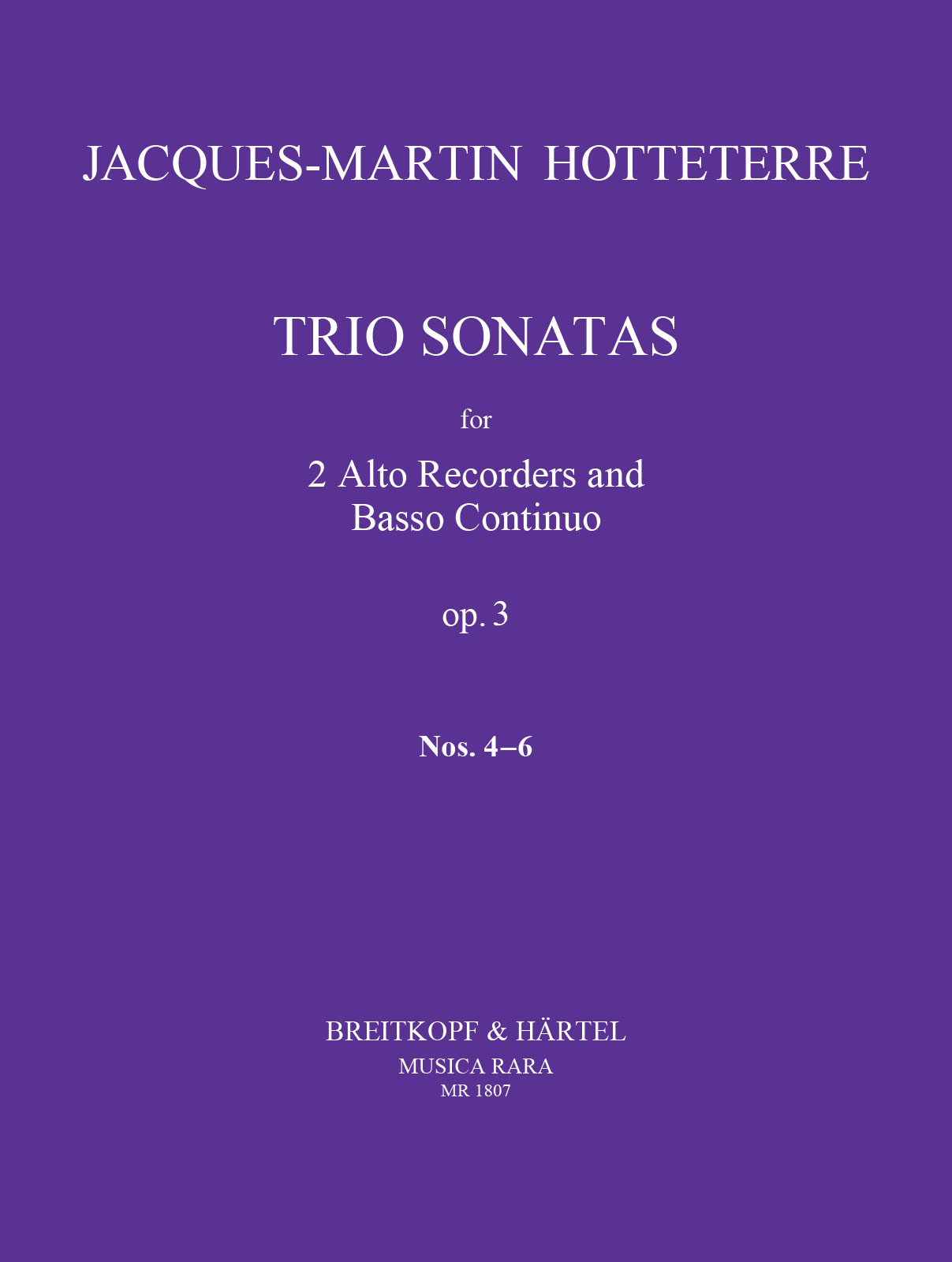
Hotteterre's Trio Sonatas Op. 3, Nos. 4-6 are Baroque chamber works for two treble instruments (such as recorders, flutes, oboes, or violins) and basso continuo.…
Hotteterre’s Trio Sonatas Op. 3, Nos. 4-6 are Baroque chamber works for two treble instruments (such as recorders, flutes, oboes, or violins) and basso continuo. The collection of six sonatas was first published in Paris in 1712 and by Musica Rara in 1807.
Originally specified for two treble recorders and basso continuo, the pieces can also be performed on transverse flutes, oboes, or violins, with the continuo typically involving a bass instrument (like a cello or viola da gamba) and a chordal instrument (like a harpsichord or theorbo).
The sonatas blend the refined French courtly style with Italian elements.
Sonata No. 4 in E minor: Movements include Grave and Gigue (Vivement).
Sonata No. 5 in A major: Movements include Prélude (Lentement), Courante, Sarabande, and Légèrement.
Sonata No. 6 in G major: Movements include Prélude (Lentement), Fugue (Gay – Grave), and Vivement.