Tag: guitar

  • D’Addario EFT15

    Acoustic Guitar Strings, flat tops, Phosphor Bronze, Extra Light

    According to the label. they have a warm, semi-bright tone. A semi-flat ultra smooth surface, perfect for slide playing, flat picking and recording, with reduced finger noise.

    Well the last part’s right, the finger noise is reduced from the beginning. First impressions on re-stringing them was that they were very bright. V.V. Bright Indeed. Any brighter and you could use them as fog lamps. But….

    I don’t think I’ve ever had a set of strings settle down quite so quickly. At the start, finger picking seemed to make the strings buzz, flat picking you could hear the noise of the pick on the string over the sound of the note. But I played them for several minutes (John Denvers’ Annies Song if you’re interested – because of the rapid chord changes) gave them their 4th stretch of the day and tried again.

    Now they resemble the blurb.

    They come in a phosphor bronze coloured pack, or as we say in England, Brown, wrapped in a plastic pouch with a number on it that you’re encouraged to enter into the D’Addario website Players Circle rewards program. Join this and you can send your strings back for recycling and gain extra (Brownie?) points. The strings aren’t individually wrapped but they are colour coded on the end of the string you stick in your guitars body. They’re coiled together in pairs, E-A, D-G, B-e. I’m not going to tell you how to restring a guitar; there’s enough tutorials out there to help you, though I’d suggest you learn the very simple Luthiers Knot and find a tutorial that shows you that if you don’t already know it. Also take the opportunity, with the strings off, to clean your guitar thoroughly.

    Give your strings a stretch: over the sound hole (or cone cover on a resonator) hook you’re forefinger under each string and pull up quite hard, the run the forefinger of your other hand from the neck to the highest fret, keeping in contact with the fretboard, 3 or 4 times.

    Retune

    Try to play. Note how you go out of tune very quickly. Repeat the stretch. try to play. About the 3rd time you’ll be able to play for a few minutes and after the 4th for a while longer. Keep your tuner to hand and, for this first day at least, keep stretching the strings. When that doesn’t change the tuning, you can stop stretching.

    Now you’ll also hear the strings as they’ll sound for some time to come. How much time? I’ll come back to this blog and let you know.

    Update

    It’s about 2 months since I strung my guitar with these strings. They’ve been played regularly, every day at home and for about 21 days (not in a row) in one of the most hostile environments known to half naked people – The Beach. 20mph winds, temperatures up to 26c, salt air and sand being blasted everywhere.,

    Despite this the strings maintained their tone and kept their tuning quite well – until this last week before writing this update. This week I’ve had to retune several times a day, and a day means 3 to 4 hours or constant playing. In a less hostile environment they don’t need retuning all that much. The sound has diminished but still isn’t bad. However I wouldn’t want to do a studio session with these strings as they are now.

    One other thing that I’ve noticed was that after a couple of weeks playing bends became radically easier. Although my previous strings were also lightweight it was never really possible to get much more than a half-tone bend, but with these I’ve managed close to, if not actually on, a full tone bend. Blues players might find that noteworthy.

    So, recommended usage.

    These strings will do quite well in a studio environment, especially if your guitar is left there for the whole session. you might want to think about replacing them after about 3 weeks, closer to 2 if you’re going to be doing a lot of overdubs on your previous recordings. You might be able to get 4 weeks out,

    Gigging constantly, maybe 3-4 weeks, depending on what sort of sound you want.

    A professional rehearsing for studio or tours, or maybe song-writing. 5-6 weeks, although you might still be happy with the sound at that point so stick with them until you aren’t. Change them a couple of days before any performance, but I shouldn’t need to tell you that 🙂

    Recreational player? You could get 6 to 9 months, maybe longer.

    Like all things the timings given above are just guidelines. You need to make your own mind up about the condition of your strings and whether you need new ones. The variables are how often and hard you play, how hot or humid it is, what type of music you play, finger or flat picking? I can’t tell you what will happen in your world, only what happened in mine.

    At the time of writing these could be bought for £23.99 with a RRP of £27.90
  • Guitar Stands

    Our favourite guitar stand supplier is Hercules. Originator of the auto-grab system, which is so convenient, these are good robust stands. Personally, I prefer stands which hold the neck (vital if you have children and dogs running around), but there are good A frames stands of you are short of space, or just want something compact. Wall hangers are a good choice, especially if you are short of floor space, but be careful not to position them above radiators or on outside walls.

    This portable K&M A-frame guitar stand is suitable for acoustic, electric, and bass guitars. There is a push button system that enables adjustment for different types of guitars. This stand folds flat for easy transport and can also be used with guitars which have a nitrocellulose finish. As usual for K&M, this comes with K&M standard 5-year guarantee. Make sure you pick the correct one to hold your guitar (electric guitars are much thinner than classical and acoustic ones), but this model will work for all types.

    This Hercules guitar stand also fits acoustic and electric guitars has hard rubber contacts and a special formulated foam which protects your guitar from scratches. Very compact design which will fit most gig bags as well. The design fits both acoustic and electric instruments and folds down enough to fit in gig bags. Very light weight at just 0.5kg.

    Hercules guitar wall hangers are a great option, especially if you need to keep your guitars off the floor (you know – kids, pets, or just being a bit of a klutz). The have the Hercules Auto Grip System and we have used the slatwall version of these successfully for years. For home use the wood finishes are aesthetically pleasing. The grip mechanism itself uses specially formulated foam rubber fully protects your guitar and will take up to 7kg in weight.

    For Multi-Guitar stands the K&M and Hercules are excellent choices.

  • Admira Guitars

    Admira Guitars

    Admira Label

    He looked at me and said “You’re using harmonics?” I nodded. “I never thought of that. I’ve had it a few years and still can’t play. Take it, it’s yours”. That’s how I came to have a classical guitar that’s been in my possession for the last 30 odd years. It was an Admira and I found out a bit later that it would have cost him around £300.

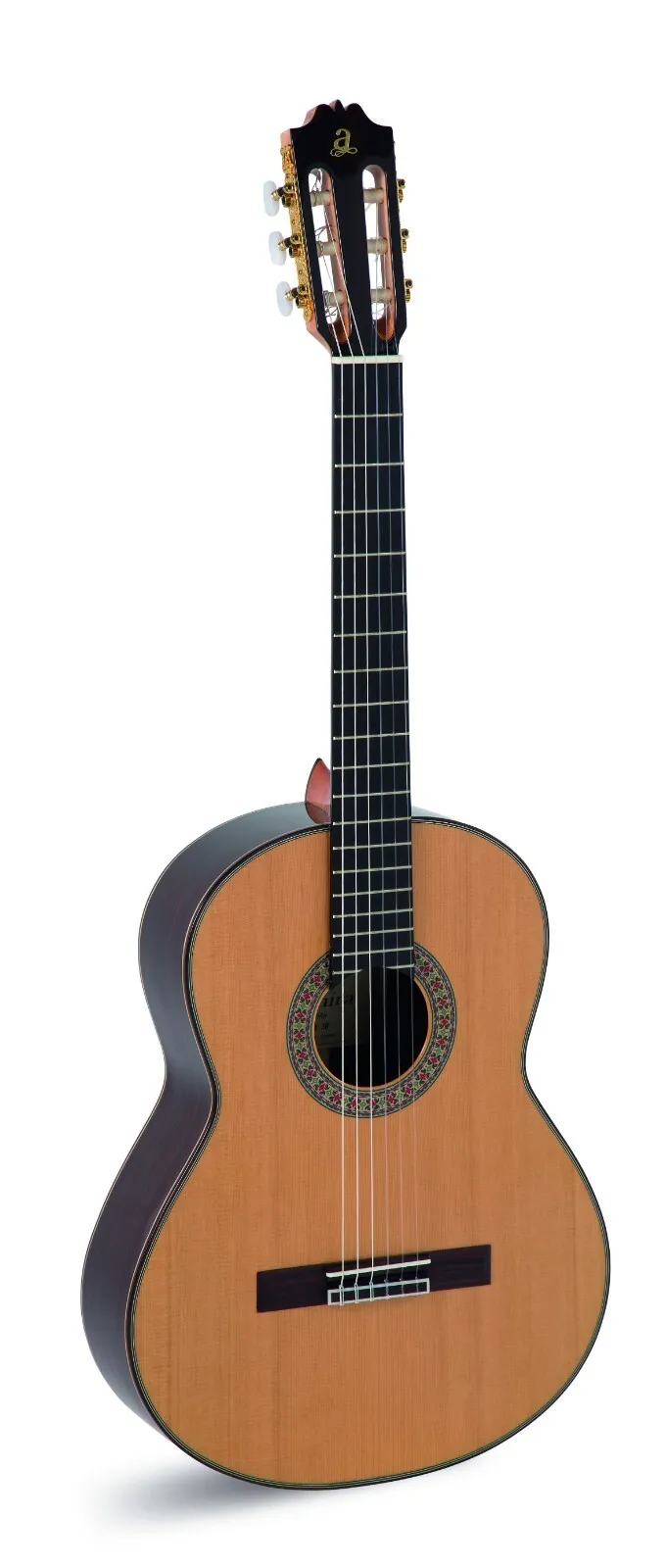
    Recently I had the opportunity to play the latest model in that series and was excited to see if it had changed in anyway or had the same quality as mine

    If we start with the construction of mine, it’s made with the following materials

    • Top: Solid Cedar with a Satin finish.
    • Sides and Back: Rosewood with a Satin finish. Some listings mention Ovangkol, which is very similar to Rosewood in its tonal properties.
    • Neck: African Mahogany.
    • Fretboard: Mahogany.
    • Bridge: Mahogany.
    • Machine Heads: Nickel Lyre.

    These materials are chosen for their durability and contribution to the guitar’s tone and resonance. The combination of solid cedar and rosewood or ovangkol is typical for classical guitars, providing a warm, rich sound with ample volume and clarity. And 30 years later that’s still the case. It’s a beautiful instrument to play.

    But how does it compare to the A20 latest version?

    Well the construction materials are almost identical. The only difference is the newer model has an ebony fretboard and the whole thing costs more more than 4 times as much as the 1980s model at £1,290 on Amazon. That’s probably a great bargain considering how prices have risen in 30 years (a 50p pint of beer will now cost you £5.70). The sound though, well seriously it’s well named. You could pay £4,000 or more for a similar sounding guitar. It’s a joy to play. Your fingers just seem to find the right frets as if by magic, the tone can only be described as amazing and when you need to move your left hand rapidly from 1st to 3rd position your thumb slides up the neck as if it were oiled but never feels slippery. When you stop you feel secure in whatever position on the neck you happen to be. Harmonics just ring out loud and clear.

    If you want an instrument for fairly frequent performances but you don’t get paid top whack (yet), well this one will be a good investment.

    But what if you don’t have a spare £1,300 lying around or maybe you’re just starting out in classical guitar playing? Well first lets look a little at the company and ethos.

    Admira guitars are crafted with a blend of traditional Spanish guitar-making techniques and modern manufacturing systems. The process involves:The manufacturing workshops are based in Zarautz, northern Spain, where the guitars are produced to maintain the highest quality. The dedication to craftsmanship at Admira ensures that each guitar upholds the rich tradition of Spanish guitar making while incorporating modern elements for today’s musicians.

    • Selecting Woods: Admira guitars often use solid cedar for the top and Indian rosewood or mahogany for the back and sides, which are known for their tonal qualities and durability.
    • Handcrafting: While some processes are automated, the vast majority of each guitar is built and finished by hand by skilled craftsmen and women.
    • Neck Construction: The neck is typically made of mahogany with rosewood reinforcement, enhancing the instrument’s sturdiness and attractiveness.
    • Bridge: A rosewood bridge is used, aiding resonance, intonation, and tone.
    • Spanish Heel: The ARTESANÍA series, for example, is made with the union between the body and the neck of the guitar through the Spanish heel, a traditional method of construction.

    The manufacturing workshops are based in Zarautz, northern Spain, where the guitars are produced to maintain the highest quality. The dedication to craftsmanship at Admira ensures that each guitar upholds the rich tradition of Spanish guitar making while incorporating modern elements for today’s musicians.

    This applies pretty much to every guitar they make, no matter what the cost and they start at £123 for a full size guitar. It’s the Alba Student guitar. In this case, though, the word Student doesn’t apply to the musician but to the craftsperson who made it, under supervision of one of Admiras’ master luthiers. A rosewood back, sapele sides, pine top, mahogany neck means it[‘s suitable for a beginner

    Next up is the Malaga, made from spruce, mahogany and rosewood. This is a solid top guitar and you will be very hard pressed to find one of this quality and craftsmanship for £258. You’d probably get one of these, or the Concerto, when going for your grade 4 exams.

    Of course you could splash out a bit more and get the Concerto model. A cedar top and rosewood back. cedar body and mahogany neck give this guitar one of the best sounds at this price . £279

    But now we’re going to skip a few models and head to the £400 mark (£402 on the day of writing) with the A4. This instrument has a mahogany back and sides with a cedar top, mahogany with ebony reinforcements for the neck and kabakulli for the fretboard. `The neck joint is with the Spanish Heel technique, considered the most highly developed technique for this area. At this price range you’re getting serious about your guitar playing and this is an instrument that will back you all the way. an excellent sound. You just won’t get a much better guitar at this price. You’re also unlikely to get one that’s all solid wood, and it will last.

    Our last look on this visit was at the A45. This model is part of Admira’s ARTESANÍA series, which is crafted by skilled luthiers using traditional handcrafting methods to produce guitars with exceptional tone, clarity, and expression. This series represents the crown jewel of Admira’s offerings, blending top-quality materials with passionate craftsmanship. You can guess that just as the materials are superior, so is the tone and the sheer playability of this guitar. If you’re doing your B. Mus. and focussing on classical guitar this model would be up there on my list of ones to buy. £649 at the time of writing

    Disclaimer: Admira didn’t pay us, or ask us to write this review. We just happen to be very impressed by their guitars. But if you do buy from Amazon we’ll get a small commission.

The Music Realm
Privacy Overview

This website uses cookies so that we can provide you with the best user experience possible. Cookie information is stored in your browser and performs functions such as recognising you when you return to our website and helping our team to understand which sections of the website you find most interesting and useful.