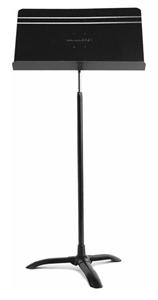
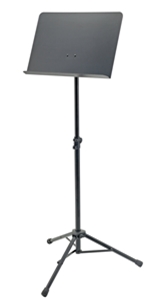
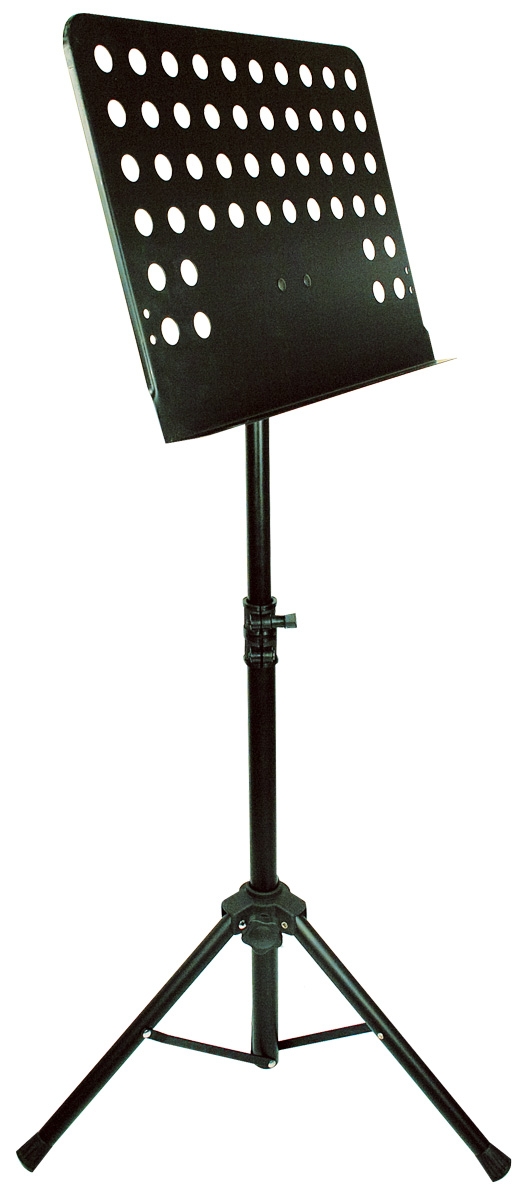
Your standard foldable music stand will almost certainly have been your introduction to the world of music stands. Orchestral and conductor stands are the next stage. These tend to be more robust in construction, have a non-folding desk, and are specifically designed for use by players in an orchestral situation – either in the pits (always thought that’s a charming name!) or as a conductor. They are also a useful option if you just happen to want a more robust stand – one that allows you to put some fairly heavy pieces of music on it (specifically, I’m thinking about things like the 256 page O’Neill’s Music of Ireland which weighs in at a hefty 1kg).
The stand out offering (pardon the pun) is probably the Manhasset Symphony Model no. 4801. It’s an extremely popular stand and with good reason. The high quality steel construction is very sturdy weighing in at just over 3kg with a load capacity of 3.6kg. So, for example, you’ll safely be able to put your linen bound full score of Mahler’s Third Symphony in a Breitkopf edition, which weighs 1,775g, on the stand without worrying about it collapsing. It has good height adjustment (660 to 1536 mm) and the solid desk has dimensions of 508 x 317.5 mm. The desk also has a friction tilt system whereby you adjust the angle of the desk to what suits you and it stays in that position until you need to alter it. Very clever! Manhasset claim that this stand is used by more schools than all other stands combined, and I can well believe it. You’ve got a choice of colours (although black is the most popular) and can get good deals on the 6 packs if you need to buy in bulk. There are some useful accessories such as clip-on lights you can also buy, and if you are working in an orchestral environment the storage carts are definitely worth considering. The only downside of this stand is that the legs don’t fold up, so it’s not so convenient if you need to carry it round with you (in which case it’s worth looking at their model no 5201, which has traditional foldable tri-pod legs), but other than that, it is a fantastic option.
If you’re looking to spend a little less and have a more portable offering, I would definitely take a look at the Konig and Meyer 11960 and the TGI 1042B. The spec of these stands is pretty similar: The Konig stand has a height range of 670 to 1200mm, weight of 3.6kg and desk dimensions of 490 x 340 mm. As with all Konig stands, it is a very well constructed stand, and although it doesn’t come with a bag, you can purchase one separately. The TGI height is 700 to 1200mm, the weight 3.3kg and the desk dimensions 500 x 340 mm (n.b. the desk is perforated rather than solid, which may, or may not, bother you). I’ve sold a lot of the TGI stands over the years, and they are a very decent offering for the price. Good, robust stand which comes with a handy carry bag – you can also put you music scores in the bag, which is handy.
Manhasset 4801K&M 11960TGI 1042B
To see other reviews on music stands, please click on the buttons below:
We think the two offerings by Hercules and K&M are the best ones to choose from. They all offer good stability with rubber feet giving solid grip, and have good height adjustability.
Two K&M offerings are the 14985 and the149/9 which is a bit more expensive but more robust in its’ construction.
The best-selling 14985 has a 2-piece folding design. The height adjustable tubular design is made from solid steel with a fibreglass reinforced plastic base, it has an adjustable plastic peg. The foldable legs are of the socket style, rather than the swivel style of the Hercules models. Non-marring height-adjustment mechanism.
The K&M upgrade is the 149/9. The trombone itself rests on a rubber cone which is designed not to damage your instrument. The tripod legs are braced for extra stability and can extend out to over 20 inches. This is a 2-part stand is made from tubular steel, and folds down quickly and easily, which is very compact when folded.
From the Hercules brand the DS520B trombone stand is robust stand which will hold most. The sturdy tripod legs have cross braces which give good stability for most trombone models and the legs use Hercules usual swivel method of folding down. The top bracket has two slots and a catch to secure the slide braces. The Hercules TravLite Trombone Stand DS420B folds easily and compactly and stores inside the bell of the instrument; velvet pads protect the instrument. As the name implies, this is a lightweight stand designed for good portability. It’s very quick and easy to set up. The in-bell design means that the stand can be stored safely in the bell or your trombone meaning no extra space is needed in your case. It comes with a velvet base design protects the finish of the instrument.
If price is an issue, then the Nomad NIS-C022 is quite good considering the price. This trombone stand has a one-piece folding design with tripod retractable legs, and the bell mount is cushioned. As you would expect, it’s not quite well designed and built as the K&M and Hercules models, but at £20.99 (at the time of writing) it is good value for money.
The lightweight K&M trumpet stand (model number 15213) we think represents a good choice for your trumpet. There are 5 legs which fit inside the bell and give excellent stability, and the rubber peg tip and felt pads give a good secure hold and protects your trumpet from scratches. The entire stand can fit inside the bell of the trumpet making it a very portable stand.
By comparison, the Hercules Trumpet/Cornet Stand DS510BB has really solid legs which give good stability, and a velvet peg which prevents scratches to your trumpet. It has a height adjustment lever and comes with a carrying bag as well. Locking pins hold the legs firmly in place. To fold the stand, just press the pins and swivel to fold. The stand comes with a carry bag.
Of the budget offerings, the Nomad NISC011 stand is worth considering. It has a sturdy tripod design, but the manufacturing quality is not quite as good as the K&M or Hercules ones.
Saxophone stands are essential accessories for saxophonists, providing a safe and convenient place to rest the instrument when not in use. It’s just not practical to disassemble and put it back in its’ case when you’re going to resume playing in a few moments. Saxophones are fairly expensive and can be quite heavy so a good robust stand is essential. Look for a solid tripod or weighted base to make sure your sax doesn’t topple over. Before you buy your stand it’s worth thinking about if you want a single instrument stand, or one that will also hold multiple saxophones or your saxophone and another instrument. Also bear in mind that if you are travelling a lot with you instrument the portability and foldability of the stand is important.
Alto and Tenor Stands
The Hercules DS-530BB is our pick for Alto and Tenor stands. The robust construction and stability given by the tripod base are hard to beat. The stand itself weighs just under 1kg and has a load capacity of 10 kg, which should be more than enough given that the average alto weighs just over 2kg and tenors about 3 kg. It has a folding yoke, an adjustable backrest, and locking pins that lock the stand in place. To fold the stand after use, you just press the pin and hold it in. It comes with a bag which makes carrying it around with you easy. are secure and stable for use with Tenor or Alto Saxophones. A storage bag included.
K&M 14300 Alto/ Tenor Sax stand is a decent offering, and a little bit cheaper than the Hercules DS-530BB. The tripod base is sturdy, and the support arms have a protective plastic coating. The height of the lower support arm can also be adjusted as there are several locking positions, and the upper support arm is flexible and can be adjusted to different bell sizes. K&M also produce a couple of peg holders which can be used with this stand and you can also get a bag, but it is not included.
Baritone Saxophone Stands
The Baritone Sax Hercules DS535B stand has a folding yoke with locking pins to secure the upper yoke in the correct position. The backrest has a lever to adjust the height and the swivel legs also have locking pins which lock the stand in place There is a peg hole if your stand needs to hold another instrument. The pegs are sold separately and will hold instruments like soprano saxophones, trumpets clarinet and flute, but the peg won’t hold an alto or tenor sax. If you need a bari stand that also holds an alto or tenor sax, take a look at the DS536B which comes with a detachable fitting.
Of the K&M offerings the 14410 is our choice as it has an extra-sturdy tripod base with cross braces giving the legs extra load capacity and a two-piece folding design. The support bracket has several locking positions. As you would expect, the height is adjustable, and as with their alto/tenor sax stand the support arms are covered with special non-marring (i.e. non-damaging) plastic to protect instrument. One caveat; this stand has limited suitability for baritone saxophones with a low Bb, due to the shape of the bell flare.
Soprano Sax Stands
The solid tripod legs on Hercules DS531BB provide good stability and there is a height adjustment lever (this stand will also hold a flugel horn). The velvet covered peg is detachable and the stand comes with a carrying bag.
Rather than a tripod base, the K&M 15290 stand has 5 legs which provides really good stability for the instrument. The detachable metal leg base screws into the peg so that the entire unit can be stored in the bell of the instrument for easy transport. The black plastic peg is covered with a felt ring to protect the instrument.
If you have a curved soprano sax then the K&M 14315 is worth a look.
Multi Sax stands
The Hercules DS537B will hold 2 alto/tenor saxophones has a one-piece folding design with the locking pins providing a secure solid stand. To fold the stand, you just press the pin and fold. This is a robust stand which has a total weight capacity of 19.95 kg.
For a combined alto/tenor stand which will hold a soprano sax, the Hercules DS-533BB and has all the features you expect from this manufacturer.
And the DS538B will hold a staggering 2 alto/tenor saxophones, 1 soprano saxophone and 2 clarinets or flutes.
For the full range of Hercules and Konig & Meyer stands, click on the buttons below.
When selecting a keyboard stand, it’s worth taking some time to consider the following factors:
How much does your keyboard weigh and will the stand you are considering support the weight of your keyboard. You will need a more stable stand such as a Z style or table-style stand if you have a heavy keyboard stand or a have a rigorous playing style. Also check the adjustability of the height and width to make sure you can get a comfortable playing position.
If you need to transport the stand frequently for gigging, look at good lightweight and foldable stands. Additionally, some stands come with additional tiers or racks for extra equipment.
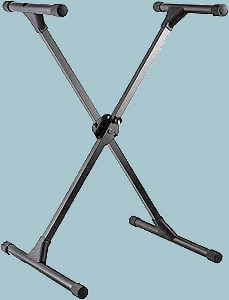
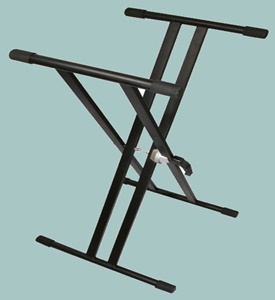
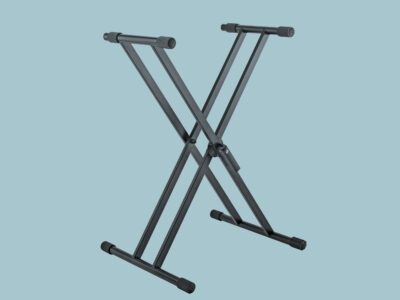
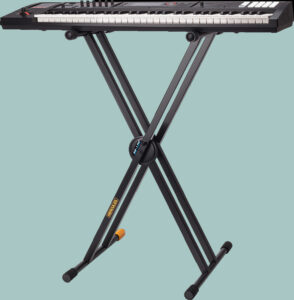
X-Style Stands have an “X” shape and are one of the most common types due to their affordability and portability. These tend to be lightweight and easy to fold and transport. The downside is that they may not be as stable for heavier keyboards and can have limited adjustability in width (there are usually only 4 settings). They stands can be single or double brace (i.e double X), with the double brace style stands giving better stability. The biggest drawback with X style stands is playing your keyboard in the seated position. As soon as you sit down, it’s hard to position yourself without knocking your knees into the brace, which in true domino style can result in the keyboard getting knocked off the stand.
Our choice for single X style stands are:
TGI TGKS1K&M37230Hercules KS100B
And for double brace stands, which are more solid than single brace ones, the following are good options:
TGI TGKS2K&M 18990Hercules KS120B
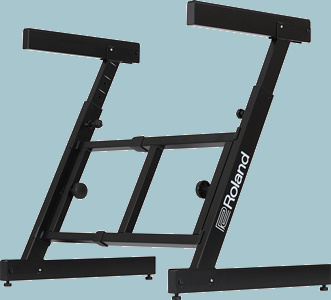
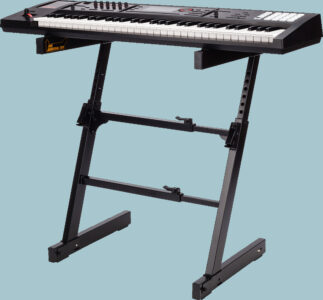
Z-Style Stands have a “Z” shape, providing better stability and more surface area for the keyboard. They tend to be more stable that the X style stands and can support heavier keyboards. This does make them heavier and bulkier to transport. I like the Roland KS 11Z and the Hercules KS400B. Neither are cheap, but they give good support to your (possibly quite expensive) keyboard.
The Roland KS 11Z is one of the best around – a really solid stand at 10 kg. The KS-11Z provides a robust and stable platform which can handle portable keyboards and pianos with up to 88 keys and weighing up to 100kg. There are multiple adjustment points which allows you to tailor the width and height to your keyboard: There is a quick release lever for the width adjustment of between 566mm and 940mm and a spring-loaded for the height adjustment of 645mm to 917mm. The adjustable feet give good stability on uneven floors and the support arms a padded and fold down for transport and storage. The arms also quickly lock into place when putting the stand up. An impressive stand.
The Hercules KS-400B Z-Stand Keyboard Stand has a built-in AutoLock System which allows you to set the desired height by simply raising the arms with height parameters of 604.5mm to 929.6mm and you can adjust the width between 508mm and 851mm. There are fluorescent marks to allow you to adjust both arms evenly which is useful when on a dark or dimly lit stage. The locking pins give a quick and secure set up and adjustable feet give a good stable setup. Weighing in at 8kg, it has an impressive load capacity of 127.9kg
Of the more affordable options, Rockjam has a pretty good offering.
Roland KS 11z Hercules KS400BRockjam
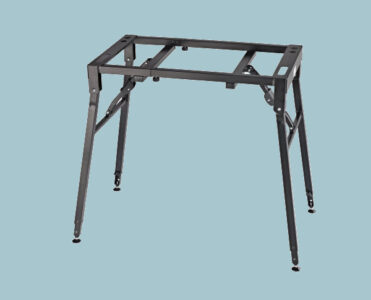
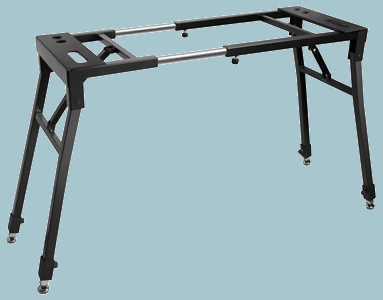
Table-Style Stands resemble a small table and often come with additional features like racks for gear. They are very stable, offer height adjustability and can hold additional equipment, but they tend to be very heavy (i.e. not as portable) and more expensive than other stands.
A couple of the K&M models are our best picks if you need a quality, robust stand, but TGI do a good offering as well.
The K&M 18950 is a high quality, steel-made table style keyboard stand. Because the legs can be individually adjusted and each leg has levelling feet, and non-slip rubber pads, it is a very stable stand. The height adjustment is from 600mm to 1,000 mm, and can take a second keyboard if needed. Weighing in at 10.7 kg it has a maximum load capacity is 80kg. As you can see here, it folds down really neatly as well.
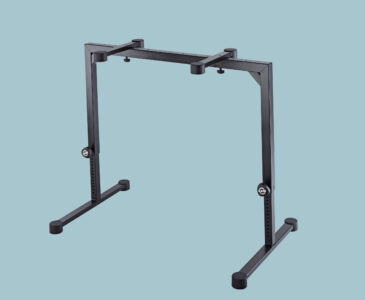
The other K&M offering I quite like is Omega 18810. It’s very stable and robust keyboard stand (9.2kg) which has a spring-loaded height adjustment and is quick to assemble The support depth is 345mm, width is from 180mm to 790mm and the height ranges from 600mm to 1020 mm. You can also bolt on a range of attachments such as ipad and tablet holder, mic stands and even has 4 velcro tapes for cable management. All in all, quite an impressive offering.
If you don’t want to spend quite so much, the TGKT1 stand is pretty good as well. Weighing in at just under 9kg, it’s quite solid, and will support up to 80kg, giving it the same capacity as the K&M 18950. The height range is 620mm – 790mm, the width is 710mm – 1020mm, and the depth is 320mm.
K&M18950K&M18810TGI TGKT1
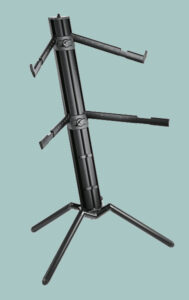
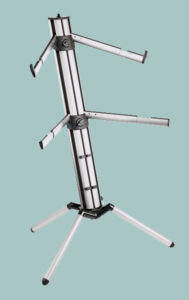
Column Stands have a central column with arms extending out to hold the keyboard. These stands offer good stability and often have multiple tiers for multiple keyboards. The design of these can be quite sleek, but they are often not as adjustable as other keyboard stands and can be bulky. If you are looking at these stands you are prepared to spend (they tend to be quite expensive) so I would just go for the best on the market which in my opinion is the K&M 18860 Spider Pro. There is no Hercules offering for this style of stand, The Spider Pro is an aluminium made stand has a tripod base with adjustable legs. This stand has an innovative double tiered design with arms coming out of a wide vertical spine of the stand with tripod base. The upper arms can also be moved to a 15 degree angle which allows easier access to the keyboard on the lower arms. You can also add additional support arms and attach a third keyboard. You can also attach microphone booms. It weighs 10.8 kg and the arms have weight capacity of 35kg per level. Extra arms and a carrying case can be purchased separately.
Cello and double bass stands are essential for safely storing and displaying these larger string instruments when they’re not in use. Although there are wall hangers available, I’ve never really found a satisfactory one – I think the instruments are simply too big in the body – and would always go for a sturdy floor stand. Both K&M and Hercules have good offeringss in the mid-to-high price range. While they may be more expensive than some basic models, in each case the quality, durability, and features more than justify the investment. For me, they offer excellent value for money, especially for serious musicians who need a reliable stand.
The K&M 141/1 Cello Stand is renowned for its quality and durability, making it a popular choice among cellists. This stand is constructed with high-quality materials, featuring a sturdy metal frame, wide base, rubberise supports, and a cushioned backrest to ensure the cello is securely held without any risk of damage or scratches. The stand’s build quality is robust, providing long-lasting durability. I also like the adjustable arms which means it will hold various sizes of cello securely
Cello Stands
It is also relatively lightweight and foldable, which makes it reasonably portable (and lets’ face it cellos are bulky enough to carry round, especially on public transport, so every little helps), allowing cellists to transport it easily to rehearsals, performances, or lessons. The compact folding design is also is convenient to store when not in use.
Despite its solid construction, the Hercules DS580B is relatively lightweight and foldable, making it easy to transport. It folds down to a compact size, which is convenient for storage and travel.
Stability is a key feature of the Hercules DS580B stand. It boasts a wide base with non-slip rubber feet that prevent it from slipping on various surfaces.
The stand has a sleek and modern appearance with a clean design that fits well in various environments, from home studios to concert stages.
As a budget option this Cobra stand seems quite good, but I haven’t had enough experience of this stand to fully assess it. However, at £32.95, a 4.4 star rating on Amazon, and coming with a 2-year warranty it seems to be a decent offering for the price.
Double Bass Stands
For double bass players, the K&M 141 model Double Bass Stand is a sturdy (vital with such a large instrument) and adjustable floor stand. The soft rubber covered adjusting arms will hold you bass securely. Pretty much the best stand out there for basses in my opinion.
The Hercules offering is the Hercules DS590B. As with all Hercules stands, it has a good solid construction, but lacks a bow holder and a neck brace, which I think is a disadvantage, especially on such a large and expensive instrument.
Woodwind and brass stands are specialized supports designed to hold your instrument securely when they are not being played. Look for good stability and make sure the sections of the stand which come into contact with you instrument are padded in order to avoid damaging your instrument. A good stand will prevent damage to your instrument by holding it securely, offer a safe place to put the instrument during practice, rehearsal or performance when you may need to swap from one instrument to another, and can help maintain the instruments condition by preventing any undue stress on the body of the instrument and the key and valve mechanisms. I also think that, especially for wind and brass instruments, leaving your instrument on a stand helps it dry after use.
Some of the stands have quite fragile legs, which is why for example, I prefer the K&M 152/3 to the K&M 15232 Compact Flute Stand, but the compact models do fold down to a really small size which can be a consideration when travelling. (Double bass players will snigger at that!)
If you need stands for multiple instruments, Hercules have some of the best offerings on the market.
Flute stands are essential accessories for flutists. Designed to securely hold and display flutes when they are not in use, a good stand helps prevent damage to the instrument and provide easy access during performances or practice sessions. Before you buy, it’s always worth considering if you just need a single flute stand, or one which can hold a second instrument – most commonly a piccolo, clarinet or an alto flute (if you have one). Look for stands with a sturdy base to prevent tipping: Tripod bases are common and provide good stability. Ensure the stand has padding or rubberized surfaces at the contact points to protect the flute’s finish from scratches and damage, and if you need to transport the stand frequently, consider foldable or collapsible designs that are easy to carry.
Stands are typically made from plastic, metal, or wood. Metal stands are durable but heavier, while plastic stands are lightweight but may be less robust.
Ultimately, the “best” flute stand will depend on your specific needs, such as whether you need it primarily for home, studio use, or frequent travel (the Hercules Travlite is a good choice here). It’s well worth taking time to consider what you want in terms of stability, portability, and overall build quality to make the right choice for your situation.
My favourites, as usual are Hercules, which are renowned for their stability and durability and K&M whose high-quality stands with adjustable features and robust construction are among the best you will find.
The Hercules DS640BB is a high-quality single flute stand which has a velvet-covered peg to protect the instrument from scratches. As an alternative the K&M 15232 is a compact and foldable single flute stand with a stable base. The Nomad NIS-C015 is a popular, and reliable, choice for those on a budget.
If having a stand which fits in your flute case, the Hercules DS460B Travlite stand offers easy to set up and provides a strong, stable base for the instrument. The Compact In-Bell Design allows stand to store safely in the bell of the instrument taking no space in the instrument case, and the velvet on the base of the stand protects the finish of the instrument.
Before you buy, it’s worth considering if you just need a single clarinet stand, or are you going to need a stand which holds another instrument, such as a flute, as well. Either way, you will need a stable stand which has a good solid base or a tripod design. Padded pegs for the instrument to sit on are a good idea, as this prevents your instrument getting scratched. Make sure your stand fits inside your instruments case of gig bag if you frequently travel with your instrument.
Hercules Stands and K&M both have high quality offerings and are about the best available.
Known for their robust construction and innovative designs, the Hercules DS640BB clarinet stand is a solid, heavy-duty stand, and has a velvet covered peg. It comes with a bag, which is handy because it probably won’t fit in your case. König & Meyer offer high-quality stands with excellent stability and durability. The K&M 15228 Pavilion stand is well-regarded for its foldable design and gives good stability from the 5 metal legs. It can also be stored insdie the bell of the clarinet which gives good portability. If price is an issue the Nomad NIS-C043 stand is an excellent choice; the folding design collapses quickly, but isn’t quite as stable or robust as the Hercules or K&M models mentioned above.
If you want a really compact stand, the Hercules DS440B clarinet stand is a good option as it fits inside the bell of the clarinet. Alternatively, the K&M 15222 Compact Clarinet Stand is a good quality stand 4 leg stand which is small enough to fit in most cases.
As with everything musical, there is a huge range to choose from. I always prefer to stay away from super cheap stands. Your instrument can be worth a lot of money, so why skimp on the stand and risk damage? After all, it’s better to spend a little bit of money on a stand rather than putting it down on a chair and sitting on it – anyone who has done this will never forget the sound of a shattering instrument. A good stand will also be designed to keep your instrument in good condition by avoiding improper storage. In a more professional situation, it’s easier to manage the use of multiple instruments if good, well designed stands are used, and in a domestic situation you’re more likely to play your instrument if you can see it – tucked away in a bag in the corner makes it easy to ignore!
My favourite instrument stand brands are Konig & Meyer (which come with 5 year guarantees) and Hercules. Both these brands, which in my many years in retail, have very, very low rates of returns, with TGI and Nomad giving good cheaper options.
Click on the links below to see our reviews on stands for your instrument.