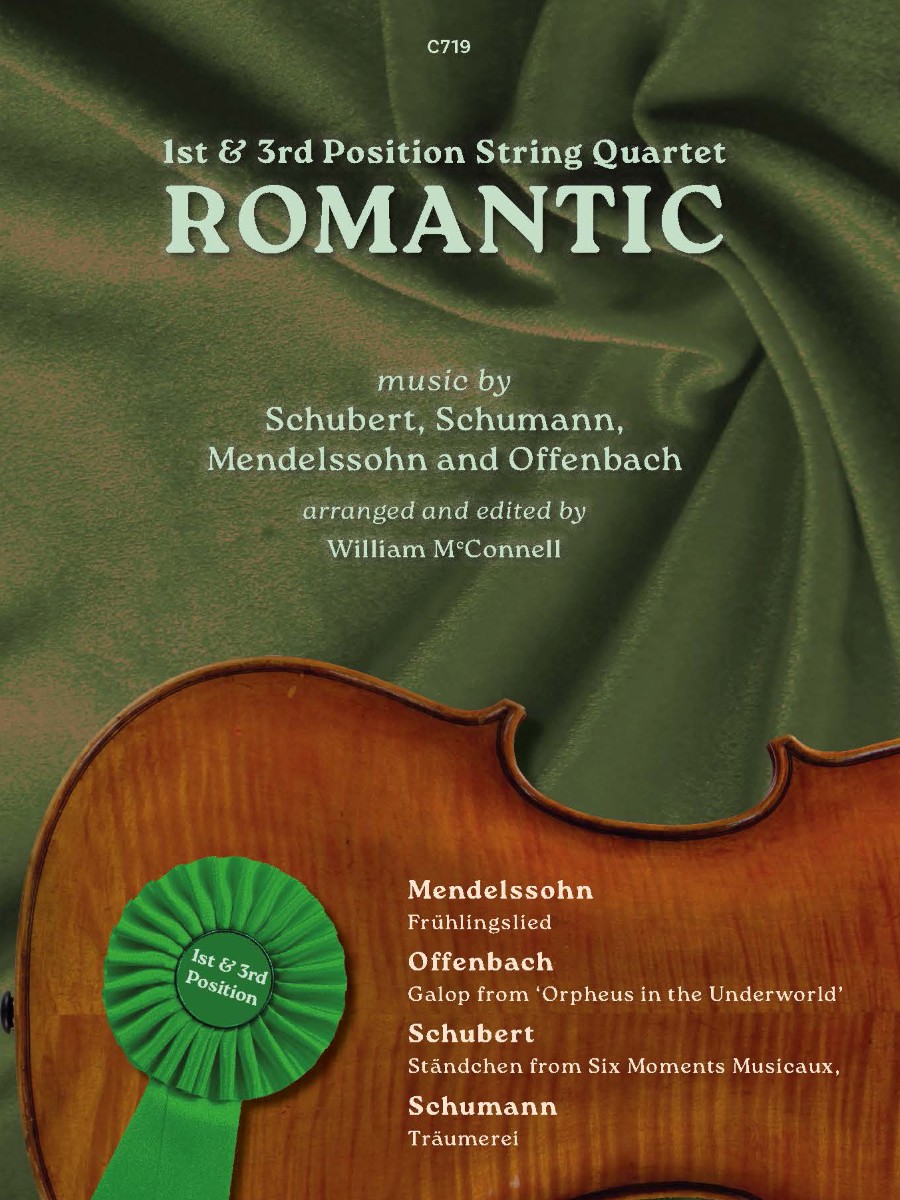
1st & 3rd Position String Quartet: Romantic
Digital Download – PDF
R.R.P £14.95
Our Price: £12.71
Composer: Schubert, Franz; Schumann, Robert; Mendelssohn, Felix;Offenbach, Jacques;
Arranger: McConnell, William;
Format: Score and parts
Publisher Clifton Edition
About the Composers
Schubert, Franz
Franz Peter Schubert was an Austrian composer born on January 31, 1797, in Himmelpfortgrund, near Vienna, Austria. He passed away on November 19, 1828, in Vienna. Despite his short life, Schubert left behind an extensive oeuvre, including more than 600 secular vocal works (mainly lieder), seven complete symphonies, sacred music, operas, incidental music, and a large body of piano and chamber music.
His major works include the art songs “Erlkönig,” “Gretchen am Spinnrade,” and “Ave Maria”; the “Trout Quintet”; the Symphony No. 8 in B minor (“Unfinished”); the Symphony No. 9 in C major (“Great”); the String Quartet No. 14 in D minor (“Death and the Maiden”); the String Quintet in C major; the Impromptus for solo piano; the last three piano sonatas; the Fantasia in F minor for piano four hands; the opera “Fierrabras”; the incidental music to the play “Rosamunde”; and the song cycles “Die schöne Müllerin,” “Winterreise,” and “Schwanengesang”.
Schubert showed uncommon gifts for music from an early age. His father gave him his first violin lessons, and his elder brother gave him piano lessons, but Schubert soon exceeded their abilities. At the age of eleven, he became a pupil at the Stadtkonvikt school, where he became acquainted with the orchestral music of Joseph Haydn, Wolfgang Amadeus Mozart, and Ludwig van Beethoven. He left the Stadtkonvikt at the end of 1813 and returned home to live with his father, where he began studying to become a schoolteacher. Despite this, he continued his studies in composition with Antonio Salieri and still composed prolifically.
In 1821, Schubert was admitted to the Gesellschaft der Musikfreunde as a performing member, which helped establish his name among the Viennese citizenry. He gave a concert of his works to critical acclaim in March 1828, the only time he did so in his career. He died eight months later at the age of 31, the cause officially attributed to typhoid fever, but believed by some historians to be syphilis.
Appreciation of Schubert’s music while he was alive was limited to a relatively small circle of admirers in Vienna, but interest in his work increased greatly in the decades following his death. Felix Mendelssohn, Robert Schumann, Franz Liszt, Johannes Brahms, and other 19th-century composers discovered and championed his works. Today, Schubert is ranked among the greatest composers in the history of Western classical music, and his work continues to be admired and widely performed.
Schumann, Robert
Robert Schumann was a German composer, pianist, and influential music critic of the Romantic era, born on June 8, 1810, in Zwickau, Saxony, Germany. He passed away on July 29, 1856, in Endenich, near Bonn, Prussia, Germany. Schumann is renowned particularly for his piano music, songs (lieder), and orchestral music. Many of his best-known piano pieces were written for his wife, the pianist Clara Schumann.
Schumann’s early years were marked by his father’s influence, who was a bookseller and publisher. He began his musical education at the age of six, studying the piano. In 1827, he came under the musical influence of Austrian composer Franz Schubert and the literary influence of German poet Jean Paul Richter. In the same year, he composed some songs.
Despite initially studying law at the University of Leipzig, Schumann’s passion for music prevailed. He studied the piano seriously with Friedrich Wieck, Clara’s father, and eventually married Clara despite Wieck’s opposition2. Schumann’s early works were mainly piano pieces, including the large-scale “Carnaval” (1834–1835). He co-founded the “Neue Zeitschrift für Musik” (New Musical Journal) in 1834 and edited it for ten years, contributing significantly to music criticism.
His compositions include the “Piano Concerto in A Minor, Op. 54,” “Symphony No. 1 in B-flat Major,” and song cycles such as “Frauenliebe und -leben” and “Dichterliebe.” Schumann turned to orchestral music in 1841, chamber music and choral works in the following years, and his wife Clara premiered many of his works, including the Piano Concerto.
Schumann’s life was troubled by mental health issues, which led to his attempted suicide in 1854 and subsequent confinement in a sanatorium, where he died two years later. His legacy remains significant, as he was one of the most important Romantic composers and a highly regarded music critic, whose deeply personal music reflects the nature of Romanticism.
Offenbach, Jacques
Jacques Offenbach was a German-born French composer, cellist, and impresario, renowned for his contributions to the development of operetta.
Born: June 20, 1819, in Cologne, Prussia (now Germany)
Died: October 5, 1880, in Paris, France
Offenbach showed early musical talent and was accepted as a student at the Paris Conservatoire at the age of 14. However, he found academic study unfulfilling and left after a year, but remained in Paris. From 1835 to 1855, he earned his living as a cellist, achieving international fame, and as a conductor. His ambition was to compose comic pieces for the musical theatre.
In 1855, finding the management of Paris’s Opéra-Comique company uninterested in staging his works, Offenbach leased a small theatre in the Champs-Élysées. There, he presented a series of more than two dozen of his own small-scale pieces, many of which became popular. His first full-length operetta, “Orphée aux enfers” (“Orpheus in the Underworld”), produced in 1858 with its celebrated can-can, was exceptionally well received and has remained his most played work.
During the 1860s, he produced at least eighteen full-length operettas, including “La belle Hélène” (1864), “La Vie parisienne” (1866), “La Grande-Duchesse de Gérolstein” (1867), and “La Périchole” (1868). The risqué humor and mostly gentle satiric barbs in these pieces, along with Offenbach’s facility for melody, made them internationally known.
Offenbach became associated with the Second French Empire of Napoleon III, who personally granted him French citizenship and the Légion d’honneur. However, with the outbreak of the Franco-Prussian War in 1870, and the fall of the empire, Offenbach found himself out of favor in Paris due to his imperial connections and his German birth. Despite this, he remained successful in Vienna, London, and New York.
In his last years, he strove to finish “The Tales of Hoffmann,” but died before the premiere of the opera, which has entered the standard repertory in versions completed or edited by other musicians12. Offenbach’s legacy includes nearly 100 operettas and the influential opera “The Tales of Hoffmann,” which continues to be a part of the standard opera repertory.
1st & 3rd Position String Quartet: Romantic contains 4 pieces, from some of the most famous composers of the Romantic period, all expertly arranged by William…
Page ? of ?