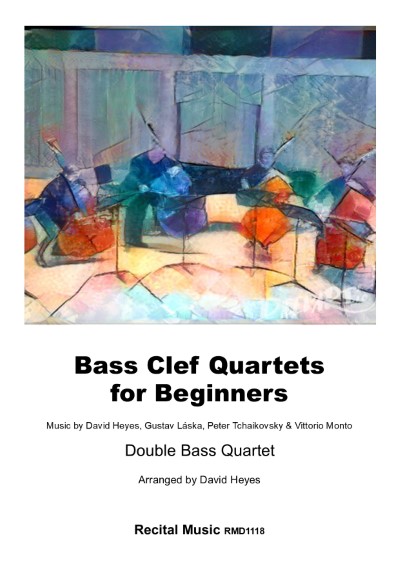
Bass Clef Quartets for Beginners
Digital Download – PDF
R.R.P £10.00
Our Price: £8.50
Composer: Heyes, David; Laska, Gustav; Tchaikovsky, Pyotr Illych; Monti, Vittorio;
Instrumentation: 4 Double Basses
Arranger: Heyes, David;
Publisher Recital Music
About the Composers
Heyes, David
David Heyes (b.1960) studied double bass with Laurence Gray and Bronwen Naish, later at the Royal College of Music in London, and completed his post-graduate studies in Prague with František Pošta (Principal Bass, Czech Philharmonic Orchestra). He has given recitals and masterclasses in 20 countries over the past few years and has been a juror at a number of international competitions, three times as chairman.
David’s collaborative work gained him a prestigious award from the David Walter Charitable Trust of New York for his pioneering activities as a soloist, teacher, publisher, and commissioner of new music for double bass and he works with composers throughout the world to expand the double bass repertoire by commissioning new music and by rediscovering forgotten ones. Since 1983 more than 700 works have been written for him, music from one to twenty basses and from beginner to virtuoso, and he has premiered ten contemporary concertos with orchestra.
David began to compose in 2013 and has had music performed and recorded in 29 countries across five continents. He is a D’Addario Performing Artist and has recently commissioned a solo double bass from British master-luthier Martin Penning.
Laska, Gustav
Gustav Láska was born in Prague on 23 August 1847 and died in Schwerin (Germany) on 16 October 1928, aged 81 and after a long and successful career. He studied at the Prague Conservatoire from 1861-7 with Josef Hrabě (double bass), Jan B. Kittl (music theory) and Josef Krejci (composition) and after graduation gave solo performances in Austria and subsequently became a member of the orchestra in Kassel, Germany. He travelled extensively in Europe and America, both as a soloist and orchestral player, and was Principal Double Bass at the Bayreuth Festival for many years.
Throughout his life Láska also taught, conducted and composed, alongside his solo and orchestral performances, and Franz Tischer-Zeitz who edited the Dittersdorf Concerto in the 1930s, was one of his students. In 1904 his Method for Double Bass Op.50 was published in Leipzig but is practically forgotten today – the fate of many similar double bass tutors. From 1878 until his death in 1928 he was a member of the Court Opera Orchestra of Mecklenburg-Schwerin and was also choirmaster of the Schwerin Singakademie and church choir.
Gustav Láska was a prolific composer, writing in many genres, including three operas (Der Kaisersoldat, Sunde and Abu Seid), two orchestral overtures, two symphonies, sacred choral works, piano music, and many of works for double bass. His music for double bass is well written for the instrument, featuring many technical challenges alongside lyrical and cantabile melodies, but much of it has fallen from the repertoire since his death almost 90 years ago.
The smaller works are probably best described as salon or characteristic music, but of a high quality, and many are still worthy of performance today. His music often fuses the technical skills of the Czech School with the lyricism and virtuosity of Bottesini, although still with one foot very firmly in the Czech camp. The salon style is a little out of step with today’s music making and sensibilities but fashions do change and there is a wealth of great music awaiting rediscovery by the curious and adventurous bassists.
Tchaikovsky, Pyotr Illych
Pyotr Ilyich Tchaikovsky was a legendary Russian composer whose works are among the most popular in the classical music repertoire. He was born on May 7, 1840, in Votkinsk, Russia, and died on November 6, 1893, in St. Petersburg. Tchaikovsky’s music is known for its rich melodies, harmonies, and expressive orchestration, which evoke a deep emotional response.
He was the second of six surviving children of Ilya Tchaikovsky and Alexandra Assier. Tchaikovsky showed a clear interest in music from an early age, and by the age of four, he had made his first recorded attempt at composition with his younger sister Alexandra. His formal music education began at the St. Petersburg Conservatory, and after graduating in 1865, he taught at the Moscow Conservatory from 1866.
Tchaikovsky’s oeuvre includes seven symphonies, eleven operas, three ballets, five suites, three piano concertos, a violin concerto, and over a hundred songs and piano pieces. His most famous works include the ballets “Swan Lake,” “The Nutcracker,” and “The Sleeping Beauty,” the “1812 Overture,” his “First Piano Concerto,” and the “Violin Concerto,” as well as the operas “Eugene Onegin” and “The Queen of Spades”.
Despite his success, Tchaikovsky’s life was marked by personal crises and depression, influenced by events such as the early death of his mother, the death of his close friend Nikolai Rubinstein, a failed marriage, and the end of his association with his patroness Nadezhda von Meck. His personal struggles, including his private homosexuality, have been considered significant factors in his life.
Tchaikovsky’s legacy is profound; he was the first Russian composer to make a lasting international impression, and his music continues to be celebrated for its emotional depth and innovative integration of Russian and Western musical elements.
Bass Clef Quartets for Beginners includes four short, fun and engaging quartets which are aimed at the progressing or intermediate Double Bass Quartet. Each part…
Page ? of ?