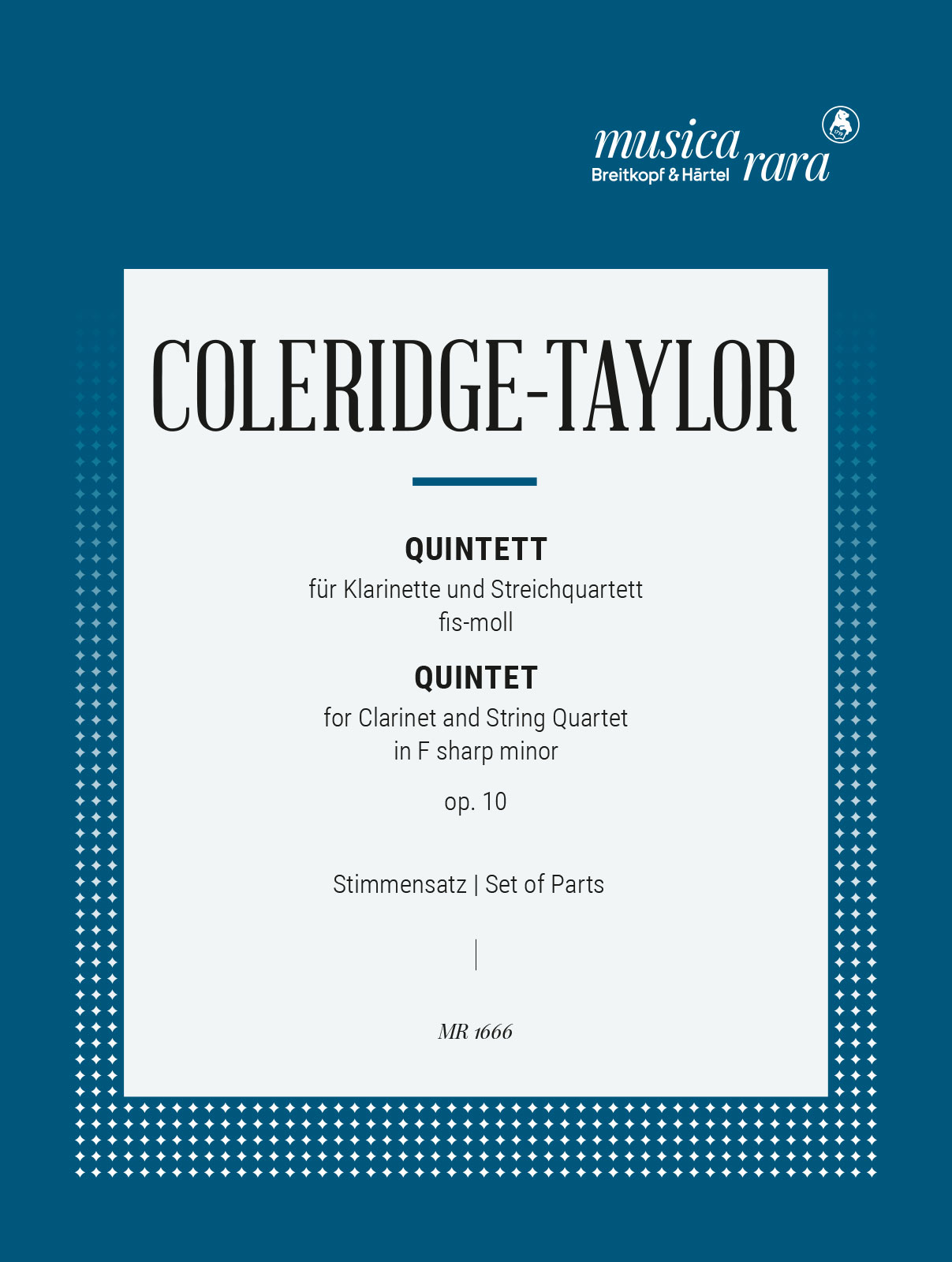
Composer: Coleridge-Taylor, Samuel
Instrumentation: Clarinet, Violin I, Violin II, Viola and Cello
Publisher:
| Product Code: | 979-0-004-81812-1 |
| ISMN: | 979-0-004-81812-1 |
| Publishers Number: | MR 1666D |
| Page count: | 61 |
| Condition: | New |
Coleridge-Taylor was known for his cantatas based on the epic 1855 poem “The Song of Hiawatha” by American Henry Wadsworth Longfellow. He premiered the first section in 1898, when he was just 23 years old. He married Jessie Walmisley, and both of their children, Hiawatha and Avril Coleridge-Taylor, pursued musical careers.
His early life was shaped by his mother, Alice Hare Martin, and his absent father, Daniel Peter Hughes Taylor, a Krio man from Sierra Leone. Alice named her son after the poet Samuel Taylor Coleridge. Coleridge-Taylor’s musical ability became apparent early on, and his grandfather paid for him to have violin lessons. He studied at the Royal College of Music from the age of 15, changing from violin to composition under Charles Villiers Stanford.
After completing his degree, he became a professional musician, appointed a professor at the Crystal Palace School of Music, and began conducting the orchestra at the Croydon Conservatoire. His name is sometimes seen with a hyphen, which is said to be due to a printer’s error.
Coleridge-Taylor’s legacy includes a rich body of work that has influenced many and continues to be celebrated for its cultural significance and musical beauty.
The Clarinet Quintet in F-sharp minor Op. 10, is a seminal chamber work by British composer Samuel Coleridge-Taylor, written in 1895 when he was only…
The work was the response to a challenge by his teacher, Charles Villiers Stanford, who had stated that no one could write a clarinet quintet without being heavily influenced by Brahms’s Clarinet Quintet Op. 115, a Romantic period masterwork in the genre.
Stanford was so impressed by the result that he remarked, “You’ve done it, my boy!” and took the score to Berlin in 1897 to have it performed by the prestigious Joachim Quartet.
The quintet reflects the influence of Dvořák rather than Brahms, featuring rhythmic vitality, folk-like melodies, and a “uniquely geographically unplaceable” atmosphere.
The quintet consists of four movements with an approximate duration of 25–30 minutes:
Allegro energico: A bold, rhythmic opening movement in F-sharp minor.
Larghetto affettuoso: A pastoral, expressive slow movement in B major, often compared to Dvořák’s lyrical style.
Scherzo (Allegro leggiero): Notable for its playful cross-rhythms, written in a combination of 3/4 and 9/8 time signatures.
Finale (Allegro agitato): A high-energy closing movement featuring ostinatos and concluding with a Vivace coda
R.R.P £35.00
Our Price: £30.00
Digital Download – PDF
Shipping costs: No shipping
Please create and forward a copy of this publication to the customer
Your basket is currently empty!
Notifications