Antonio Vivaldi was an Italian Baroque composer, virtuoso violinist, and teacher born on March 4, 1678, in Venice. He is best known for his contributions to the development of the concerto form and for his numerous concertos for violin and other instruments. Vivaldi’s most famous work is “The Four Seasons,” a series of violin concertos that depict scenes appropriate for each season of the year.
Vivaldi’s early life was marked by his musical talent, which was evident from a young age. He began studying for the priesthood at the age of 15 and was ordained at 25. However, due to a health problem, he was given dispensation to no longer say public Masses.
Throughout his career, Vivaldi composed over 500 concertos, more than 40 operas, and numerous sacred choral works. Many of his compositions were written for the all-female music ensemble of the Ospedale della Pietà, a home for abandoned children in Venice.
Vivaldi’s influence during his lifetime was widespread across Europe, giving origin to many imitators and admirers. He pioneered developments in orchestration, violin technique, and programmatic music. Despite his success during his lifetime, Vivaldi died in poverty in Vienna on July 28, 1741.
After almost two centuries of decline, Vivaldi’s musical reputation underwent a revival in the early 20th century. Many of his compositions, once thought lost, have been rediscovered and continue to be performed and celebrated today.
In this first edition for oboe and piano, the non-ornamented version is given first and followed by the version supplied by editor Sandro Caldini with…
In this first edition for oboe and piano, the non-ornamented version is given first and followed by the version supplied by editor Sandro Caldini with ornaments typical of Vivaldi’s time.
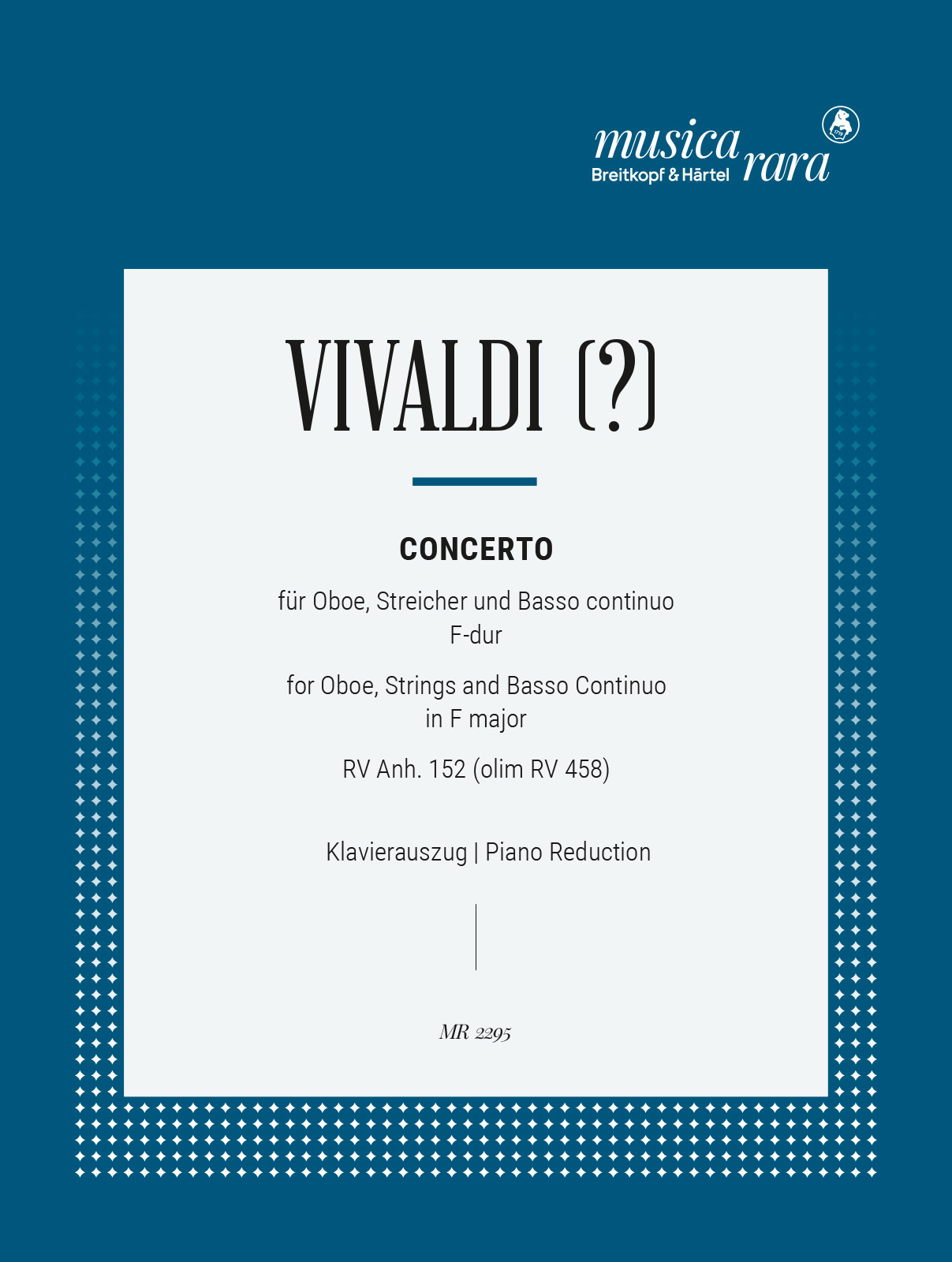
It is difficult to determine exactly how many oboe concertos Antonio Vivaldi wrote. Although the present Concerto in F major was earlier seen as a secure work by Vivaldi (therefore it has the old RV-number 458), Vivaldi’s authorship got even more disputable (in contrast to the C major Concerto RV 446 MR 2294). The doubts cannot even be dispelled by the existence of two sources from a large collection in Lund, Sweden. The Adagio central movement deserves our particular attention, as it was transmitted in different versions in the two sources. In this first edition for oboe and piano, the non-ornamented version is given first and followed by the version supplied by editor Sandro Caldini with ornaments typical of Vivaldi’s time, which make this version of the Adagio particularly interesting for performers.
Digital Download – PDF
Shipping costs: No shipping
Please Note: This product is not fulfilled by The Music Realm Ltd. Breitkopf and Hartel have requested that all purchases are referred to them for watermarking before downloading. This usually takes 1-3 days.We regret that this means you will not be able to download your purchase immediately.
R.R.P £14.00
Our Price: £11.90
Please create and forward a copy of this publication to the customer