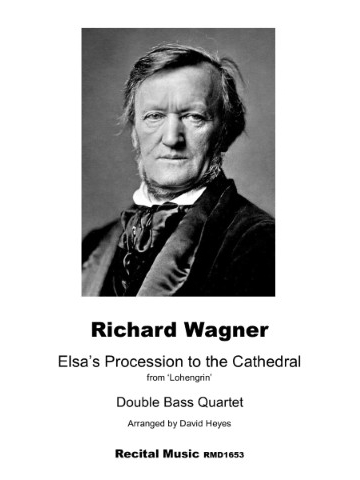
Wilhelm Richard Wagner (1813–1883) was a German composer, conductor, and essayist whose radical approach to opera reshaped Western music. He’s best known for his concept of the ‘Gesamtkunstwerk’, a “total work of art” that fused music, poetry, drama, and visual spectacle into a unified whole.
Born in Leipzig, Germany on May 22, 1813, he was raised in a theatrical family; his stepfather Ludwig Geyer was an actor and playwright. He was self-taught in composition and piano before taking up formal studies with Theodor Weinlig in Leipzig. He was heavily influenced by Beethoven, Shakespeare, and German Romanticism.
His first opera ‘Die Feen’ (The Fairies) was written in 1833 but not performed until after his death. His breakthrough works include ‘Rienzi’, ‘The Flying Dutchman’, ‘Tannhäuser’, and ‘Lohengrin’. He also created the monumental Ring Cycle (‘Der Ring des Nibelungen’), a four-opera saga based on Norse mythology and built the Bayreuth Festspielhaus, a custom-designed opera house to stage his works as he envisioned them.
He abandoned traditional operatic structures like arias and recitatives and pioneered the use of leitmotifs — recurring musical themes tied to characters or ideas. With works like ‘Tristan und Isolde’, which influenced modern music’s evolution, he pushed harmonic boundaries to the limits of the day.
Wagner wrote extensively on art, politics, and society and his essays were as provocative as his music. His antisemitic writings and associations with German nationalism have sparked ongoing debate about his legacy. Despite controversy, his influence on composers like Mahler, Strauss, and even film music is undeniable.
Wagner died in Venice, Italy on February 13, 1883.
His wife Cosima Wagner and descendants continued his legacy through the Bayreuth Festival and today, Wagner’s operas are performed worldwide, celebrated for their emotional depth and artistic ambition.
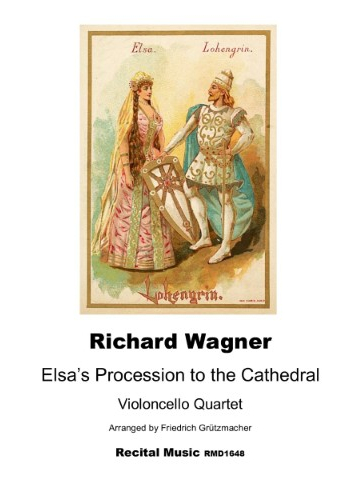
Elsa’s Procession to the Cathedral comes at the end of Act II of Wagner's Lohengrin as the heroine who is about to be married to…
Elsa’s Procession to the Cathedral comes at the end of Act II of Wagner’s Lohengrin as the heroine who is about to be married to an unnamed knight, who is Lohengrin, a Knight of the Holy Grail.
The music is slow and solemn, majestic and regal, and over the years has been arranged for many ensembles. Friedrich Grützmacher (1832-1903) arranged it for cello quartet in the 1880s and it was published by Breitkopf & Härtel in 1882 as part of their chamber music collection.
Cello 1 has much of the melodic material, although there is something of interest for each player, and the rich harmonies are well suited to the intermediate cello quartet with the emphasis on the sonorous and singing qualities of the cello across its middle and upper register.
Wagner’s opera Lohengrin was completed in 1848 and was premiered in Weimar (Germany) two years later, under the direction of Franz Liszt, a close friend and supporter of the composer.