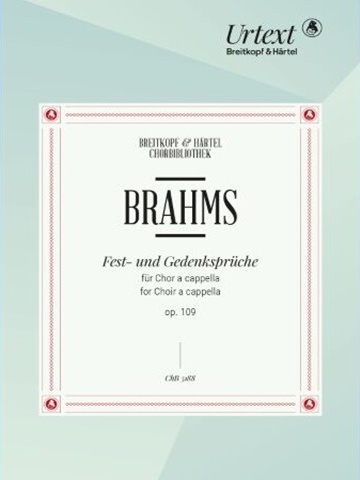
Festival and Commemoration Sentences:
1. Unsere Väter hofften auf dich (Our fathers hoped in Thee) – Feierlich bewegt
2. Wenn ein starker Gewappneter (When a strong man armed) – Lebhaft und entschlossen
3, Wo ist ein so herrlich Volk (Where is there so great a nation) – Froh bewegt
Johannes Brahms was a German composer, pianist, and conductor of the mid-Romantic period, born on May 7, 1833, in Hamburg, Germany. He passed away on April 3, 1897, in Vienna, Austria-Hungary (now Austria). Brahms is often grouped with Johann Sebastian Bach and Ludwig van Beethoven as one of the “Three Bs” of music, a comment originally made by the nineteenth-century conductor Hans von Bülow.
Brahms’s music includes symphonies, concerti, chamber music, piano works, choral compositions, and over 200 songs. His style is deeply rooted in the structures and compositional techniques of the Classical masters, yet his music also embodies deeply Romantic motifs. While some contemporaries found his music to be overly academic, his craftsmanship was admired by later figures as diverse as Arnold Schoenberg and Edward Elgar.<
His life began in a Lutheran family, and his father, Johann Jakob Brahms, was a musician who found work as a jobbing musician and a string and wind player in Hamburg. Johannes showed early promise as a pianist and first studied music with his father. At age seven, he was sent for piano lessons to F.W. Cossel, who three years later passed him to his own teacher, Eduard Marxsen.
Between ages 14 and 16, Brahms helped support his family by playing in inns in the dock area of Hamburg, while also composing and sometimes giving recitals. In 1850, he met Eduard Reményi, a Jewish Hungarian violinist, with whom he gave concerts and from whom he learned something of Roma music—an influence that remained with him always.
The turning point in his career came in 1853 when he met the violin virtuoso Joseph Joachim, who instantly recognized Brahms’s talent. Joachim introduced him to composer Robert Schumann, and this connection led to Brahms’s music being published and gaining recognition
Brahms was a virtuoso pianist who premiered many of his own works. He worked with leading performers of his time, including the pianist Clara Schumann and the violinist Joseph Joachim, the latter being a close friend. His works have become staples of the modern concert repertoire, and his influence on music has been profound, with his detailed construction of works serving as a starting point and inspiration for a generation of composers.
Fest- und Gedenksprueche (Festival and Commemoration Sentences), Op. 109, is a cycle of three motets for mixed double choir composed by Johannes Brahms between 1888…
Fest- und Gedenksprueche (Festival and Commemoration Sentences), Op. 109, is a cycle of three motets for mixed double choir composed by Johannes Brahms between 1888 and 1889.
Brahms composed these pieces to mark his appointment as an Honorary Citizen of Hamburg, his birthplace. He dedicated the work to Dr. Carl Petersen, the Mayor of Hamburg. While the occasion was civic, the music also reflects the nationalistic sentiment following the 1871 unification of Germany and the “Year of Three Emperors” (1888), which saw the deaths of Wilhelm I and Frederick III.
The work is scored for an eight-part unaccompanied mixed choir (SATB + SATB) and consists of three movements based on biblical texts:
Unsere Väter hofften auf dich (Our fathers hoped in Thee) – Feierlich bewegt
Wenn ein starker Gewappneter (When a strong man armed) – Lebhaft und entschlossen
Wo ist ein so herrlich Volk (Where is there so great a nation) – Froh bewegt
R.R.P 6
Our Price: 5
Digital Download – PDF
Shipping costs: No shipping
Please create and forward a copy of this publication to the customer