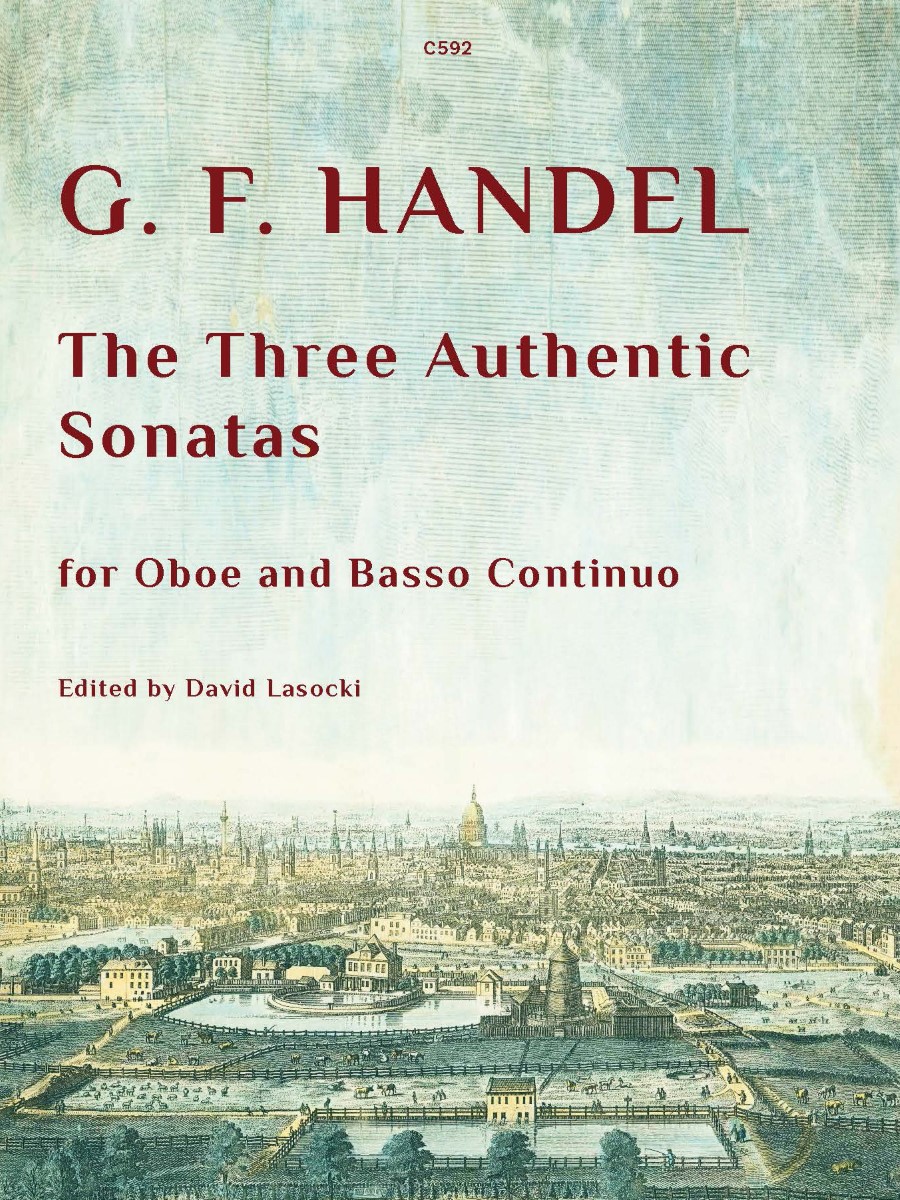
Composer: Handel, George Frideric
Editor: David Lasocki
Instrumentation: Oboe and Piano / Oboe and Continuo
Publisher:
| Product Code: | 979-0-570-81592-0 |
| ISMN: | 979-0-570-81592-0 |
| Publishers Number: | C592 |
| Difficulty: | Grades 5 – 8 |
| Language: | English |
| Page count: | 28 |
| Condition: | New |
Handel’s music is renowned for its grandeur, dramatic qualities, and depth of expression. Notably, he composed the most famous of all oratorios, Messiah (1741), and is also known for such occasional pieces as Water Music (1717) and Music for the Royal Fireworks (1749).
His early musical education was under the composer Friedrich W. Zachow in Halle. After his father’s death, Handel enrolled as a law student at the University of Halle but quickly gravitated towards a career in music. He served as an organist at the Reformed Cathedral in Halle for a year before moving to Hamburg, where he joined the opera orchestra and presided over the premiere of his first opera, Almira.
Handel traveled in Italy from 1706 to 1710, where he met many of the greatest Italian musicians of the day, including Arcangelo Corelli and Alessandro Scarlatti. His time in Italy was prolific, resulting in two operas, numerous Italian solo cantatas, and some Latin church music.
In 1712, Handel settled in London, where he spent the bulk of his career and became a naturalized British subject in 1727. His influence was such that he started three commercial opera companies to supply the English nobility with Italian opera. After a physical breakdown in 1737, he changed direction creatively, addressing the middle class with English choral works. Following the success of Messiah in 1742, he never composed an Italian opera again.
Handel’s legacy includes more than forty operas and a wealth of other works. His music was admired by Classical-era composers, especially Mozart, Haydn, and Beethoven, and remains a cornerstone of the Western classical music canon.
As the title of this edition, ‘The Three Authentic Sonatas’, implies, the sonatas contained herein are in some ways different from those that have been…
The differences are in fact of three kinds: (a) an addition, (b) a subtraction, and (c) new sources.
Firstly, a sonata in F major that Handel almost certainly wrote for the oboe has previously been known only in the G major version for flute that was published in Handel’s lifetime as Opus 1 No. 5. Secondly, a sonata in G minor (published as Opus 1 No. 6) that Handel wrote for the violin or viola da gamba has been thought of as an oboe sonata because it was mis-attributed by the 18th-century publisher John Walsh. Thirdly, in preparing modern editions of the sonatas, the autograph manuscript of the C minor sonata (Opus 1 No. 8) and the copyists’ manuscripts of both this and the F major sonata have not been made use of, and accordingly all the available sources have never been properly evaluated. In addition, the Bb major sonata, although it has been available in an edition for thirty years, does not seem to be widely known.
This edition, then, is an attempt to present all three of the sonatas that Handel intended for the oboe (C minor, Bb major and F major) in a critical text that takes account of all the extant sources, both manuscript and printed. The Basso Continuo part and full details and a discussion of the sources, as well as a statement of the editorial procedures and a listing of important differences among the sources are all available to download from this webpage.
Previously published by Nova Music
Former catalogue number NM100
R.R.P 10.95
Our Price: 9.31
Digital Download – PDF
Shipping costs: No shipping
Your basket is currently empty!
Notifications