Camille Saint-Saëns was a French composer, organist, conductor, and pianist of the Romantic era, born on October 9, 1835, in Paris. He is best known for his symphonic poems, the opera “Samson et Dalila,” and the orchestral piece “The Carnival of the Animals.” Saint-Saëns was a musical prodigy, making his concert debut at the age of ten. After studying at the Paris Conservatoire, he became a church organist and later a successful freelance pianist and composer.
Saint-Saëns was enthusiastic for the most modern music of his time, particularly that of Schumann, Liszt, and Wagner. His own compositions were generally within a conventional classical tradition, but he was also a scholar of musical history and remained committed to the structures worked out by earlier French composers. This sometimes brought him into conflict with composers of the impressionist and expressionist schools of music in his later years.
He held only one teaching post at the École de Musique Classique et Religieuse in Paris and remained there for less than five years. However, it was an important institution in the development of French music, with his students including Gabriel Fauré1. Saint-Saëns’s influence on later composers is widely recognized, and he is revered as a genius by many.
Danse Macabre Op. 40 by Saint-Saens started life in 1874 as a tone poem scored for violin and orchestra which vividly describes a poem by…
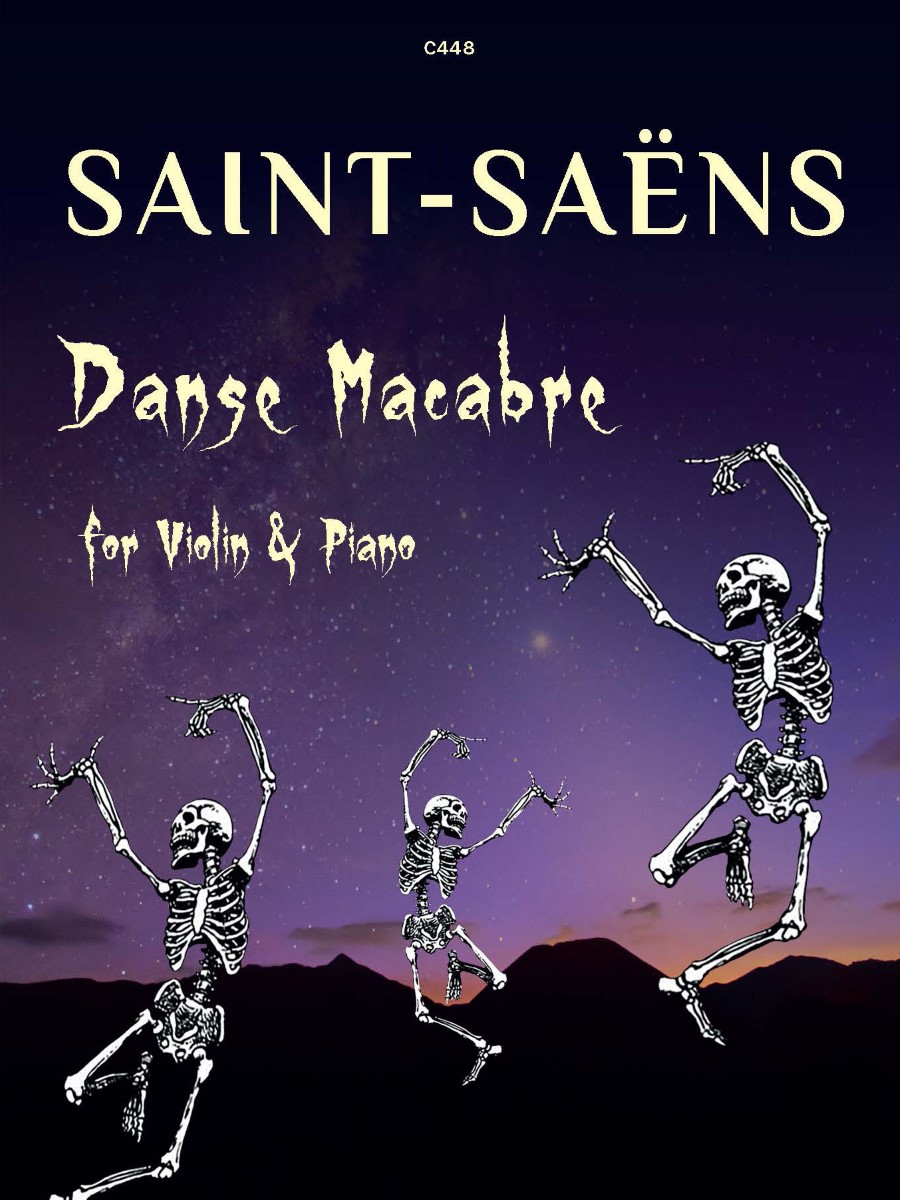
Danse Macabre Op. 40 by Saint-Saens started life in 1874 as a tone poem scored for violin and orchestra which vividly describes a poem by Henri Cazalis. As the clock strikes midnight, the cloaked figure of Death appears and calls on the skeletons to dance to the waltz he plays on his violin. The E string is tuned a semitone lower to create a diminished fifth, the dissonant interval referred to as ‘the devil in music’ during the Middle Ages. The dance builds and builds but eventually, as the cock crows, heralding the approaching dawn, the skeletons vanish back into their graves, and death departs.
This arrangement for violin and piano was made by Saint-Saens himself in 1877.