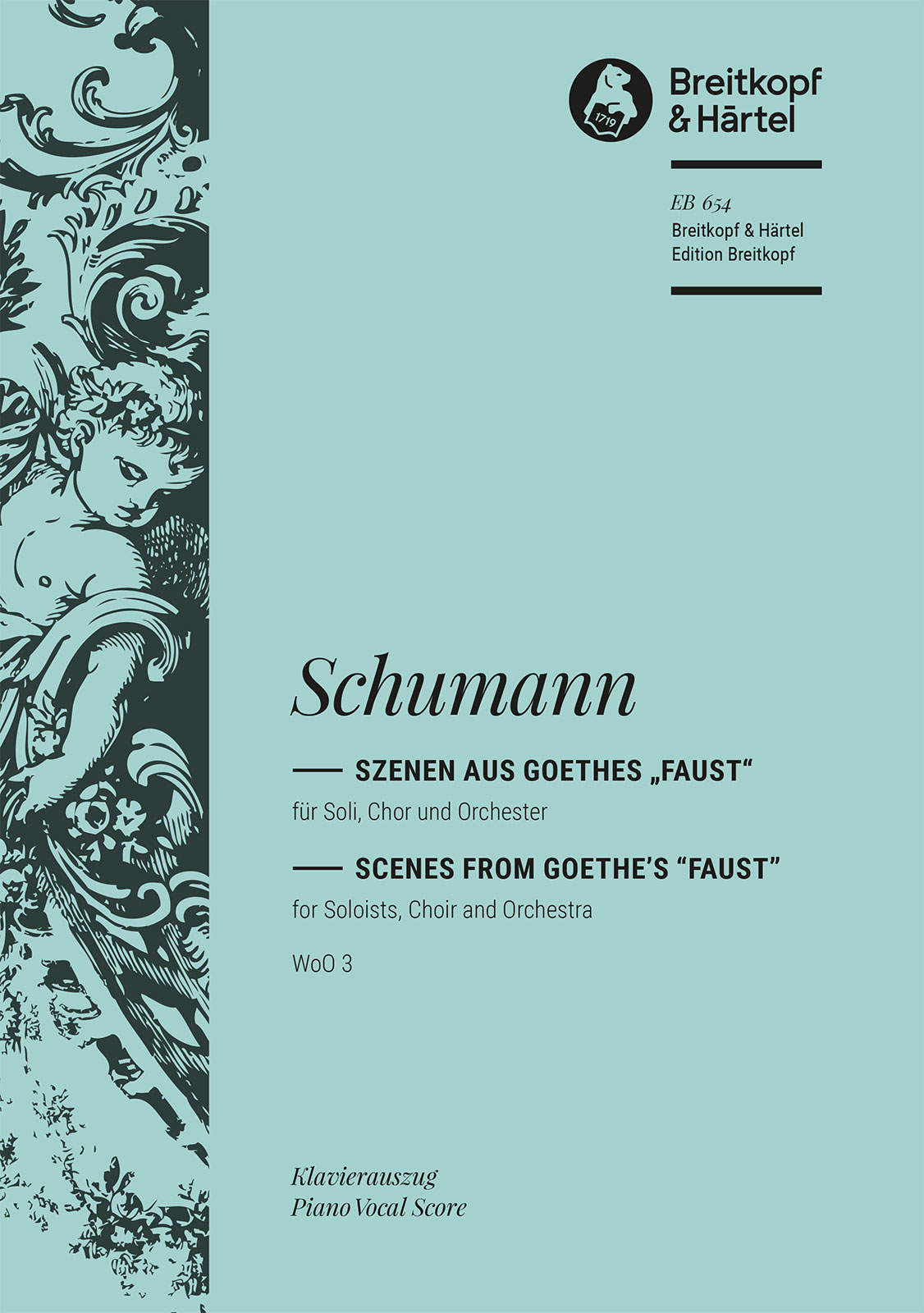
Composer: Schumann, Robert
Arranger: Stern, Julius (KA)
Arranged for: Chorus (with Soloists) and Piano
Instrumentation: Chorus (with Soloists) and Piano
Publisher:
| Product Code: | 979-0-004-81006-4 |
| ISMN: | 979-0-004-81006-4 |
| Publishers Number: | EB 654D |
| Orchestration: | solos: SATTBarB – choir: SSAATTBB – pic2.2.2.2. – 4.2.3.1. – timp. – hp – str |
| Page count: | 180 |
| Condition: | New |
Schumann’s early years were marked by his father’s influence, who was a bookseller and publisher. He began his musical education at the age of six, studying the piano. In 1827, he came under the musical influence of Austrian composer Franz Schubert and the literary influence of German poet Jean Paul Richter. In the same year, he composed some songs.
Despite initially studying law at the University of Leipzig, Schumann’s passion for music prevailed. He studied the piano seriously with Friedrich Wieck, Clara’s father, and eventually married Clara despite Wieck’s opposition2. Schumann’s early works were mainly piano pieces, including the large-scale “Carnaval” (1834–1835). He co-founded the “Neue Zeitschrift für Musik” (New Musical Journal) in 1834 and edited it for ten years, contributing significantly to music criticism.
His compositions include the “Piano Concerto in A Minor, Op. 54,” “Symphony No. 1 in B-flat Major,” and song cycles such as “Frauenliebe und -leben” and “Dichterliebe.” Schumann turned to orchestral music in 1841, chamber music and choral works in the following years, and his wife Clara premiered many of his works, including the Piano Concerto.
Schumann’s life was troubled by mental health issues, which led to his attempted suicide in 1854 and subsequent confinement in a sanatorium, where he died two years later. His legacy remains significant, as he was one of the most important Romantic composers and a highly regarded music critic, whose deeply personal music reflects the nature of Romanticism.
Robert Schumann's Scenes from Goethe's Faust, WoO 3, is a large-scale cantata for soloists, two choirs, and orchestra, inspired by the second part of Goethe's epic…
Key Aspects:
Literary Inspiration:
The cantata draws directly from the second part of Goethe’s Faust, a work that profoundly influenced Romantic composers.
Dramatic Scope:
Schumann created a sweeping panorama of scenes, including the tender Gretchen/Faust encounter, the solemn presence of the Mater Dolorosa, and the celestial redemption of Faust’s soul.
Musical Style:
The work showcases some of Schumann’s finest and most moving choral writing, characterized by his quintessential Romantic concern with literary and extra-musical expression.
Structure:
The piece opens with an overture and includes various scenes depicting Faust’s experiences, culminating in his transfiguration and the triumph of celestial forces.
Notable Scenes and Themes:
Gretchen’s Scene: Captures the initial love scene between Gretchen and Faust.
Mater Dolorosa: Features Gretchen’s address to the Mater Dolorosa.
In the Cathedral: Depicts a significant moment in the narrative, with a contrasting mood to the previous scene.
Ariel and the Suns’s Rise: A contrast to the darker scenes, showcasing the vibrant music of nature and the spirits.
Midnight: An ominous scene featuring Faust and Mephistopheles.
Faust’s Death and Transfiguration: The work concludes with scenes of Faust’s death, the struggle with demonic forces, and his final, soaring redemption by celestial beings.
Significance and Reception:
Scenes from Goethe’s Faust is now acknowledged as one of Schumann’s finest scores and a pinnacle of Romantic choral music.
Although sometimes overlooked in the past, its importance has been recognized, and it has enjoyed a resurgence in performance and appreciation since the 1970s.
R.R.P £27.00
Our Price: £23.00
Digital Download – PDF
Shipping costs: No shipping
Please create and forward a copy of this publication to the customer
Your basket is currently empty!
Notifications