| Product Code: | RMD1488 |
| Publishers Number: | RMD1488 |
| Published date:: | Mar-24 |
| Language: | English |
| Page count: | 61 |
| Condition: | New |
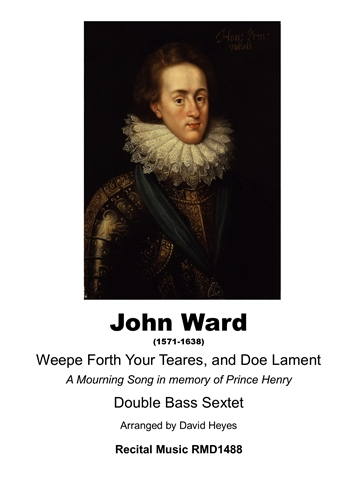
John Ward composed madrigals, works for viol consort, services, and anthems. His madrigals are remarkable for their fine texts, broad melodic lines and originality.
John Ward's Mourning Song, Weepe Forth Your Teares, and Doe Lament, was one of a number of laments composed for the funeral in 1612 of…
The lament transcribes well for double bass sextet and the slow chordal writing suits the generally low tessitura of the ensemble. A wealth of colours and timbres can be created by the subtle use of vibrato and non-vibrato and entries should be carefully shaped to draw attention from player to player. Dynamics and articulations are at the discretion of the bassists.
Henry Frederick Stuart, Prince of Wales (19 February 1594 – 6 November 1612) was the elder son of King James I & VI and Anne of Denmark. His name derives from his grandfathers: Henry Stuart, Lord Darnley and Frederick II of Denmark. Prince Henry was widely seen as a bright and promising heir to his father’s thrones. However, at the age of 18, he predeceased his father when he died of typhoid fever. The heirship to the English and Scottish thrones passed to his younger brother Charles.
Prince Henry’s death was widely regarded as a tragedy for the nation. According to Charles Carlton, “Few heirs to the English throne have been as widely and deeply mourned as Prince Henry.” His body lay in state at St. James’s Palace for four weeks. On 7 December, over a thousand people walked in the mile-long cortege to Westminster Abbey to hear the two-hour sermon delivered by the Archbishop of Canterbury. As Henry’s body was lowered into the ground, his chief servants broke their staves of office at the grave.
R.R.P £6.50
Our Price: 5.2
Shipping costs: No shipping
Your basket is currently empty!
Notifications